
Sand washing wastewater — high in fine clay particles, silica fines, and suspended solids — is one of the most straightforward PAM applications in practice, but it’s also one where poor dissolution and incorrect dosing point placement consistently undermine results that should be reliable. This article covers the complete treatment sequence, where PAM is added and why, and what correct operation actually looks like.
Why Sand Washing Wastewater Needs Chemical Treatment
Raw sand washing wastewater contains fine particles in the 1–50 µm range that don’t settle under gravity within any practical timeframe. These fines — primarily clay minerals, silt, and fine silica — carry negative surface charge and remain in stable suspension indefinitely without flocculation. Discharging this water directly violates suspended solids limits in virtually every jurisdiction; recycling it untreated returns fine particles to the washing circuit and degrades product quality.
PAM at appropriate dosage aggregates these particles into large, dense flocs that settle rapidly in thickeners and dewater efficiently in filter presses — converting wastewater that can’t be reused or discharged into clarified water suitable for process recycling and a solid filter cake suitable for disposal or land application.
The Two-Stage Treatment Process
Stage 1: Thickener — Solid-Liquid Separation
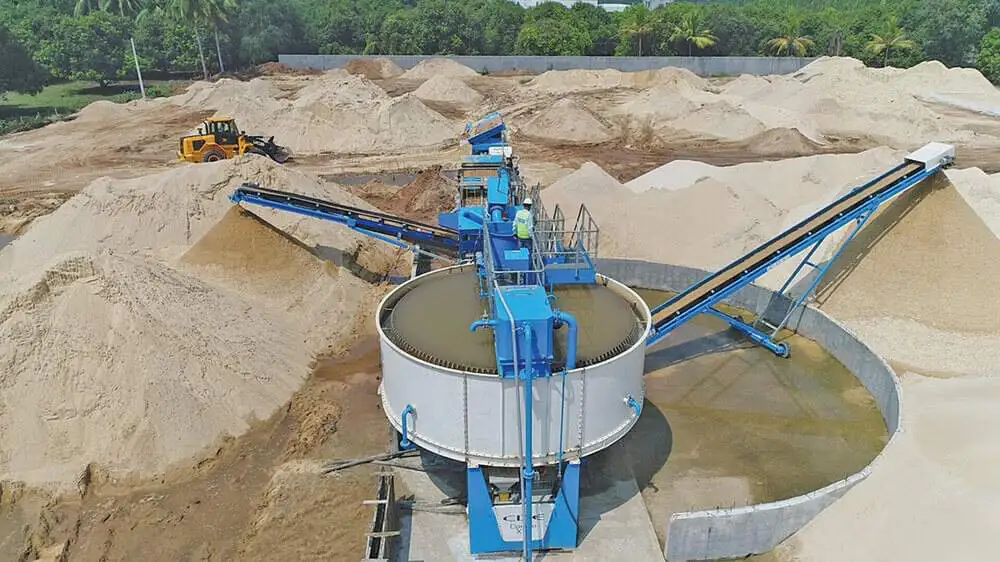
Wastewater from the sand washing circuit flows by gravity or pump to a collection tank, then transfers to a sludge thickener. PAM solution is dosed into the inlet pipe or feedwell of the thickener, where turbulent flow distributes the polymer through the wastewater stream before it enters the settling zone.
What happens inside the thickener: PAM polymer chains adsorb onto the surface of fine clay and silica particles, bridging multiple particles into large floc aggregates that settle rapidly to the thickener underflow. The clarified overflow — typically achieving suspended solids below 50–100 mg/L with optimized PAM dosing — recycles directly to the washing circuit, reducing fresh water consumption by 60–80% in closed-loop operations.
The thickener underflow concentrates sludge from the feed concentration of typically 2–5% solids to 15–30% solids, reducing the volume of material requiring further dewatering by 5–15×.
PAM dosing parameters for thickener stage:
| Parameter | Value |
|---|---|
| PAM type | Anionic, 12–18 million Da, ionic degree 20–35% |
| Dosage | 20–60 g/tonne of dry solids |
| Solution concentration | 0.1–0.2% |
| Dosing point | Feedwell or inlet pipe, zone of moderate turbulence |
| Expected overflow SS | < 50–100 mg/L |
Stage 2: Filter Press — Sludge Dewatering
Thickener underflow at 15–30% solids transfers to the filter press feed system. A second PAM addition — typically 2–5 kg/tonne DS of the same or higher ionic degree grade — is dosed into the pump discharge pipe before the filter press inlet. This second conditioning step improves floc structure in the concentrated sludge, producing a filter cake with lower moisture content and shorter press cycle time than unconditioned thickener underflow.
Belt filter presses process the conditioned sludge through three sequential zones:
- Gravity dewatering zone: Free water drains under gravity through the filter cloth
- Wedge/pressure zone: Converging belts apply increasing pressure, squeezing water from the floc structure
- High-pressure pressing zone: Rollers compress the sludge cake to final moisture content
Well-conditioned sand washing sludge achieves filter cake moisture of 65–75% on a belt filter press — solid blocks that can be handled by loader, transported by truck, and used as fill material or disposed of in regular solid waste facilities.
PAM dosing parameters for filter press stage:
| Parameter | Value |
|---|---|
| PAM type | Anionic, same grade as thickener or higher ionic degree |
| Dosage | 2–5 kg/tonne DS |
| Solution concentration | 0.1–0.2% |
| Dosing point | Pump discharge pipe, 2–3 meters before press inlet |
| Expected cake moisture | 65–75% |
Critical Success Factors
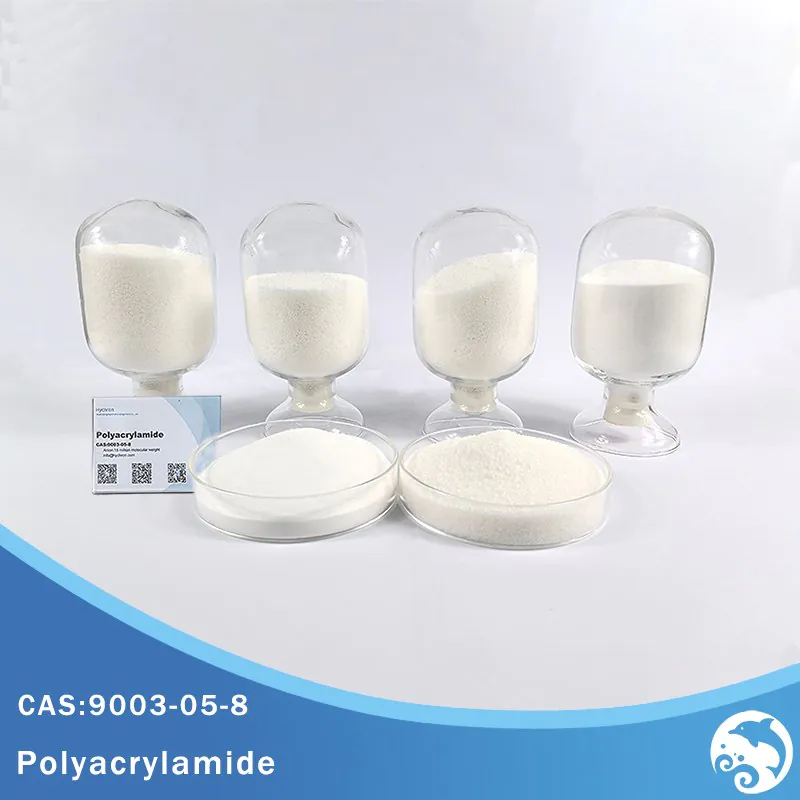
Complete PAM dissolution: Undissolved PAM gel particles don’t contribute to flocculation and can block nozzles and pipes. Dissolve at 0.1–0.2% concentration in clean water with gentle agitation for 40–60 minutes before use. Never add dry PAM powder directly to the wastewater stream. Water temperature should be 20–40°C — below 15°C, extend dissolution time to 60–90 minutes.
Correct dosing point location: PAM must contact wastewater in a zone of sufficient turbulence for distribution, but not excessive shear that breaks flocs immediately after formation. The thickener feedwell and the pump discharge pipe upstream of the filter press are the two correct locations — not the collection tank, not directly into the press inlet.
Dosage calibration through settling test: Start at the low end of the dosage range and increase in 10 g/t increments, measuring settling rate and overflow clarity at each step. The minimum dose achieving clear overflow and rapid settling is the operating target — overdosing wastes chemical without improving results and can cause viscosity problems in the thickener underflow.
Filter cloth maintenance: PAM-conditioned sludge releases cleanly from properly maintained filter cloth, but cloth blinding from inadequate washing progressively degrades cake moisture and cycle time. Wash cloth continuously at 3–5 bar on belt presses and clean plate press cloth at every maintenance interval.
FAQ
Q: How do I tell if my PAM dosage in the thickener is correct, and how should I adjust it?
A: Check thickener overflow clarity visually — well-dosed overflow should be nearly clear with no visible suspended particles. Also observe floc at the feedwell: flocs should be large and visible (> 2–3 mm), settling rapidly. If overflow is turbid and flocs are small, increase dose by 10 g/t and reassess after 15 minutes. If overflow is clear but sludge underflow is unusually viscous or hard to pump, you may be overdosing — reduce by 10 g/t. Make one adjustment at a time and allow the thickener to reach steady state (typically 20–30 minutes) before evaluating.
Q: What is the difference between adding PAM once versus twice in the sand washing treatment process, and is the second addition always necessary?
A: The first addition at the thickener promotes settling and clarifies overflow water — this is always required. The second addition before the filter press improves cake moisture and press cycle time by reconditioning the concentrated sludge after it has been pumped and partially sheared in transfer. Whether the second addition is necessary depends on your target cake moisture and press performance. If thickener underflow at 20–25% solids already dewaters to acceptable cake moisture without additional PAM, the second addition may not be cost-justified. Test press performance with and without the second PAM dose on your actual sludge to determine whether the improvement justifies the additional chemical cost.
Q: Can the same PAM grade be used for both the thickener and filter press stage, or do they need different grades?
A: The same grade can work for both stages and simplifies procurement. However, the filter press stage benefits from slightly higher ionic degree if thickener underflow contains high organic content from washing additives or fine organic particles — higher cationic demand in the concentrated sludge may require higher ionic degree PAM at the press stage than the thickener stage needs. If cake moisture is acceptable using the same grade at both points, there’s no operational reason to use two different grades. If press performance is poor despite correct dosage, test a higher ionic degree grade at the press stage while keeping the thickener grade unchanged.
Correct PAM Use Solves Sand Washing Wastewater Reliably
Sand washing wastewater treatment with PAM is not technically complicated — the chemistry is well understood and the equipment is straightforward. What causes performance problems in practice is almost always one of three things: incomplete PAM dissolution, incorrect dosing point location, or dosage set outside the optimal range without systematic testing. Address these three variables correctly and PAM-based treatment consistently delivers clarified water suitable for process recycling and filter cake dry enough for practical disposal.
HyChron supplies anionic PAM for sand washing wastewater applications with technical support for dissolution protocol and dosage optimization. Contact our team for product specifications or application guidance for your specific sand washing circuit.