Skip to content
Flocculant selection is one of those decisions that looks straightforward until the wrong grade causes poor effluent quality, high chemical consumption, or dewatering equipment problems. The choice between inorganic and organic flocculants, and within organic flocculants between ionic types, molecular weights, and charge densities, determines treatment performance more than dosage does. This guide provides a systematic framework for matching flocculant to wastewater type and treatment stage.
Step 1: Understand What You’re Trying to Remove
Before selecting any flocculant, characterize the dominant pollutant form in your wastewater:
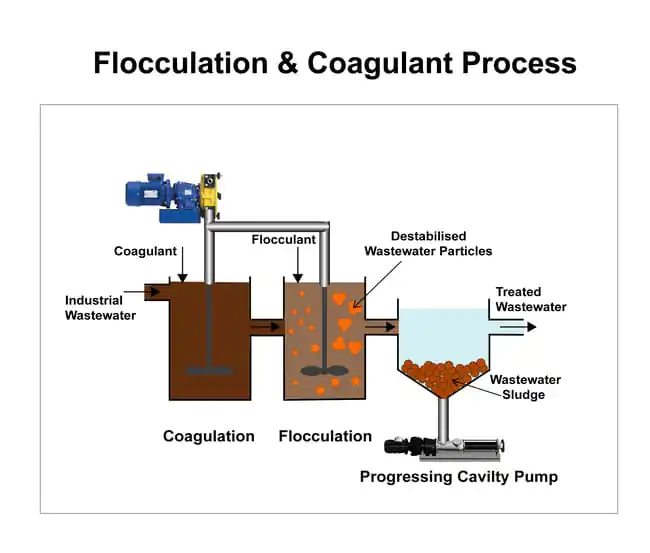
Colloidal suspended solids (particle size 0.001–1 µm) carry stable surface charge that resists gravitational settling. These require charge neutralization first — inorganic coagulants (PAC, alum, ferric sulfate) or cationic PAM destabilize the colloids before floc formation can occur.
Coarse suspended solids (> 1 µm) settle with less chemical assistance. High molecular weight PAM bridging alone is often sufficient without prior coagulation.
Organic suspended solids (biological sludge, food processing waste) typically carry negative charge and respond to cationic PAM. The higher the volatile solids (VS) content — a proxy for organic fraction — the higher the cationic charge density required.
Inorganic suspended solids (mining tailings, mineral slurry, water plant sludge) respond best to anionic PAM at high molecular weight, using divalent cation bridges (Ca²⁺, Mg²⁺) in the water to link anionic polymer to negatively charged mineral surfaces.
When colloids are the dominant problem and PAM alone produces flocs too small to settle, combine inorganic coagulant with high MW PAM — the coagulant handles charge destabilization, PAM handles bridging into large settleable aggregates. This dual-component system consistently outperforms either chemical used alone at higher dosage.
Step 2: Select the Ionic Type
Ionic type is the most important PAM selection variable. Using the wrong type wastes chemical and may worsen treatment performance.
| Wastewater / Sludge Type | Recommended PAM Ionic Type | Reason |
|---|---|---|
| Municipal biosolids | Cationic (medium-high, 20–60%) | Organic, negatively charged |
| Industrial organic sludge (food, fermentation) | Cationic (high, 40–80%) | High VS content, strong negative charge |
| Papermaking sludge | Cationic (low-medium, 10–40%) | Mixed organic/inorganic |
| Mining tailings / mineral slurry | Anionic (20–40%) | Inorganic, bridged via Ca²⁺/Mg²⁺ |
| Water plant alum sludge | Nonionic or anionic (low) | Inorganic, near-neutral charge |
| Printing and dyeing wastewater | Nonionic or anionic | Acidic conditions, complex charge |
| Medical / pharmaceutical wastewater | Cationic (high, 60–80%) | High organic load, complex composition |
Nonionic PAM performs best in strongly acidic conditions (pH < 5) where ionic PAM grades lose charge character and effectiveness. It’s also the safe choice when wastewater chemistry is highly variable or when ionic interaction with other additives creates compatibility problems.
A jar test resolves ionic type uncertainty more reliably than any general guidance. Add equal doses of anionic and cationic PAM to separate samples of your sludge, stir gently for three minutes, and compare floc size and filtrate clarity at five minutes. The winner is usually visually obvious.
Step 3: Match Molecular Weight to Dewatering Equipment
Molecular weight determines floc size, strength, and shear resistance — and the optimal range depends on how much mechanical shear the floc will experience in your dewatering equipment.
| Equipment Type | Recommended MW Range | Reason |
|---|---|---|
| Centrifuge (decanter) | High (12–20 million Da) | Strong shear requires shear-resistant floc |
| Belt filter press | Medium-high (8–15 million Da) | Moderate shear, needs large floc for wire capture |
| Plate-and-frame filter press | Medium (5–12 million Da) | Lower shear, drainage through filter cloth |
| Gravity thickener | High (12–20 million Da) | Large floc needed for settling, minimal shear |
| Dissolved air flotation (DAF) | Low-medium (5–10 million Da) | Small, light floc floats more effectively than large dense floc |
Using excessively high MW PAM in filter press applications produces very large flocs that compress under press pressure and seal drainage channels in the cake — counter-intuitively worsening dewatering performance compared to a medium MW grade. This is one of the most common PAM performance problems we encounter in field optimization.
Step 4: Select Charge Density (Ionic Degree)
Within the correct ionic type and MW range, ionic degree determines how efficiently the flocculant neutralizes particle surface charge at minimum dosage.
For cationic PAM in sludge dewatering:
- Higher volatile solids content (> 60% VS/TS) → higher ionic degree required (40–80%)
- Lower volatile solids content (< 40% VS/TS, more inorganic) → lower ionic degree (10–30%)
- Anaerobically digested sludge tends to need higher ionic degree than aerobic sludge of equivalent VS content, because digestion increases charge density on particle surfaces
For anionic PAM in mineral processing:
- Higher process water ionic strength (more Ca²⁺, Mg²⁺) → lower ionic degree needed, since bridging is enhanced by divalent cations
- Low ionic strength or soft water circuits → higher ionic degree (30–50%) to maintain bridging efficiency
Ionic degree selection through jar testing is more reliable than calculation. Test three grades — low, medium, high ionic degree within your selected ionic type — at the same dosage and compare settling rate and filtrate quality. The grade producing the best result at the lowest dosage is the right choice for your specific sludge.
Step 5: Consider Molecular Structure
Most commodity PAM flocculants for wastewater treatment are linear polymers — the default structure and the best starting point. Two specialty structures serve specific applications:
Dendritic (branched) structure: More dosing points per polymer chain, more stable floc under variable shear. Suitable for applications where floc shear stability matters more than maximum floc size — such as DAF systems and high-turbulence treatment circuits.
Cross-linked structure: Highest shear resistance, forms gel-like floc structures. Used in specialty filtration applications requiring extremely rigid cake structure. Requires higher dosage than linear grades and is not suitable for thickener or gravity settling applications.
For most wastewater treatment and sludge dewatering applications, linear PAM at appropriate MW and ionic degree outperforms specialty structures at lower cost.
Flocculant Selection Quick Reference
| Selection Variable | Key Question | Decision |
|---|---|---|
| Inorganic vs organic | Are pollutants colloidal or particulate? | Colloidal → inorganic coagulant first; particulate → PAM may suffice |
| Ionic type | What is the surface charge and organic content of sludge? | Organic → cationic; inorganic → anionic; acidic/variable → nonionic |
| Molecular weight | What dewatering equipment is used? | Centrifuge → high MW; filter press → medium MW; thickener → high MW |
| Ionic degree | What is the VS content and water chemistry? | High VS → high ionic degree; high divalent cations → lower ionic degree |
| Molecular structure | Standard or specialty application? | Default to linear; use branched or cross-linked only for specific needs |
FAQ
Q: How do I run a jar test to confirm flocculant selection before committing to a bulk purchase?
A: Fill four 1-liter graduated cylinders with your sludge or wastewater. Add candidate PAM grades at the same dosage (start at 3 kg/t DS for cationic sludge dewatering, or 2 mg/L for wastewater). Stir at 60 rpm for 2 minutes, then 30 rpm for 3 minutes, then stop and observe. Measure floc size visually, settling rate at 5 minutes, and filtrate clarity. The grade producing the largest floc, fastest settling, and clearest filtrate at the lowest effective dosage is your selection. Adjust dosage in 0.5 kg/t increments to find the optimum before ordering bulk quantity.
Q: What is the difference between choosing a flocculant for DAF versus gravity sedimentation?
A: DAF requires small, low-density flocs that attach to rising air bubbles and float to the surface — high MW PAM producing very large, dense flocs actually performs worse in DAF than medium MW grades that produce smaller, lighter aggregates. Gravity sedimentation is the opposite — large, dense flocs settle fastest, so high MW PAM at optimized ionic degree is preferred. Using DAF-optimized PAM in a gravity settler, or vice versa, consistently underperforms the correct grade by a significant margin.
Q: When should I use a combination of inorganic coagulant (PAC) and organic flocculant (PAM) versus PAM alone?
A: Use PAC + PAM when your wastewater contains significant colloidal material — particles below 1 µm that carry stable surface charge. PAM alone cannot bridge colloids that repel each other electrostatically. PAC neutralizes that charge first, then PAM bridges the destabilized particles into large floc. For sludge with primarily coarse particle size (> 5 µm) and adequate surface charge for PAM bridging, PAM alone is sufficient and more cost-effective. When in doubt, run a parallel jar test comparing PAM alone versus PAC + PAM — the combination outperforms where colloids are the limiting factor.
Systematic Selection Prevents the Costly Mistakes of Trial-and-Error Procurement
The most expensive flocculant decision isn’t choosing a premium product — it’s buying the wrong ionic type in bulk and discovering the problem after delivery. Working through the five selection steps in order — pollutant form, ionic type, molecular weight, ionic degree, and structure — narrows the field to two or three candidate grades that a targeted jar test can differentiate. This process takes less time than troubleshooting a poorly performing treatment system, and it produces a selection that performs reliably rather than one that requires constant dosage adjustment to compensate for a fundamental grade mismatch.
HyChron supplies cationic, anionic, and nonionic PAM across the full MW and ionic degree range, with technical support for selection testing and dosage optimization. Contact our team for grade recommendations or a sample set for jar testing on your specific wastewater.