
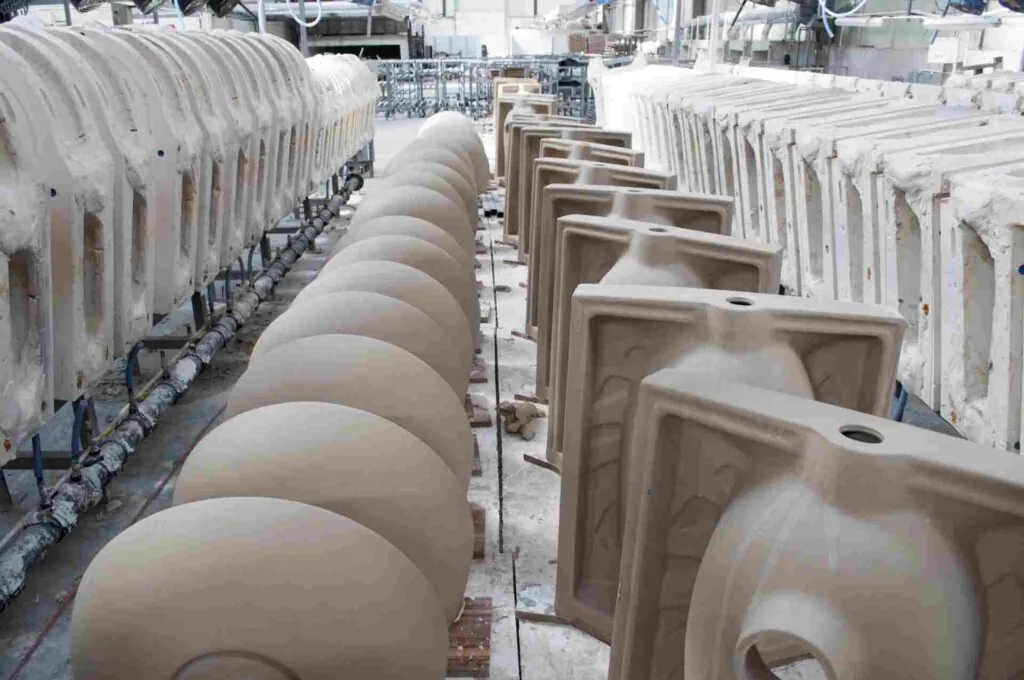
Ceramic manufacturing generates large volumes of wastewater containing high levels of suspended solids (TSS), turbidity, glaze residues, polishing abrasives, and fine clay particles. These colloidal particles carry strong negative surface charges, preventing natural sedimentation and making treatment challenging.
Without proper treatment, ceramic wastewater poses environmental risks and regulatory violations. An optimized chemical coagulation-flocculation process is essential for sustainable plant operation.
Why the PAC and PAM Combination Is Highly Effective
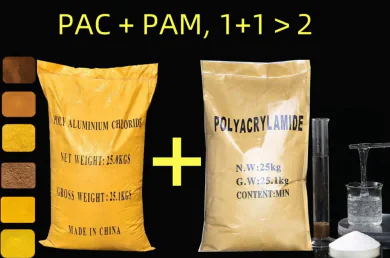
The most widely adopted solution in ceramic wastewater treatment is a two-step chemical process using Polyaluminium Chloride (PAC) and Polyacrylamide (PAM).
PAC as a Coagulant (Charge Neutralization)
Polyaluminium Chloride (PAC) is an inorganic coagulant that:
- Neutralizes negative charges on clay particles
- Destabilizes colloids
- Forms micro-flocs through coagulation
- Performs effectively across a wide pH range
This destabilization step allows particles to begin aggregating.
PAM as a Flocculant (Bridging Effect)
After coagulation, anionic PAM is introduced.
Its long molecular chains:
- Bridge micro-flocs together
- Form large, dense flocs
- Accelerate sedimentation
- Improve supernatant clarity
This synergistic combination can remove over 90% of turbidity and suspended solids in most ceramic wastewater scenarios.
Single-Tank Solution: Cationic Polyacrylamide (CPAM)
Many ceramic factories face equipment limitations and may only have one chemical dissolution tank.
In such cases, Cationic Polyacrylamide (CPAM) offers a practical alternative.
Why CPAM Works
Cationic PAM carries positive charges that:
- Neutralize negatively charged clay particles (coagulation effect)
- Provide polymer bridging (flocculation effect)
This dual functionality allows CPAM to act as both coagulant and flocculant.
Advantages of Cationic PAM
- Requires only one dissolution tank
- Simplifies dosing system
- Produces fast-settling flocs
- Reduces operational complexity
- Generates clear effluent
Advanced Treatment Options
1. Enhanced Chemical Programs
For wastewater containing dyes or highly stable colloids:
- High-charge-density polymers such as POLYDADMAC may be used
- Can be combined with PAM for stronger coagulation-flocculation performance
- Requires careful jar testing and dosage control
2. Engineering Optimization
Pipe Static Mixer Setup
A cost-effective modification:
- Install a static pipe mixer on the wastewater line
- Dose PAC and PAM separately via pumps
- Achieve instant in-line mixing
- Avoid installing an additional dissolution tank
Improved Dissolution Systems
Specialized dissolving units ensure:
- Complete polymer hydration
- Uniform solution preparation
- Prevention of pipe clogging
- Stable dosing performance
Key Optimization Strategies
Jar Testing Is Essential
On-site jar testing determines:
- Optimal chemical type (anionic PAM, CPAM, or combination)
- Accurate dosage
- Best pH adjustment level
- Cost-performance balance
Sludge Management
Effective flocculation produces sludge that must be:
- Thickened
- Dewatered
- Properly disposed
Optimized polymer selection reduces sludge volume and disposal costs.
Conclusion
Ceramic wastewater treatment relies on understanding the science of charge neutralization and polymer bridging.
- PAC + anionic PAM remains the industry benchmark.
- Cationic PAM provides a practical single-tank alternative.
- Pipe mixer systems offer low-cost engineering upgrades.
Through proper jar testing and system optimization, ceramic manufacturers can achieve high removal efficiency, regulatory compliance, reduced operating costs, and sustainable water reuse.

