
Calcium chloride (CaCl₂) is one of the most versatile inorganic salts used in modern industry. From winter road maintenance to oilfield operations, its chemical stability, hygroscopicity, and exothermic properties make it indispensable across multiple sectors.
This article explores:
- Chemical properties and production methods
- Core industrial applications
- Performance advantages
- Safety and environmental considerations
- Future development trends
Chemical Properties and Forms
Calcium chloride exists primarily in two commercial forms:
- Anhydrous calcium chloride – contains no water molecules; highly effective for moisture absorption
- Calcium chloride dihydrate – contains two water molecules; more stable and widely used in industrial applications
Key physical characteristics include:
- High water solubility
- Strong hygroscopic behavior
- Exothermic heat release when dissolved
- Excellent freezing point depression
These properties allow industries to tailor product selection based on performance requirements.
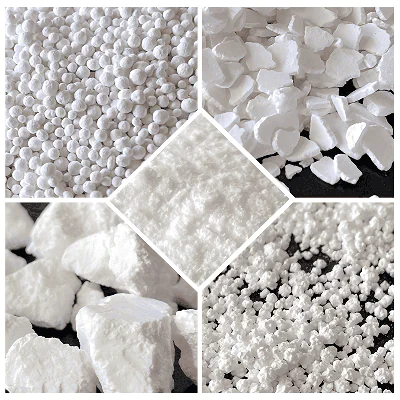
Production Methods
Limestone–Hydrochloric Acid Process
This method reacts calcium carbonate (limestone) with hydrochloric acid to produce high-purity calcium chloride.
Advantages:
- Controlled impurity levels
- Suitable for food-grade and pharmaceutical-grade production
- Stable quality consistency
Natural Brine Extraction
[Image Placeholder: Industrial brine evaporation facility]
Calcium chloride can also be obtained from natural brine deposits. The brine is concentrated and purified to meet industrial standards.
Advantages:
- Cost-effective for large-scale production
- Lower raw material processing requirements
- Suitable for bulk industrial-grade supply
Key Industrial Applications
1. Moisture Control
Calcium chloride is widely used as a desiccant in:
- Warehouses
- Shipping containers
- Food storage facilities
- Electronics manufacturing
Its hygroscopic nature allows it to absorb excess humidity, protecting goods from moisture damage.
2. De-icing and Road Maintenance
[Image Placeholder: Calcium chloride applied on snowy highway]
Calcium chloride lowers the freezing point of water and remains effective at temperatures as low as -25°C.
Advantages over traditional rock salt:
- Faster ice melting
- Heat release during dissolution
- Reduced application quantities
- Improved road safety
It is commonly used for highways, airport runways, and municipal winter maintenance.
3. Dust Suppression
On unpaved roads and mining sites, calcium chloride:
- Absorbs moisture from the air
- Keeps surfaces damp
- Binds fine particles
This significantly reduces airborne dust, improving air quality and operational safety.
4. Oil and Gas Industry
In drilling operations, calcium chloride is used to formulate high-density brines that:
- Stabilize boreholes
- Balance formation pressure
- Improve drilling efficiency
- Reduce clay swelling
It plays a critical role in safe and efficient hydrocarbon extraction.
5. Construction Industry
Calcium chloride accelerates cement hydration, providing:
- Faster setting times
- Improved early strength development
- Increased productivity in cold weather
It is particularly valuable in time-sensitive infrastructure projects.

Advantages in Industrial Applications
Cost Efficiency
Calcium chloride delivers strong performance at competitive cost, particularly in:
- De-icing
- Moisture control
- Dust suppression
Its multi-functionality reduces the need for alternative additives.
Performance Superiority
Due to its:
- Hygroscopic properties
- Exothermic dissolution
- High solubility
It often outperforms competing compounds in freezing point depression and humidity management.
Controlled Environmental Profile
When applied responsibly and at regulated dosages, calcium chloride is considered less environmentally persistent than many chemical alternatives.
Proper management minimizes soil and water impact.
Conclusion
Calcium chloride remains a cornerstone chemical in industrial operations worldwide. Its adaptability, cost-effectiveness, and strong performance characteristics make it indispensable in:
- Road safety
- Moisture control
- Oil extraction
- Construction acceleration
- Dust suppression
With proper handling, environmental management, and technological innovation, calcium chloride will continue to provide reliable industrial solutions.
As a professional manufacturer, we offer:
- Multiple purity grades (industrial, food, feed)
- Flexible packaging options
- Stable production capacity
- Quality control documentation upon request
For technical specifications or bulk supply inquiries, contact our team for customized solutions.