
Thickeners are the workhorses of solid-liquid separation in mining, mineral processing, and heavy industrial operations. A well-performing thickener produces dense underflow that dewaters efficiently and clear overflow that can be recycled directly — simultaneously reducing water consumption, lowering disposal costs, and enabling higher throughput.
When thickener performance falls short, the consequences compound quickly. Dilute underflow increases pumping costs and dewatering loads downstream. Turbid overflow cannot be recycled without further treatment, increasing fresh water demand. And when thickeners overflow or flood, the disruption to the entire processing circuit can be severe.
Polyacrylamide is the primary chemical tool for thickener optimization in mining and industrial applications. The right grade at the correct dosage transforms settling speed, underflow density, and overflow clarity simultaneously — delivering operational and financial benefits that few other interventions can match.
How Thickeners Work and Where PAM Intervenes
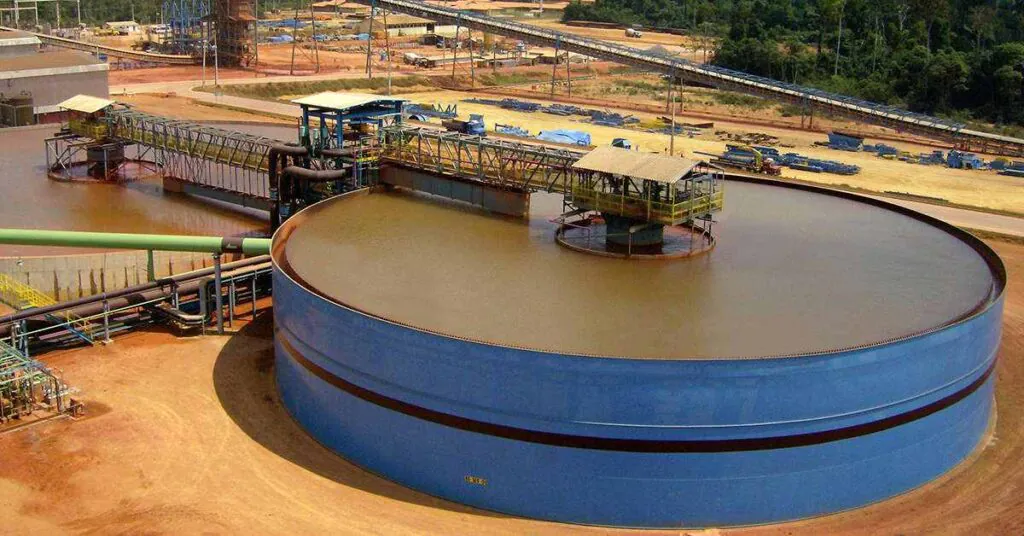
A thickener is a continuous gravity settling vessel. Feed slurry enters at the center through a feed well, designed to dissipate inlet energy and distribute flow evenly across the settling area. Solids settle to the bottom and are raked toward a central discharge cone for underflow pumping. Clarified liquid overflows a peripheral launder for recycling or further treatment.
Performance is measured by two outputs: underflow solids content (higher is better — reduces disposal volume and dewatering load) and overflow turbidity (lower is better — determines water recycling quality).
PAM improves both simultaneously by accelerating particle aggregation and settlement. When high-MW anionic PAM is dosed into the thickener feed, it bridges fine particles into large, rapidly settling flocs. These flocs settle faster, compact more efficiently in the thickener bed, and release water more completely during raking — producing denser underflow and clearer overflow than unassisted gravity settlement can achieve.
Selecting the Right PAM Grade for Thickeners
Thickener applications in mining and mineral processing represent some of the most demanding PAM applications in terms of molecular weight requirements. The combination of high solids loading, fine particle size, and continuous high-volume operation requires grades that deliver consistent, strong bridging under challenging conditions.
Molecular weight: 15–20 million Daltons is the standard range for most thickener applications. Higher MW produces larger flocs with faster settling rates and better compaction characteristics. For very fine particle slurries — ultra-fine tailings, fine coal, or clay-rich ores — the highest available MW grades deliver the most significant performance improvement.
Charge density: Medium anionic charge density (20–35%) is appropriate for most mineral slurries in the neutral to mildly alkaline pH range typical of mineral processing. Higher charge density (35–50%) may improve performance in slurries with high clay content or strong colloidal stability. Very low charge density (below 15%) provides minimal charge-assisted adsorption and is generally not recommended for thickener applications.
Form: Both dry powder and emulsion grades are used in thickener applications. For large-volume continuous operations, dry powder is typically more cost-effective. For remote sites or operations with limited preparation infrastructure, emulsion offers faster activation and simpler handling.
For complete grade selection guidance, see: Choosing the Right PAM Grade for Your Industry
Dosing Point Optimization for Thickeners
The feed well is the optimal PAM dosing location in most thickener configurations — and the difference between dosing at the feed well versus other locations can be as significant as the difference between the right and wrong PAM grade.
Why the feed well works: The feed well provides moderate turbulence from the incoming slurry jet — enough mixing energy to distribute polymer rapidly through the feed stream without the high shear that destroys flocs. Residence time in the feed well (typically 1–3 minutes) allows initial floc formation before the conditioned slurry enters the low-turbulence settling zone.
Dosing into the feed pipe (upstream of feed well): Acceptable if the pipe section between the dosing point and the feed well provides adequate mixing without excessive shear. Avoid dosing immediately upstream of any pump or valve that would subject the polymer to high mechanical energy before it has contacted particles.
Dosing directly into the thickener tank: Ineffective. Polymer introduced into the still water of the settling zone cannot distribute effectively. Contact with particles is limited to diffusion — far too slow for practical bridging. This approach consistently underperforms regardless of dosage.
Key Performance Metrics and Targets
Optimizing thickener performance requires measuring the right parameters and understanding what the numbers mean operationally.
| Parameter | Typical Without PAM | With Optimized PAM | Operational Impact |
|---|---|---|---|
| Overflow turbidity | 500–5,000 NTU | 20–100 NTU | Enables direct water recycling |
| Underflow solids content | 35–50% w/w | 50–70% w/w | Reduces disposal volume 20–40% |
| Settling rate | 0.5–2 m/h | 3–8 m/h | Allows higher feed rate or smaller thickener |
| Unit area required | High | Reduced 30–50% | Capital cost reduction for new installations |
For existing thickeners operating below capacity, PAM optimization frequently allows feed rate increases of 20–40% without infrastructure changes — a significant throughput benefit in production-constrained operations.
Contact our technical team today for a free thickener performance assessment and PAM grade recommendation for your ore type and processing conditions. → Contact our technical team today
Managing Dosage in Variable Feed Conditions
Mining operations rarely have perfectly consistent feed conditions. Ore grade variation, changes in processing rate, and shifts between ore zones all affect slurry characteristics and optimal PAM dosage. Managing dosage effectively under variable conditions is one of the most important operational skills in thickener management.
Express dosage on a dry solids basis: Dosage in grams of PAM per tonne of dry solids processed is more meaningful than dosage in mg/L of slurry volume, because it normalizes for variations in feed slurry density. When feed rate increases but solids concentration stays constant, dosage in g/t should remain approximately constant — while mg/L dosage must be increased proportionally.
Use overflow turbidity as the primary control signal: Continuous turbidity monitoring at the thickener overflow provides real-time feedback on settling performance. Rising overflow turbidity is the earliest indicator that dosage is insufficient for current feed conditions — before underflow density or rake torque are affected.
Establish dosage response protocols: Define the dosage adjustment steps for specific turbidity triggers, so all operators respond consistently to changing conditions rather than making independent judgments. A simple protocol — increase dose by 10% if overflow turbidity exceeds X NTU for more than Y minutes — eliminates operator-to-operator variability in dosage management.
Troubleshooting Thickener Performance Problems
Problem: Turbid overflow despite PAM dosing
Likely causes: Underdosing for current feed solids; incorrect grade for ore type; dosing into tank rather than feed well; hydraulic overload
Solutions: Increase dosage in 10% steps; verify dosing point is at feed well; check hydraulic loading against thickener design capacity; conduct jar test with current feed sample
Problem: Dilute underflow despite good overflow clarity
Likely causes: Rake speed too high disrupting settled bed; underflow pump rate too high drawing dilute material; PAM producing light, fluffy flocs rather than dense compact ones
Solutions: Reduce rake speed; reduce underflow pump rate; trial higher charge density grade for denser floc compaction
Problem: High PAM consumption with inconsistent results
Likely causes: Feed solids concentration varying without dosage adjustment; polymer solution degraded beyond 24-hour limit; overdosing causing restabilization of fine particles
Solutions: Implement turbidity-based dosage control; enforce 24-hour solution replacement; reduce dosage in steps to check for restabilization
Frequently Asked Questions
What underflow solids content is achievable with PAM optimization?
Achievable underflow density depends on ore type, particle size distribution, and thickener design. For most mineral processing applications, optimized PAM programs achieve underflow solids of 55–70% w/w — compared to 35–50% without polymer. Fine tailings and clay-rich ores typically achieve lower densities than coarser crystalline mineral slurries regardless of polymer optimization.
Can PAM optimization allow us to reduce thickener size in a new installation?
Yes. PAM-assisted settling rates are typically 3–5 times faster than unassisted settling for most mineral slurries. This directly reduces the unit area required per unit of feed throughput, allowing smaller thickener vessels to handle the same feed rate. For new installations, incorporating PAM into the design basis from the start can significantly reduce capital cost.
How does ore type affect PAM grade selection for thickeners?
Different ore mineralogy affects particle surface charge and clay content — both of which influence optimal PAM grade. Clay-rich ores typically require higher charge density and may benefit from coagulant pre-treatment. Sulfide ores may have different surface chemistry than oxide ores from the same deposit. Jar testing with representative feed samples from your specific ore is the only reliable way to confirm grade selection.
Conclusion
Thickener performance is directly controllable through PAM grade selection, dosage optimization, and dosing point location. Facilities that invest in systematic thickener optimization consistently achieve denser underflow, clearer overflow, and higher throughput than those operating on default polymer programs without regular review.
The financial returns are substantial — reduced water consumption, lower disposal costs, improved dewatering efficiency downstream, and in some cases meaningful throughput increases without capital investment. For new installations, PAM-optimized design reduces capital cost directly.
Ready to improve your thickener performance? Contact our technical team today for a free assessment and PAM grade recommendation tailored to your ore and processing conditions. → Get in touch today

