
Written by the HyChron Technical Team — chemical engineers and water treatment specialists with over 15 years of field experience in municipal and industrial water systems. Last reviewed: April 2026 | Reading time: ~5 minutes
If your water treatment system suffers from slow settling, excessive sludge, unstable performance under changing water conditions, or rising chemical costs — the root cause is often the coagulant you are using, or how it is being applied.
Poly Aluminum Chloride (PAC) is the coagulant most widely used to solve these problems. This guide explains what PAC is, how it works, and how to apply it correctly.
Not sure whether PAC suits your application? Contact our technical team for a free water analysis and recommendation.
What is Poly Aluminum Chloride (PAC)?
PAC is an inorganic polymer coagulant produced by reacting aluminum hydroxide with hydrochloric acid under controlled conditions. Its general formula is [Al₂(OH)nCl₆₋ₙ]ₘ, where n and m determine basicity, polymer chain length, and coagulation efficiency.
PAC is available in two forms:
- Powder PAC (28–32% Al₂O₃) — for bulk storage and dry dosing systems
- Liquid PAC (10–11% Al₂O₃) — ready to use, preferred for automated dosing
A basicity ratio of 60–85% is recommended for most applications, providing faster reaction speed, stable cold-water performance, and consistent results across variable water conditions.

Why Engineers Choose PAC Over Traditional Coagulants
| Parameter | PAC | Alum (Al₂(SO₄)₃) | Ferric Sulfate |
|---|---|---|---|
| Effective pH range | 5.0–9.0 | 6.5–7.5 | 4.0–7.0 |
| Dosage | 30–50% lower | Baseline | Medium |
| Sludge production | 30–50% less | Baseline | Similar to alum |
| Cold-water performance | Good (< 10°C) | Poor | Moderate |
| Equipment corrosivity | Low | High | High |
| Cost per m³ treated | Lower | Higher | Medium |
Although PAC costs more per kilogram than alum, its lower dosage and reduced sludge volumes typically result in a lower total treatment cost per cubic meter — and many plants recover the difference within weeks of switching.
PAC is used across municipal drinking water, industrial wastewater, textile and dyeing effluent, paper mills, and mining and sand washing operations.
How PAC Works: The Coagulation Mechanism
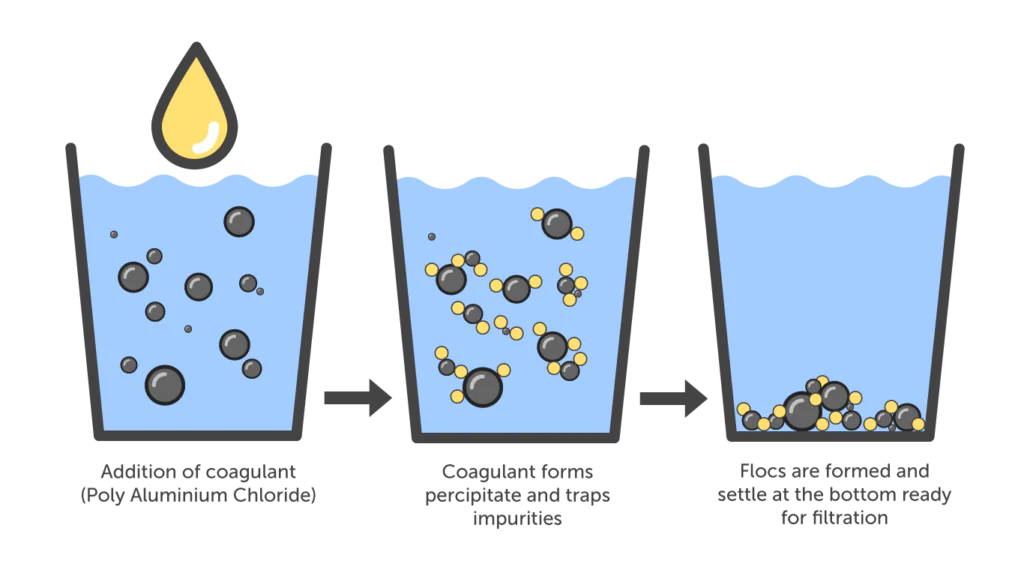
PAC removes impurities through two stages.
Stage 1 — Charge Neutralization. Most colloidal particles carry a negative surface charge (zeta potential −20 to −40 mV) that keeps them dispersed. When PAC is dosed, it hydrolyzes into positively charged aluminum species that neutralize these charges, allowing particles to approach and aggregate. Because PAC is pre-polymerized, this reaction is faster and more efficient than with alum at the same dose.
Stage 2 — Floc Formation. Destabilized particles aggregate through sweep flocculation and polymer bridging, forming dense, fast-settling flocs that are easily removed by sedimentation, DAF, or filtration.
Dosing Guidelines
Correct application is critical. The most common hidden cost in water treatment is dosing PAC incorrectly.
Recommended procedure:
- Determine dosage by jar test (ASTM D2035) before going live
- Dose at the high-turbulence flash mixing zone
- Rapid mix: 200–400 s⁻¹ for 30–60 seconds
- Slow mix: 20–60 s⁻¹ for 15–30 minutes
- Recalibrate dosage when raw water quality changes seasonally
Reference dosage ranges:
| Application | Typical PAC dosage |
|---|---|
| Drinking water (< 10 NTU) | 5–15 mg/L |
| Drinking water (10–100 NTU) | 15–30 mg/L |
| Industrial wastewater | 20–80 mg/L |
| Textile / dyeing effluent | 50–200 mg/L |
| Mining / sand washing | 30–100 mg/L |
Optimal dosage must be confirmed by jar test for your specific water source.
Why Product Quality Matters
Not all PAC products perform equally. Low-quality PAC causes higher dosage requirements, inconsistent results, and elevated residual aluminum — increasing both chemical and sludge disposal costs.
When sourcing PAC, verify: Al₂O₃ content, basicity ratio (60–85%), pH of 1% solution (3.5–5.0), heavy metal compliance (NSF/ANSI 60 or local standard), and batch-level COA documentation.
Our PAC products are manufactured under ISO-certified conditions with full batch traceability and COA on every shipment. Request a product sample to test in your own system before committing to a full order.
Frequently Asked Questions
What is PAC used for?
PAC removes turbidity, suspended solids, color, and organic matter in water treatment — used in drinking water plants, industrial wastewater, textile dyeing, paper mills, and mining operations.
What is the typical PAC dosage?
10–50 mg/L for most applications. Always determine the optimal dose by jar test, as raw water quality varies significantly by source and season.
Is PAC safe for drinking water?
Yes, when used within regulatory dosage limits. The WHO guideline value for residual aluminum in drinking water is 0.1–0.2 mg/L.
What is the difference between PAC and alum?
PAC works faster, needs a lower dose, produces 30–50% less sludge, and operates across a wider pH range (5–9) than alum. Lower unit cost of alum is typically outweighed by higher dosage and sludge handling costs.
Can PAC be used with PAM?
Yes. Add PAC first for charge neutralization, then PAM during slow-mix flocculation to improve floc size and settling speed.
Conclusion
PAC is a proven, high-performance coagulant that directly addresses the most common water treatment challenges: slow settling, excessive sludge, unstable performance, and rising costs. Applied correctly with a quality product, it delivers measurable improvements across a wide range of industries and water types.
Contact our technical team today to get a free water analysis, product sample, and customized dosage recommendation. Send us your water data — we will respond within 24 hours.