
Written by the HyChron Technical Team — water treatment specialists with over 15 years of field experience in municipal and industrial systems. Last reviewed: April 2026
Coagulation and flocculation are frequently used interchangeably — but they are different processes that happen at different times, at different mixing speeds, and produce different results. Confusing the two leads to mixing system designs and operating conditions that underperform, regardless of which chemical is used.
This article explains the distinction clearly, describes how PAC performs in both stages, and provides practical guidance on optimizing both for maximum turbidity and TSS removal.
Looking to optimize your coagulation-flocculation system? Contact our technical team for a free assessment and process recommendation.
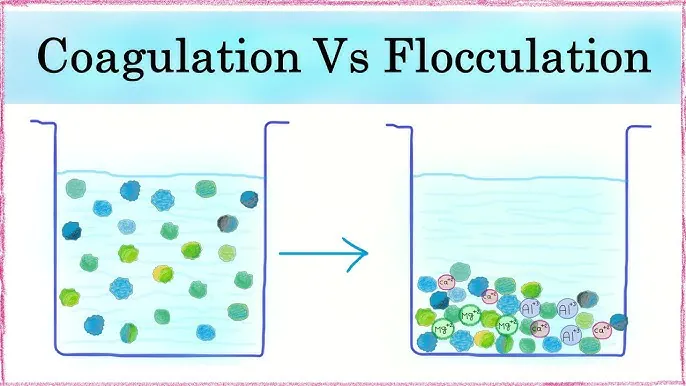
Coagulation and Flocculation: The Core Distinction
Coagulation is the chemical stage. It is what happens when PAC is added to water — the charge neutralization and initial destabilization of colloidal particles described in detail here: Mechanism of Charge Neutralization in PAC.
Coagulation happens fast — within milliseconds to seconds of PAC contact with particles. It requires rapid, high-energy mixing to ensure uniform PAC dispersion before the chemical reaction is complete. The product of coagulation is destabilized particles — microflocs that are no longer electrostatically stable and ready to aggregate.
Flocculation is the physical stage. It is what happens after coagulation — destabilized microflocs collide, stick together, and grow into larger, visible flocs that are heavy enough to settle or be captured by filtration.
Flocculation happens slowly — over 15–30 minutes of gentle mixing. It requires low-energy mixing that promotes particle collisions without breaking the fragile flocs that are forming. Too much mixing energy at this stage breaks flocs apart faster than they form.
The critical insight: coagulation and flocculation require opposite mixing conditions. This is why properly designed treatment systems have two distinct mixing stages — a flash mixer for coagulation and a slower flocculator for floc growth.
How PAC Performs in the Coagulation Stage
PAC is optimized for the coagulation stage. Its pre-polymerized active aluminum species — particularly the Al₁₃ polycation — adsorb rapidly onto negatively charged particle surfaces, neutralizing surface charges and destabilizing particles in milliseconds.
Compared to alum, PAC coagulates faster because its active species are already formed. Alum must hydrolyze in situ — a slower process that is sensitive to temperature and pH. At low temperatures or suboptimal pH, alum’s in-situ hydrolysis is incomplete, producing fewer active species and reducing coagulation efficiency.
Recommended coagulation (flash mixing) conditions for PAC:
- G-value: 200–400 s⁻¹
- Duration: 30–60 seconds
- Dosing point: at or immediately before the flash mixer inlet
How PAC Performs in the Flocculation Stage
After coagulation, the destabilized microflocs produced by PAC enter the flocculation stage. PAC’s pre-polymerized polymer chains play an additional role here — they act as bridges between microflocs, accelerating their growth into larger aggregates.
This bridging action is one of the reasons PAC produces faster floc growth than alum. The polymer chains in PAC extend between adjacent microflocs, linking them together more efficiently than the simple electrostatic attraction that drives floc growth in alum-treated water.
Recommended flocculation (slow mixing) conditions for PAC:
- G-value: 20–60 s⁻¹ (typically decreasing through the flocculation stage)
- Duration: 15–30 minutes
- Tank design: tapered mixing energy — higher at the inlet, lower at the outlet — to promote floc growth without breakage
Combining PAC with PAM for Enhanced Flocculation
PAC handles coagulation — charge neutralization and initial microfloc formation. PAM (polyacrylamide flocculant) enhances the flocculation stage by providing long polymer chains that bridge between PAC microflocs and accelerate their growth into large, dense, fast-settling flocs.
The combination of PAC + PAM consistently outperforms either chemical alone for applications requiring:
- Fast settling in high-throughput clarifiers
- Low carry-over from thickeners
- Fine particle removal (clay, coal fines, mineral slimes)
- Sludge dewatering improvement
Dosing sequence for PAC + PAM:
- Dose PAC at the flash mixing zone — rapid mix 30–60 seconds
- Dose PAM at the slow mixing zone inlet — allow 15–25 minutes of gentle mixing
- Never add PAM before PAC — PAM requires destabilized particles to bridge effectively; if particles are still electrostatically stable, PAM addition is largely wasted

Common Mixing System Problems and Solutions
Problem: Good coagulation but poor settling. Usually indicates insufficient flocculation time or excessive mixing energy in the flocculation stage breaking flocs apart. Solution: Reduce flocculation mixing energy (lower G-value) and/or increase residence time. Consider adding PAM in the flocculation stage.
Problem: Slow floc formation after PAC dosing. May indicate underdosing, poor flash mixing dispersion, or raw water pH outside PAC’s effective range. Solution: Verify PAC dose by jar test, confirm flash mixing G-value is adequate, check raw water pH.
Problem: Flocs forming well but breaking up in the clarifier. Caused by excessive turbulence in the clarifier inlet or sludge blanket. Flocs are being sheared after formation. Solution: Review clarifier inlet design, reduce inlet velocity, consider baffling to reduce turbulence at the sludge blanket.
Problem: Seasonal performance drop in cold weather. Floc formation slows and settling deteriorates in cold water. Solution: PAC is significantly more cold-water stable than alum. If already using PAC and experiencing cold-water issues, increase flocculation time (lower temperature = higher water viscosity = slower particle collision) or add PAM to enhance floc growth.
Coagulation vs Flocculation: Quick Reference
| Parameter | Coagulation | Flocculation |
|---|---|---|
| Stage | Chemical | Physical |
| Timing | Milliseconds to seconds | 15–30 minutes |
| Mixing speed | High (G = 200–400 s⁻¹) | Low (G = 20–60 s⁻¹) |
| Purpose | Charge neutralization | Floc growth |
| PAC role | Active charge neutralizer | Polymer bridging |
| PAM role | Not applicable | Floc bridge enhancer |
| Key failure mode | Poor mixing = incomplete destabilization | Too much mixing = floc breakage |
Frequently Asked Questions
Can coagulation and flocculation happen in the same tank?
Technically yes, but performance is significantly compromised. A single mixing speed cannot optimize both charge neutralization (which needs high energy) and floc growth (which needs low energy). Dedicated flash mixing followed by a separate flocculation stage consistently outperforms single-tank designs.
How do I know if my flocculation time is adequate?
Observe floc size and character at the outlet of the flocculation stage before it enters the clarifier. Well-flocculated water should show visible, pinpoint-to-pea-sized flocs that settle quickly when mixing stops. If flocs are very small or the water looks hazy rather than containing distinct particles, flocculation time or mixing conditions need adjustment.
Does PAC need a separate flocculant (PAM) to work effectively?
Not always. For moderate-turbidity applications with adequate flocculation time, PAC alone produces flocs that settle well. PAM addition is most beneficial for: ultrafine particles, cold-water conditions, applications requiring very fast settling, and sludge dewatering improvement. Jar testing will show whether PAM addition provides meaningful performance improvement for your specific water.
Conclusion
Coagulation and flocculation are complementary but distinct processes that require different conditions to perform effectively. PAC excels in the coagulation stage — providing fast, efficient charge neutralization through its pre-polymerized active aluminum species — and continues to contribute in the flocculation stage through polymer bridging between microflocs.
Understanding the distinction, designing appropriate mixing conditions for each stage, and knowing when to add PAM for flocculation enhancement are the keys to getting the most out of PAC in any treatment system.
Contact our technical team today for a free mixing system assessment and PAC optimization recommendation for your specific treatment configuration. We respond within 24 hours.