Skip to content
Written by the HyChron Technical Team — water treatment specialists with over 15 years of field experience in municipal and industrial systems. Last reviewed: April 2026
For operators and procurement managers responsible for water treatment chemicals, PAC storage is a practical daily concern that affects product quality, safety compliance, and operational continuity. Liquid PAC that freezes in an unheated tank, powder PAC that absorbs moisture and forms hard lumps, or product stored beyond its shelf life and dosed at reduced effectiveness — these are not hypothetical problems. They happen in facilities that have not established clear storage protocols.
This article addresses what operators and site managers need to know about PAC storage: what conditions are required, what can go wrong, and how to prevent the storage problems that affect treatment performance and safety compliance.
What Operators and Site Managers Need to Know First
PAC is not a hazardous chemical in the sense of acute toxicity — it is mildly acidic at working concentrations and presents low risk to personnel with normal chemical handling precautions. However, improper storage creates two practical risks:
- Product quality degradation — storage outside recommended conditions reduces Al₂O₃ content, basicity, or dissolution quality, directly affecting coagulation performance
- Operational disruption — frozen liquid, lumped powder, or contaminated product creates equipment blockages and treatment gaps that can trigger compliance incidents
Understanding the storage requirements for each PAC form is the foundation of preventing both risks.
Liquid PAC Storage
Storage Tank Requirements
- Material: HDPE (high-density polyethylene) or fibreglass reinforced plastic (FRP) — the standard materials for liquid PAC storage. Both are chemically compatible and widely available.
- Not suitable: Carbon steel (corrosion), mild steel (corrosion), aluminum (reactive), zinc-lined tanks (reactive)
- Capacity: Size storage tanks to hold a minimum of 14–30 days of average consumption (safety stock) plus the volume of a standard delivery
- Venting: Tanks must be vented to prevent pressure buildup from temperature-related volume changes. Vents should be fitted with a mesh or filter to prevent contamination
- Covers: All storage tanks must be covered to prevent evaporation, contamination from rainwater, and sunlight degradation
Temperature Requirements
- Minimum storage temperature: −5°C to −10°C (depending on product concentration — higher Al₂O₃ products have a higher freezing point)
- Maximum storage temperature: 40°C (above this, accelerated hydrolysis reduces shelf life)
- Recommended range: 5–35°C for stable storage
Cold climate risk: Liquid PAC at 10–11% Al₂O₃ begins to increase significantly in viscosity below 5°C and may crystallize or partially freeze below −5°C. In cold climates, outdoor storage tanks or tanks in unheated buildings require:
- Tank insulation (foam or fibreglass jacketing)
- Trace heating on tank exterior and dosing pipework
- Heated storage room or building if ambient temperatures fall below −5°C
Frozen or crystallized PAC can damage dosing pumps and block injection lines. If crystallization occurs, warm the product slowly to 15–20°C with gentle agitation before attempting to pump.
Shelf Life of Liquid PAC
- Typical shelf life: 6–12 months from production date under correct storage conditions
- Degradation mechanism: Gradual hydrolysis of aluminum polymer chains during storage reduces basicity and coagulation efficiency over time. The rate of degradation increases significantly above 30°C.
- Verification: Check production date on COA. For product approaching shelf life, measure Al₂O₃ content and pH before use to confirm product is still within specification.
Inspection and Maintenance
- Inspect storage tanks quarterly for signs of corrosion, liner degradation, or sediment accumulation
- Check tank vents and covers for damage at each delivery
- Calibrate level indicators annually
- Clean storage tanks annually or when switching between PAC grades or suppliers
Powder PAC Storage
Storage Requirements
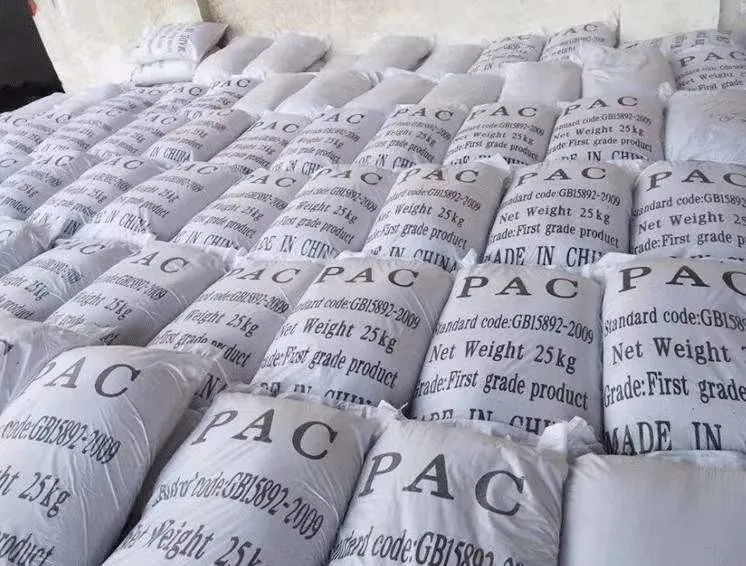
- Location: Dry, covered storage area — powder PAC is hygroscopic (absorbs moisture from air) and will cake and form hard lumps if exposed to humidity
- Temperature: Powder PAC is not temperature-sensitive in the same way as liquid — it does not freeze or crystallize. Storage in normal ambient temperature range (0–40°C) is acceptable.
- Packaging integrity: Keep bags and bulk bags sealed until immediately before use. Reseal partially used bags promptly after each use.
- Avoid: Direct contact with concrete floors (moisture wicking) — store on pallets. Avoid storage near water pipes, drains, or steam lines where condensation could wet the product.
Moisture Absorption Risk
Powder PAC that absorbs moisture:
- Forms hard lumps that dissolve incompletely, reducing effective Al₂O₃ delivery per dose
- Can block dissolution tank outlets and dosing lines
- May cause inconsistent treatment performance as lumped product dissolves at variable rates
Prevention: Keep storage dry, keep packaging sealed, use FIFO (first-in, first-out) stock rotation to prevent old stock sitting unused.
Recovery: Lightly caked powder can sometimes be broken up and used if it dissolves completely in testing. Severely lumped or hardened powder should be discarded — the dissolution quality and basicity are likely compromised.
Shelf Life of Powder PAC
- Typical shelf life: 12–24 months from production date in sealed original packaging under dry storage conditions
- Degradation mechanism: Moisture absorption leading to partial hydrolysis and caking. Dry storage at normal ambient temperature preserves product quality for the full shelf life.

Common Storage Problems and Prevention
| Problem | Cause | Prevention | Recovery |
|---|---|---|---|
| Liquid PAC frozen/crystallized | Storage below −5°C | Insulate tanks; trace heating | Warm slowly to 15–20°C; mix gently before pumping |
| Liquid PAC precipitate/sediment | Extended storage above 35°C or beyond shelf life | Store below 35°C; use FIFO rotation | Mix thoroughly; check Al₂O₃ content before use — discard if below spec |
| Powder PAC lumped/caked | Moisture exposure | Sealed storage in dry area; reseal opened bags | Break up lumps; test dissolution — discard if incomplete |
| Dosing line blockage | Frozen liquid or undissolved powder | See above | Flush lines with water; clear blockage mechanically if needed |
| Contamination in storage tank | Open/damaged tank cover | Inspect covers regularly; screen all vents | Drain, clean, and inspect tank before refilling |
Safety Considerations for PAC Storage
Chemical classification: Liquid PAC is classified as a mildly corrosive liquid (pH 3.5–5.0). Powder PAC is classified as an irritant. Neither is classified as a dangerous good for most transport purposes at commercial concentrations.
Spill response: Contain liquid PAC spills with absorbent material (sand, vermiculite). Dilute with water and dispose according to local regulations. Small spills are not hazardous; large spills should be contained to prevent discharge to surface water or drains.
Personal protective equipment: Chemical-resistant gloves and eye protection when handling concentrated liquid PAC. Dust mask when handling powder PAC in enclosed spaces.
Secondary containment: Storage tanks should be located within a bunded (secondary containment) area capable of holding 110% of the largest single tank volume. This prevents spills from reaching drains or water courses.
Incompatible materials: Do not store PAC near strong oxidizing agents, caustic soda, or concentrated acids. Do not mix PAC with PAM in the storage tank.
Frequently Asked Questions
How do I know if my liquid PAC has degraded during storage?
Check three parameters: (1) visual appearance — significant cloudiness or sediment formation suggests degradation; (2) pH of a 1% solution — should be 3.5–5.0; values above 5.0 suggest hydrolysis has progressed; (3) density — if measurably below 1.18 kg/L, product may have been diluted by condensation. For definitive confirmation, send a sample to an independent laboratory for Al₂O₃ content and basicity analysis.
Can we use liquid PAC that has partially crystallized due to cold weather?
Yes, if the product is carefully warmed and mixed back to a uniform liquid state before dosing. Warm the tank contents gradually to 15–20°C using trace heating or by moving product to a heated area. Mix the contents thoroughly before checking product consistency. Conduct a jar test to confirm that coagulation performance is normal before resuming full-scale use. Do not dose partially crystallized product directly — it will produce inconsistent dosing and may block lines.
Our storage tanks are at the end of their service life — what materials should we specify for replacement?
HDPE is the standard specification for liquid PAC storage at most treatment plants. For tanks above 50,000 liters, fibreglass (FRP) construction offers better structural integrity and resistance to UV degradation in outdoor installations. Both are chemically compatible with PAC at all commercial concentrations. Specify a minimum wall thickness appropriate for your tank volume and site conditions, and include a UV-stable exterior coating for outdoor tanks.
Conclusion
Proper PAC storage is straightforward to implement and maintains the product quality that your treatment system depends on. The key requirements — compatible tank materials, temperature control for liquid PAC in cold climates, dry sealed storage for powder PAC, and FIFO stock rotation to respect shelf life — are all manageable with basic facility planning.
Storage problems that affect treatment performance are almost always preventable. Establishing clear storage protocols and conducting quarterly inspections eliminates the majority of storage-related operational issues before they become treatment failures.
Contact our technical team today for storage specification guidance, tank sizing recommendations, and technical support on PAC handling for your specific facility. We respond within 24 hours.