Skip to content
Written by the HyChron Technical Team — water treatment specialists with over 15 years of field experience in municipal and industrial systems. Last reviewed: April 2026
The logistics of PAC supply — how it is transported to your facility, in what form, at what cost, and with what risk — are practical considerations that affect procurement decisions and operational planning. Buyers comparing liquid and powder PAC options, or evaluating domestic versus international supply, need to understand how transportation characteristics differ between the two forms and what those differences mean for total landed cost and supply reliability.
This article covers what buyers and logistics managers need to know about transporting both forms of PAC, with the risks and advantages of each clearly set out.
What Buyers Need to Understand About PAC Transport
The first practical question when comparing liquid and powder PAC for a given facility is transportation economics — specifically, how much active ingredient (Al₂O₃) you are paying to move per tonne of freight:
Liquid PAC at 10% Al₂O₃: 1 tonne of liquid contains 100 kg of active Al₂O₃ — 90% of the freight is water.
Powder PAC at 30% Al₂O₃: 1 tonne of powder contains 300 kg of active Al₂O₃ — three times more active ingredient per tonne of freight.
For long-distance or international transport, this difference is significant. The freight cost per unit of Al₂O₃ delivered is approximately three times lower for powder PAC than for liquid PAC. This is why powder PAC dominates remote and export markets, while liquid PAC dominates local and regional supply.
Liquid PAC Transport
Transport Modes
- Road tanker (bulk liquid): The most common transport mode for liquid PAC in domestic and regional markets. Tankers are typically 20,000–30,000 liter capacity (HDPE or rubber-lined carbon steel). This is the most cost-effective option for high-volume local supply.
- IBC (Intermediate Bulk Container): 1,000-liter HDPE containers on pallets. Suitable for medium-volume supply, secondary sites, or facilities without bulk tanker access. More expensive per liter than tanker delivery but more flexible.
- Drums: 200-liter HDPE drums. Highest cost per liter but appropriate for small-volume or trial supply. Used for new product qualification testing.
- ISO tank containers (sea freight): 20,000-liter stainless steel or HDPE-lined ISO tanks for international liquid PAC supply. Cost-effective for container volumes but requires adequate receiving facilities at the destination.
Transport Regulations for Liquid PAC
Liquid PAC at commercial concentrations is classified as a mildly corrosive liquid (typically UN 3265, Corrosive Liquid, Acidic, Inorganic, Class 8, Packing Group III) under international transport regulations.
Practical implications:
- Road transport: ADR/DOT compliance required for drivers and vehicles (hazmat endorsement)
- Sea transport: IMDG compliance; Class 8 declaration in shipping documents
- Air transport: Not typically transported by air due to corrosive classification and volume
Most standard road tankers and ISO containers used for liquid chemical transport are compliant for PAC. Confirm that your transport provider holds the appropriate licenses for Class 8 liquid chemical transport.
Cold Weather Transport Risks
Liquid PAC may increase in viscosity or partially crystallize if transported in unheated vehicles during cold weather (below −5°C). For deliveries in cold climates during winter:
- Request heated tanker or insulated ISO container
- Schedule deliveries to avoid overnight transit in sub-zero conditions
- Accept deliveries into a temperature-controlled storage area and allow product to equilibrate to ambient temperature before use
Receiving Liquid PAC Deliveries
- Check the tanker/container for the correct product label and batch documentation before accepting
- Measure liquid density at delivery using a hydrometer — density outside 1.15–1.25 kg/L warrants investigation
- Retain a sample from the delivery for 90 days
- Compare COA from delivery against your purchase specification before approving use
Powder PAC Transport
Transport Modes
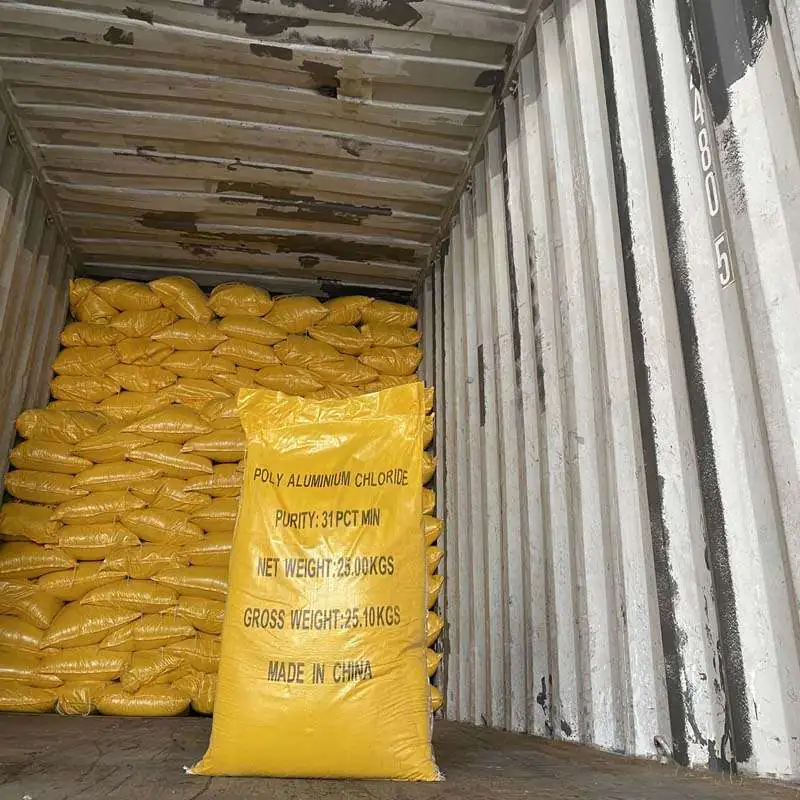
- Bulk bags (FIBC — Flexible Intermediate Bulk Container): 500–1,000 kg PP woven bags. The most common packaging for larger powder PAC volumes. Cost-effective handling with forklift or crane.
- 25 kg paper or PE bags: Suitable for smaller facilities or applications requiring precise manual dosing. More expensive per kg than bulk bags.
- Bulk road tanker (pneumatic): Available from some suppliers for very large powder consumers. Delivered pneumatically into silo storage.
- Sea freight (containerized): Powder PAC in bulk bags or palletized bags ships well in standard 20-foot or 40-foot dry containers. This is the dominant format for international powder PAC trade.
Transport Regulations for Powder PAC
Powder PAC is generally not classified as a dangerous good under most international transport regulations (ADR, IMDG, IATA) at commercial concentrations and packaging. This significantly simplifies international transport:
- No hazmat endorsement required for road drivers (in most jurisdictions)
- Standard dry container shipment by sea — no IMDG declaration in most cases
- Air freight is possible (within airline quantity limits) — relevant for urgent small shipments
This non-hazmat status is a significant logistical advantage for international supply of powder PAC versus liquid.
Moisture Risk During Transport
Powder PAC in intact sealed packaging is not sensitive to normal humidity levels during transport. However:
- Damaged packaging during transport exposes powder to ambient humidity, accelerating caking
- Sea freight in high-humidity environments (tropical shipping routes) may cause condensation inside container — particularly if there is a temperature differential between day and night
- Ensure packaging integrity is checked at delivery; damaged bags should be noted on delivery receipt and reported to the supplier
Receiving Powder PAC Deliveries
- Check packaging integrity — damaged bags should be flagged before acceptance
- Check production date on bags against your shelf life policy
- Store immediately in dry, covered storage — do not leave outside
- Weigh a sample of bags to verify fill weight matches stated specification
Liquid vs Powder PAC: Transport Comparison
| Parameter | Liquid PAC | Powder PAC |
|---|---|---|
| Al₂O₃ per tonne of freight | ~100 kg | ~300 kg |
| Freight cost per unit Al₂O₃ | Higher | Lower |
| Transport hazard classification | Class 8 corrosive liquid | Usually non-hazardous |
| Cold weather transport risk | Crystallization risk | None |
| Moisture transport risk | None | Packaging damage risk |
| Suitable for international trade | Yes (ISO tanks) | Yes (containers) — preferred |
| Receiving facility requirement | Bulk tanker connection | Forklift and covered storage |
| Suitable for remote locations | Challenging (bulky, cold risk) | Preferred (compact, non-hazmat) |
Risk Management for PAC Transport
Risk 1 — Supply disruption from logistics delay. Liquid tanker delays affect immediate supply. Mitigation: maintain 14–30 days of safety stock. For international powder supply with long lead times, maintain 30–45 days of safety stock.
Risk 2 — Product quality compromise during transport. Liquid: crystallization in cold transit; contamination from poorly cleaned tankers. Mitigation: specify tanker temperature requirements in cold weather; require tanker cleaning records before filling. Powder: moisture ingress from damaged packaging. Mitigation: inspect packaging at delivery; require moisture-proof packaging specification in procurement contracts.
Risk 3 — Transport incident. Liquid PAC is a Class 8 corrosive — spills require appropriate hazmat response. Confirm your transport provider carries adequate insurance and has appropriate emergency response procedures.
For related storage guidance: PAC Storage Guidelines: Liquid and Powder Requirements
For shelf life management: Shelf Life of PAC Products: Liquid and Powder Guide
Frequently Asked Questions
We are considering importing powder PAC from overseas to reduce unit cost — what should we plan for?
International powder PAC supply requires:
(1) 4–8 week transit time from production to delivery — plan safety stock accordingly;
(2) import documentation (commercial invoice, packing list, COA, certificate of origin, import permit if required by your country);
(3) customs clearance and port handling costs that add to landed price;
(4) a dissolution system at your facility for converting powder to dosing solution. Our team can provide full export documentation for your import requirements and advise on the landed cost calculation for your specific location.
Can we switch between liquid and powder PAC suppliers for the same treatment system?
Yes, with operational adjustments. The treatment chemistry is the same — the difference is in dosing system configuration. Switching from liquid to powder requires adding a dissolution system. Switching from powder to liquid eliminates the dissolution step. In both cases, dosage recalibration via jar test is required after the switch, even if the Al₂O₃ content is nominally equivalent, because basicity may differ between products.
Do I need a special license to transport liquid PAC by road?
In most jurisdictions, transporting liquid PAC in commercial quantities requires the driver to hold a hazmat (ADR/DOT Class 8) endorsement and the vehicle to be equipped appropriately for liquid chemical transport. This applies to contract hauliers transporting PAC on your behalf — they bear the regulatory responsibility. If you are using your own vehicles to transport PAC between sites (e.g., from a central storage facility to a remote treatment plant), verify the applicable transport regulations in your jurisdiction.
Conclusion
The transport characteristics of liquid and powder PAC each present distinct advantages — liquid PAC’s ready-to-use convenience suits local and regional supply; powder PAC’s concentrated active ingredient and non-hazmat classification favor remote and international supply.
Understanding the cost, risk, and operational implications of each form enables better procurement decisions — matching the supply format to the facility’s location, infrastructure, and consumption characteristics.
Contact our technical team today for transport options, packaging specifications, and a landed cost comparison for liquid versus powder PAC supply to your facility. We respond within 24 hours.