
Polyacrylamide (PAM) is a widely used polymer flocculant in the domestic water purification market. It is commonly applied as a coagulant aid to improve solid–liquid separation efficiency and water clarity.
Polyacrylamide is a water-soluble resin, available in both solid and liquid forms. In liquid form, it shows a certain viscosity, which helps ensure uniform dispersion during dosing.
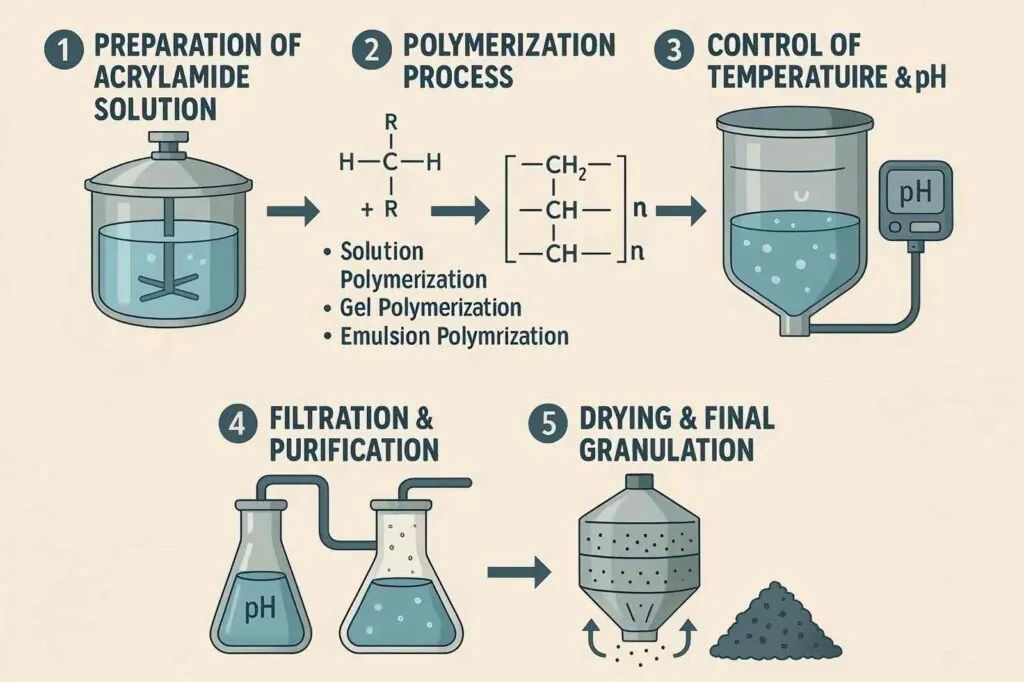
Raw Material and Production of Polyacrylamide
Polyacrylamide is produced from polypropylene nitrile, which can be hydrolyzed into acrylamide under specific conditions. Through suspension polymerization, acrylamide monomers form long-chain polyacrylamide molecules. This molecular structure makes PAM highly suitable for water purification applications.
Flocculation Mechanism of Anionic Polyacrylamide
Anionic polyacrylamide contains amide functional groups that attach to suspended particles through hydrogen bonding.
Its long molecular chains create a bridging effect, linking particles together to form large and dense flocs. These flocs settle quickly, improving turbidity removal and overall water quality.
Molecular Weight Selection for Water Treatment PAM
Molecular weight directly affects flocculation performance. However, higher molecular weight does not always mean better results.
Typical reference ranges:
- Industrial wastewater treatment: 6–18 million
- General water purification: 4–18 million
- Thickening applications: 18–25 million
The correct molecular weight should be selected based on actual water conditions.
Degree of Hydrolysis of Anionic Polyacrylamide
The degree of hydrolysis determines the charge density of anionic PAM and strongly influences its performance.
Common market classifications:
- Low hydrolysis: 12%–15%
- Medium-low hydrolysis: 17%–19%
- Medium hydrolysis: 23%–27%
- High hydrolysis: about 37%
Different hydrolysis degrees are suitable for different water qualities and treatment goals.
Application Notes in Domestic Water Purification
For stable and efficient performance:
- Use PAM as a coagulant aid, not a primary coagulant
- Control dosage to avoid over-flocculation
- Match molecular weight and hydrolysis degree to water conditions
Correct selection improves efficiency and reduces chemical consumption.
Conclusion
Anionic polyacrylamide is an effective and reliable flocculant for domestic water purification. Its molecular bridging ability improves floc formation and enhances water clarity.
By selecting the proper molecular weight and hydrolysis degree, PAM can deliver stable performance while supporting safe and efficient water treatment systems.