 Skip to content
Have you ever wondered how cloudy river water turns into the clear water flowing from your tap? Or how wastewater plants remove invisible contaminants before releasing water back to the environment? The secret lies in coagulation and flocculation—two key stages in water purification.
The Core Difference: Two Stages, One Goal
Imagine trying to clean a pool full of glitter. Tiny glitter particles do not settle on their own. Similarly, microscopic particles in water resist natural settling. Water treatment plants solve this with two steps:
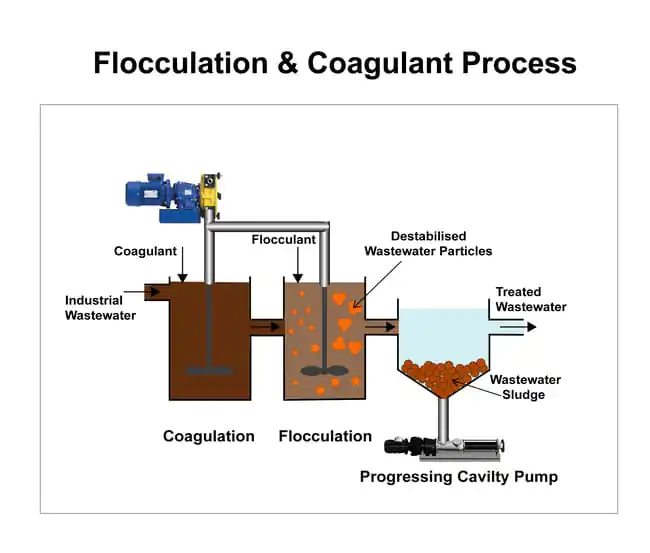
1. Coagulation – Destabilizing Particles
- Tiny particles like clay, bacteria, and organics carry negative charges that repel each other.
- Adding positively charged coagulants neutralizes this charge.
- Rapid, intense mixing ensures maximum contact within seconds.
2. Flocculation – Building Flocs
- Destabilized particles form microflocs.
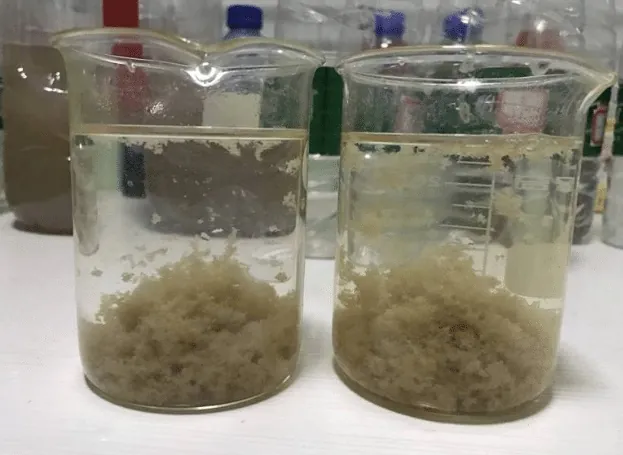
- Gentle mixing over 15–45 minutes lets these microflocs collide and grow into visible flocs, like tiny snowflakes in water.
A Simple Analogy: Making Snowballs
- Coagulation is like adding water to dry snow so it sticks together.
- Flocculation is like gently rolling the snow to form a firm snowball.
Without enough water (coagulant), the snow remains powdery. Without proper rolling (flocculation), the snowball is weak.
Common Chemicals in Water Treatment
Coagulants (Destabilizers)
- Aluminum-based:
- Alum (Aluminum Sulfate): Traditional and widely used
- Polyaluminum Chloride (PAC): Works efficiently over wide pH ranges
- Iron-based:
- Ferric Chloride: Removes phosphorus efficiently
- Ferric Sulfate: Works in cold water
- Ferrous Sulfate: Common in wastewater
- Organic Polymers: Cationic polymers to neutralize negative particles
Flocculants (Aggregators)
- Polyacrylamide derivatives: Most common
- Anionic PAM: Works with metal coagulants
- Cationic PAM: Dual function
- Non-ionic PAM: Neutral charge for specific conditions
- Natural flocculants: Eco-friendly alternatives gaining popularity
How Coagulation and Flocculation Work Together
- Rapid Mix Basin: Coagulant is injected and mixed quickly (1–30 seconds).
- Flocculation Basin: Gentle mixing allows flocs to grow (20–45 minutes).
- Sedimentation Basin: Flocs settle by gravity.
- Filtration: Remaining particles are trapped in sand or membrane filters.
Real-World Applications
- Drinking Water: Clarifies raw water efficiently.
- Wastewater Treatment: Removes organics and nutrients before discharge.
- Mining: Separates minerals from process water.
- Food & Beverage: Clarifies juices, wine, syrups.
- Swimming Pools & Industrial Processes: Keeps water clear and safe.
Environmental and Modern Innovations
Water treatment science focuses on efficient chemical dosing and minimizing residuals. New trends include:
- Electrocoagulation: Using electrical currents instead of chemicals
- Bio-flocculants: Microbes that naturally aggregate particles
- Smart dosing systems: AI-controlled chemical addition based on real-time water quality
Conclusion
Coagulation and flocculation are critical for public health. They turn tiny, repelling particles into large, settling flocs, delivering clear and safe water for billions daily.
Contact us today to learn how our chemical solutions can improve water treatment efficiency in your facility.


