
Written by the HyChron Technical Team — water treatment specialists with over 15 years of field experience in municipal and industrial systems. Last reviewed: April 2026
Choosing between liquid PAC and powder PAC is one of the first practical decisions when implementing or switching coagulant systems — and it is a decision that affects storage requirements, dosing equipment, operating cost, and logistics across the life of the treatment system.
The right choice depends on your facility’s production volume, storage capacity, supply chain reliability, and dosing system configuration. This article gives you the information needed to make that decision clearly.
Not sure which PAC form suits your operation? Contact our technical team for a free recommendation based on your facility’s specific requirements.
What Liquid PAC and Powder PAC Actually Are
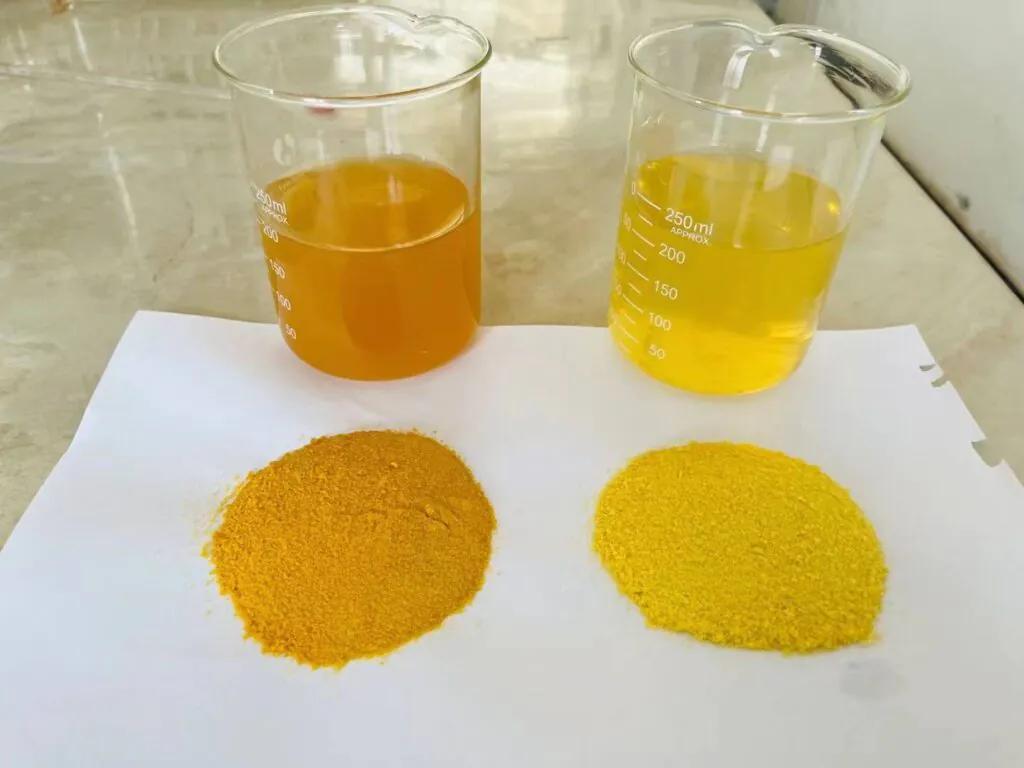
Both forms contain the same active ingredient — poly aluminum chloride — but differ in concentration, physical state, and how they are handled and dosed.
Liquid PAC is an aqueous solution of poly aluminum chloride, typically containing 10–11% Al₂O₃ by weight. It is ready to use directly from the storage tank — no dissolution required. The liquid form is brownish-yellow in color and has a slightly acidic pH.
Powder PAC is a solid form of poly aluminum chloride produced by spray drying or drum drying the liquid product. It typically contains 28–32% Al₂O₃ by weight — roughly three times the active ingredient concentration of liquid PAC by weight. Before use, powder PAC must be dissolved in water to produce a dosing solution.
Head-to-Head Comparison
| Parameter | Liquid PAC | Powder PAC |
|---|---|---|
| Al₂O₃ content | 10–11% | 28–32% |
| Ready to use | Yes | No — requires dissolution |
| Storage volume required | Higher (lower concentration) | Lower (higher concentration) |
| Transport cost per unit Al₂O₃ | Higher | Lower |
| Shelf life | 6–12 months | 12–24 months |
| Dosing system complexity | Simple — pump from tank | Requires dissolution system |
| Risk of handling errors | Lower | Moderate (dissolution step) |
| Suitability for remote locations | Lower (volume, shelf life) | Higher |
| Typical application | High-volume, continuous systems | Remote sites, lower-volume systems |
When to Choose Liquid PAC
High-volume continuous treatment systems. Municipal water plants, large industrial wastewater facilities, and other high-throughput operations favor liquid PAC because it eliminates the dissolution step and integrates directly into automated chemical dosing systems. The simplicity of pumping directly from a bulk storage tank reduces operator workload and minimizes handling errors.
Facilities with reliable supply chains. Liquid PAC has a shorter shelf life (6–12 months) and higher transport volume per unit of active ingredient. Facilities that receive regular deliveries from nearby suppliers are well-suited to liquid PAC.
Systems with automated dosing. Liquid PAC is ideal for systems using peristaltic pumps, diaphragm pumps, or flow-proportional dosing controllers. No preparation is required between delivery and dosing — the liquid goes directly from the tanker to the storage tank to the dosing pump.
Environments where dust is a concern. Powder PAC dissolution generates fine dust that can irritate the respiratory system. Liquid PAC eliminates this handling risk entirely.
When to Choose Powder PAC
Remote or logistically challenging locations. Mining sites, rural water treatment plants, and offshore or island facilities benefit from powder PAC’s higher active ingredient concentration — more Al₂O₃ per kilogram means fewer deliveries, less transport volume, and lower freight cost per unit of treatment capacity.
Longer storage requirements. Powder PAC’s shelf life of 12–24 months in sealed packaging makes it more suitable for facilities that cannot receive frequent chemical deliveries or that need to maintain strategic reserves.
Lower-volume treatment systems. Smaller treatment plants that do not justify bulk liquid tanker deliveries can receive powder PAC in bags or drums more cost-effectively.
Cold climate storage. Liquid PAC can freeze or crystallize at temperatures below approximately −5°C depending on concentration, which complicates storage in unheated facilities. Powder PAC is not affected by cold storage temperatures.

Dissolving Powder PAC Correctly
When using powder PAC, correct dissolution is critical for consistent dosing performance. Incorrectly dissolved powder produces uneven concentration in the dosing solution and inconsistent treatment results.
Recommended dissolution procedure:
- Fill the dissolution tank with clean water to approximately 80% of final volume
- Start the mixing agitator before adding powder
- Add powder PAC slowly — never dump the full bag at once
- Mix at moderate agitation until fully dissolved (typically 15–30 minutes)
- Top up to final volume with clean water and mix for an additional 5 minutes
- Allow to stand 10 minutes before dosing to ensure complete dissolution
Target dissolution concentration: 5–15% w/v solution is typical for dosing systems. Higher concentrations increase viscosity and may cause pump and pipeline issues.
Water temperature: Dissolution is faster at higher water temperatures. Below 10°C, dissolution time increases and more agitation is needed to achieve complete dissolution.
Storage and Handling
Liquid PAC storage:
- Store in HDPE or fibreglass tanks — avoid carbon steel (corrosion) and aluminum (reaction)
- Keep covered to prevent evaporation and contamination
- Maintain temperature above −5°C to prevent crystallization
- Inspect storage tanks annually for corrosion or liner degradation
Powder PAC storage:
- Store in original sealed packaging in a cool, dry location
- Avoid exposure to moisture — wet powder forms hard lumps and dissolves unevenly
- Keep away from direct sunlight
- Use opened bags promptly — reseal partially used bags immediately
Cost Comparison: Liquid vs Powder
The cost comparison between liquid and powder PAC depends on several factors that vary by location and supplier:
- Purchase price: powder PAC typically costs less per kg of Al₂O₃ than liquid PAC
- Transport cost: liquid PAC’s lower concentration means higher transport cost per unit of active ingredient — particularly for remote locations
- Dissolution equipment: powder PAC requires a dissolution tank and agitator — capital cost that liquid PAC avoids
- Labour: powder PAC dissolution adds operator time; liquid PAC requires only tanker unloading
For most high-volume operations near supply sources, liquid PAC is the lower total cost option when equipment and labour are factored in. For remote operations or lower-volume systems, powder PAC typically offers better total economics.
Frequently Asked Questions
Does liquid PAC or powder PAC perform better in water treatment?
When correctly dosed at equivalent Al₂O₃ concentrations, liquid and powder PAC from the same manufacturer perform identically — the active ingredient is the same. Performance differences arise from dosing concentration errors or incomplete dissolution of powder PAC, not from the form itself.
Can I switch from liquid to powder PAC without changing my dosing system?
Switching from liquid to powder requires adding a dissolution system — tank, agitator, and possibly a transfer pump. The downstream dosing pump and pipework can typically remain the same. Contact our technical team for guidance on dissolution system design for your specific flow requirements.
How do I check if my powder PAC has dissolved completely?
A correctly dissolved PAC solution should be clear to slightly hazy and uniformly colored. Undissolved lumps visible in the tank or white sediment at the tank bottom indicate incomplete dissolution — extend mixing time and check water temperature.
Conclusion
Liquid PAC and powder PAC deliver the same treatment performance at equivalent dosage. The choice between them is an operational and logistical decision — liquid PAC for high-volume, automated, well-supplied systems; powder PAC for remote, lower-volume, or long-storage-interval applications.
Getting this choice right from the start saves significant cost and operational complexity over the life of the treatment system.
Contact our technical team today to discuss which PAC form best suits your facility, and request product samples and pricing for both options. We respond within 24 hours.