
Chemical manufacturing plants generate some of the most complex wastewater in industrial treatment. Unlike mining or construction site runoff — where the primary challenge is volume and particle concentration — chemical plant effluent combines suspended solids with dissolved organics, variable pH, surfactants, heavy metals, and process-specific contaminants that interact unpredictably with treatment chemicals.
For plant operators, this complexity makes reliable treatment difficult. A polymer program that works well during one production run may perform poorly when the product line changes. Seasonal variation, batch changeovers, and upstream process upsets all create treatment challenges that simpler industrial wastewater systems rarely face.
Polyacrylamide, when correctly selected and optimized, addresses the suspended solids and colloidal fraction of chemical manufacturing wastewater effectively — reducing turbidity, improving clarifier performance, and enabling consistent compliance with discharge limits even as influent characteristics vary.
This guide covers how PAM is applied in chemical manufacturing wastewater treatment, which conditions require specific grade adjustments, and how to build a polymer program that handles process variability.
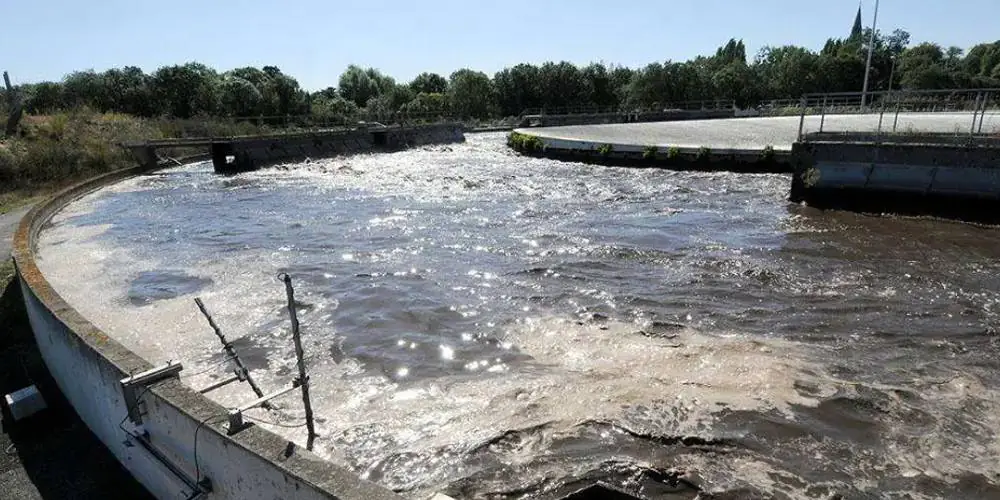
The Wastewater Challenge in Chemical Manufacturing
Chemical manufacturing wastewater is rarely a single, consistent stream. Most plants generate multiple effluent streams from different process areas — reactor washdowns, cooling water blowdown, scrubber water, tank cleaning effluent, and stormwater — each with different characteristics that combine in the collection system before treatment.
Common suspended solids and colloidal contaminants in chemical plant effluent include:
| Contaminant Type | Source | Treatment Challenge |
|---|---|---|
| Catalyst fines | Reactor systems | Very fine particles, variable surface charge |
| Precipitated salts | Reaction byproducts | Fine crystals, variable solubility |
| Polymer and resin particles | Synthesis processes | Hydrophobic surfaces, poor wettability |
| Emulsified organics | Solvent use, extraction | Requires demulsification before flocculation |
| Metal hydroxide precipitates | pH adjustment steps | Fine, slow-settling flocs without polymer |
| Pigment and dye particles | Colorant manufacturing | Strong surface charge, high polymer demand |
The combination of contaminant types — and the fact that this combination changes with production schedule — means that a single fixed PAM grade and dosage is rarely optimal across all operating conditions.
How PAM Fits Into Chemical Plant Treatment Systems
In most chemical manufacturing treatment systems, PAM is applied at one or more of three stages:
Primary clarification: After pH adjustment and coagulant addition, high-MW anionic PAM bridges fine precipitate particles and colloidal solids into settleable flocs. This stage handles the bulk of suspended solids removal before biological or advanced treatment.
Secondary clarifier: After biological treatment, cationic PAM improves the settlement of biological sludge and any residual suspended solids not captured in primary treatment.
Sludge dewatering: Cationic PAM conditions mixed chemical and biological sludge before filter press or centrifuge dewatering, improving cake solids content and reducing disposal volume.
Each stage may require a different PAM grade — and the optimal grade at each stage may need to change as production schedules shift.
Contact our technical team today for a free assessment of your current polymer program and grade recommendations for each treatment stage. → Contact our technical team today
Grade Selection for Chemical Manufacturing Effluent
The right PAM grade for chemical manufacturing wastewater depends on the dominant contaminant type and the treatment stage.
When Anionic PAM Works Best
High-MW anionic PAM is effective for primary clarification of chemical plant effluent when:
- Inorganic precipitates (metal hydroxides, calcium carbonate, silica) dominate the suspended solids
- Coagulant pre-treatment has already been applied
- pH is within the 6–9 range for anionic grade compatibility
- Salinity is moderate (TDS below 3,000 mg/L)
For catalyst fines and fine inorganic precipitates, molecular weight above 15 million Daltons provides the bridging reach needed to aggregate very fine particles into settleable flocs.
When Cationic PAM Works Best
Cationic PAM is preferred when:
- Organic contaminants — resins, polymer particles, biological solids from secondary treatment — dominate the suspended fraction
- Sludge dewatering performance is the priority
- Effluent contains significant colloidal organics with strong negative surface charge
- pH is variable and may drop below 6, where anionic grades lose effectiveness
When Nonionic PAM Is Required
Some chemical manufacturing effluents contain high concentrations of surfactants or have very high ionic strength from dissolved process chemicals. In these conditions, anionic PAM chain extension is suppressed and performance deteriorates significantly.
Nonionic PAM maintains consistent performance in high-salinity or surfactant-rich effluent where ionic grades underperform. It is also applicable in strongly acidic effluent (pH below 5) where both anionic and cationic grades are less effective.
For a complete guide to PAM grade selection across industries, see: Choosing the Right PAM Grade for Your Industry
Managing Variability: The Core Challenge
The most common complaint from chemical plant operators about their polymer program is inconsistency — performance that was acceptable last week is inadequate this week, despite no apparent change in dosage or procedure.
In most cases, the cause is influent variability rather than polymer performance. Chemical manufacturing wastewater characteristics can shift significantly within hours as production batches change. The suspended solids concentration, particle type, pH, and organic load all vary — and a dosage optimized for one production run may be significantly off for the next.
Three practical strategies help manage this variability:
Strategy 1 — Maintain a grade library Keep two or three pre-qualified PAM grades on site — typically a high-MW anionic, a cationic, and optionally a nonionic — that have been jar-tested against different production streams. When production changes, operators can switch to the appropriate grade quickly without waiting for new product procurement.
Strategy 2 — Use online turbidity monitoring Turbidity monitoring at the clarifier outlet provides real-time feedback that allows dosage adjustment as influent characteristics change. Automated dosage control linked to turbidity setpoints can handle moderate variability without manual intervention.
Strategy 3 — Establish a regular jar testing schedule Rather than waiting for performance problems to develop, run a jar test at the start of each major production campaign using fresh effluent samples. This identifies whether the current grade and dosage are still optimal before problems appear in the full-scale system.
Request product samples and technical data sheets for multiple grades to build your on-site grade library. → Get in touch today
Combining PAM with Coagulants in Chemical Plant Treatment
Many chemical manufacturing effluents — particularly those containing very fine colloidal particles, emulsified organics, or heavy metals — benefit from coagulant pre-treatment before PAM addition.
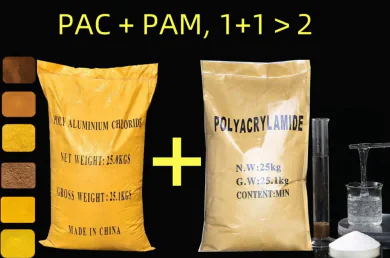
Coagulants (polyaluminum chloride, ferric chloride, or ferric sulfate) neutralize colloidal charge and initiate micro-floc formation. PAM then bridges these micro-flocs into larger, faster-settling aggregates. The combined program typically achieves better removal efficiency at lower total chemical cost than either chemical alone.
Dosing sequence is critical: Always add coagulant first with 30–60 seconds of rapid mixing before introducing PAM. Adding PAM before coagulant has reacted with the wastewater reduces removal efficiency significantly.
For chemical plant effluents containing emulsified oils or solvents, a demulsifier or emulsion breaker may be required before coagulant and PAM addition. PAM cannot bridge emulsified droplets effectively until the emulsion is destabilized.
Frequently Asked Questions
Can PAM remove dissolved organic contaminants from chemical plant effluent?
PAM removes suspended and colloidal contaminants through flocculation and settlement. It does not remove truly dissolved organics — these require biological treatment, activated carbon adsorption, or advanced oxidation. However, by improving the removal of colloidal organics and suspended solids, PAM reduces the load on downstream biological treatment, improving overall system efficiency.
Our effluent pH varies widely between production batches — which PAM grade handles this best?
For effluent with pH regularly outside the 6–9 range, nonionic PAM provides the most consistent performance across the full pH range. If pH excursions are infrequent and short, anionic PAM with pH monitoring and adjustment at the dosing point is typically more cost-effective. For pH consistently below 6, cationic PAM often outperforms anionic grades.
How do surfactants in chemical plant effluent affect PAM performance?
Surfactants can adsorb onto particle surfaces and block PAM attachment sites, reducing flocculation efficiency. High surfactant concentrations may require coagulant pre-treatment to break surfactant-stabilized colloids before PAM addition. In effluents with very high surfactant loading, nonionic PAM is less affected than anionic grades.
Conclusion
Chemical manufacturing wastewater treatment presents challenges that simpler industrial applications do not — complex contaminant mixtures, variable influent characteristics, and strict discharge requirements that must be met regardless of production schedule.
Polyacrylamide addresses the suspended solids and colloidal fraction of this challenge effectively, provided the grade is matched to the dominant contaminant type and the dosage is adjusted as production conditions change. A multi-grade approach — with anionic, cationic, and optionally nonionic grades pre-qualified and available for rapid deployment — gives chemical plant operators the flexibility needed to maintain consistent treatment performance across varying production conditions.
If your chemical plant treatment system is struggling with variable performance or compliance challenges, contact our technical team today for a free program assessment and grade recommendations. → Contact our technical team today