Skip to content
Larger flocs settle faster. This relationship is fundamental to gravity-based wastewater treatment — Stokes’ Law tells us that settling velocity increases with the square of particle diameter. Doubling floc diameter produces four times the settling speed. For plant operators trying to improve clarifier performance or increase throughput, increasing floc size is one of the most direct levers available.
The challenge is that floc size cannot simply be increased by adding more polymer. Beyond the optimal dosage, additional PAM does not produce larger flocs — it produces smaller ones, through the restabilization mechanism that reverses flocculation at excess polymer concentrations. And aggressive mixing to grow flocs mechanically breaks the polymer bridges that hold them together.
Increasing floc size safely requires understanding what limits floc growth in your specific system — and addressing those limits through targeted adjustments rather than simply increasing chemical dose.
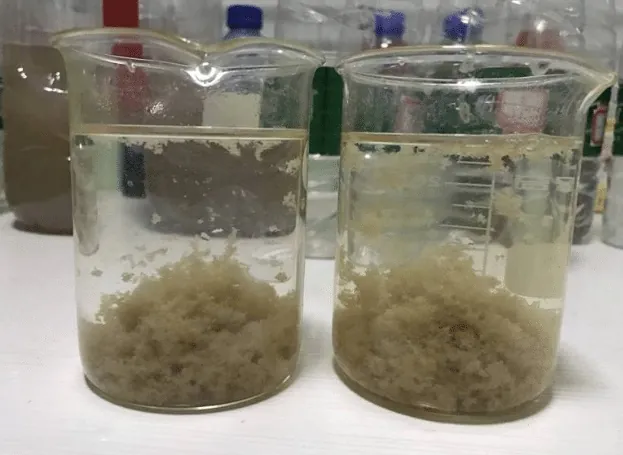
What Controls Floc Size
Floc size at any point in the treatment process is the result of a balance between two competing forces: aggregation (particles coming together) and breakage (flocs being torn apart). Maximum achievable floc size is determined by whichever of these forces is dominant.
Factors that promote aggregation and larger flocs:
- Higher PAM molecular weight — longer chains bridge more particles simultaneously
- Adequate slow-mix contact time — allows flocs to grow progressively
- Sufficient PAM dosage — but only up to the optimal dose
- Coagulant pre-treatment — destabilizes particle surface charge, enabling PAM to bridge more effectively
- Moderate particle concentration — provides sufficient collision frequency for growth
Factors that limit floc size or cause breakage:
- Excessive mixing energy — shear forces exceed polymer bridge strength
- Overdosing — restabilization reverses aggregation
- Low molecular weight PAM — insufficient bridging reach for large aggregate formation
- Very low particle concentration — insufficient collision frequency for floc growth
- pH outside effective range — reduces polymer adsorption efficiency
Increasing floc size means either strengthening the aggregation side of this balance or reducing the breakage side — ideally both simultaneously.
Request high molecular weight PAM samples to trial in your system. → Get in touch today
Strategy 1: Upgrade to Higher Molecular Weight PAM
The most reliable route to larger flocs in most applications is increasing PAM molecular weight.
Longer polymer chains bridge particles across greater distances and connect more particles per chain — both effects produce larger, more robust floc structures. The improvement from upgrading molecular weight is typically more significant than equivalent dosage increases, and it does not carry the restabilization risk of overdosing.
In practice, upgrading from a 10–12 million Dalton grade to a 15–18 million Dalton grade commonly produces 30–60% increases in settled floc size under otherwise identical conditions. For applications where settling speed is the primary performance constraint — thickeners operating near capacity, clarifiers with limited residence time — this improvement can meaningfully increase throughput without infrastructure changes.
When to consider a MW upgrade:
- Current floc size is visibly small despite dosage being within the optimal range from jar testing
- Settled water clarity is adequate but settling speed is too slow for current throughput
- Performance was previously better and has declined — a new batch with lower effective MW than stated is a possible cause
Strategy 2: Optimize the Slow-Mix Flocculation Stage
Floc growth requires time. After PAM is introduced and initial bridging begins, flocs grow progressively as collisions between small aggregates produce larger ones. This growth process needs a low-shear environment with adequate residence time — conditions that the slow-mix flocculation stage is designed to provide.
Many treatment systems underperform on floc size not because of polymer selection but because the flocculation stage is too short, too turbulent, or both.
Residence time: Minimum 10 minutes in the slow-mix zone is required for most applications. Systems with less than 5 minutes of flocculation residence time consistently produce smaller flocs than the polymer is capable of generating under adequate conditions.
Mixing intensity: The G value (velocity gradient) in the flocculation zone should decrease progressively from around 60–80 s⁻¹ near the PAM dosing point to below 20 s⁻¹ near the clarifier inlet. Running the flocculation agitator at a fixed speed that is too high for the later stages of floc growth is a common and easily corrected limitation.
Tapered flocculation: Where multiple flocculation chambers exist in series, reduce agitator speed in each successive chamber. This tapered energy profile — high shear early for polymer distribution, progressively lower shear for floc growth — consistently produces larger flocs than uniform mixing throughout.
Strategy 3: Improve Coagulant Pre-Treatment
PAM bridges particles — but it bridges them most effectively when coagulant has first reduced the repulsive surface charge that keeps particles apart. Without adequate coagulation, PAM must overcome both the distance barrier and the charge barrier simultaneously, limiting the number and quality of bridges it can form.
Improving coagulant pre-treatment is often overlooked as a route to larger flocs because the focus tends to fall on the polymer itself. But in systems where coagulant dosage is suboptimal or contact time is insufficient, improving the coagulation stage can increase achievable floc size as significantly as upgrading PAM molecular weight.
Signs that coagulation is limiting floc size:
- Flocs form but remain small regardless of PAM dosage
- Increasing PAM dose above the current level produces no improvement in floc size
- Jar test with coagulant dose increase shows significant improvement before PAM is added
For applications where coagulant and PAM are used together, see: Integrating PAM in Clarifier Systems Effectively
Strategy 4: Reduce Post-Formation Shear
Flocs that form adequately but break apart before settling are a different problem from flocs that never grow to adequate size — but the visible result is the same: small particles in the settling zone and turbid effluent.
If flocs are forming well in the flocculation zone but appear small at the clarifier inlet, shear between these two points is the likely cause. Pumps, pipe fittings, control valves, and flow measurement devices all introduce shear that can reduce floc size after formation.
Practical shear reduction steps:
- Replace centrifugal pumps between the flocculation zone and clarifier with peristaltic or progressive cavity pumps
- Remove or bypass unnecessary control valves in the post-flocculation flow path
- Increase pipe diameter to reduce flow velocity and turbulence in transfer lines
- Dose PAM as close to the clarifier inlet as mixing conditions allow, minimizing the distance over which formed flocs must travel
What Not to Do: Common Mistakes When Trying to Increase Floc Size
Increasing PAM dosage beyond the optimal range The most common mistake. More polymer past the optimum decreases floc size through restabilization. Always confirm current dosage is at or below the jar test optimum before increasing.
Increasing mixing speed to “grow” flocs faster Higher mixing energy breaks polymer bridges and reduces maximum achievable floc size. Floc growth cannot be accelerated by increasing shear — only by providing adequate time at appropriate low shear.
Adding a second polymer dose downstream Re-dosing partially formed flocs with additional PAM introduces new polymer that interacts with floc surfaces unpredictably — sometimes improving bridging, more often disrupting existing bridges. If a second dosing point is being considered, trial it carefully through jar testing rather than implementing directly.
Frequently Asked Questions
Is there a maximum floc size beyond which settling speed no longer improves?
In practice, yes. Very large flocs — above approximately 2–5 mm in diameter for most applications — become mechanically fragile and tend to break apart under the turbulence present even in settling zones. The target is the largest floc size that is stable under your specific hydraulic conditions, not the absolute maximum achievable in a jar test under still conditions.
How do I measure floc size in my system?
Visual observation during jar testing is the most practical method for routine monitoring — experienced operators can estimate relative floc size reliably. For more precise measurement, photographic comparison against reference images or simple image analysis tools provide quantitative data. Online floc size analyzers are available for continuous measurement in large installations where floc size monitoring justifies the investment.
Can changing the PAM addition point increase floc size?
Yes, significantly in some systems. Moving the dosing point to a location with better mixing energy — typically the feed well or a dedicated rapid-mix chamber rather than a pipe injection point — improves initial polymer distribution and contact with particles, which is the foundation of larger floc formation.
Conclusion
Increasing floc size safely is a systematic optimization process, not a dosage adjustment. The four strategies in this guide — upgrading molecular weight, optimizing the slow-mix stage, improving coagulant pre-treatment, and reducing post-formation shear — each address a specific limiting factor that may be constraining floc size in your system.
Working through these strategies in sequence, starting with a jar test to confirm current dosage is optimal, typically identifies one or two dominant limiting factors that account for most of the performance gap. Addressing those specific factors delivers floc size improvement without the chemical waste and compliance risk that come from simply increasing polymer dose.
Contact our technical team today to discuss PAM grade upgrades and floc size optimization for your specific treatment system. → Contact our technical team today