
Description
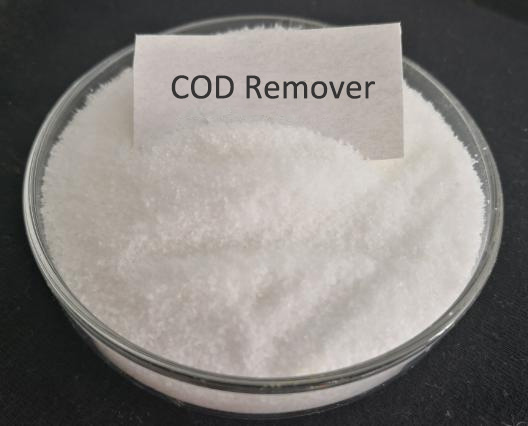
COD Remover
Product Overview
COD Remover combines oxidation, chemical precipitation, and adsorption technologies to quickly reduce COD levels in wastewater. It takes only 2–3 minutes to react, making it an ideal solution for treating wastewater with excessive COD.
Product Features
-
Fast Reaction Time – Greatly shortens the treatment process.
-
Effective Treatment – Efficiently reduces high COD levels.
-
Eco-Friendly – Does not introduce secondary pollution.
Technical Specifications
|
Item
|
Standard
|
|
Appearance
|
White solid
|
|
Content
|
≥ 99%
|
|
pH Value
|
Mildly acidic
|
Application Areas
This product is widely used in industries such as electroplating, PCB manufacturing, textile dyeing, chemical processing, and municipal wastewater treatment. It is suitable for various types of industrial wastewater with high COD levels.
Usage Instructions
-
Lab Test Procedure:
Before full-scale use, a lab test is recommended:
a. Take a sample of wastewater (e.g., 500ml or 1L from the reaction tank).
b. Weigh a certain amount of COD remover (e.g., 500PPM / 800PPM / 1000PPM).
c. Add the chemical to the wastewater sample.
d. Stir for 1–2 minutes to allow full reaction.
e. Add a suitable coagulant and flocculant (such as PAM).
f. Let it settle, then check the treated water quality.
-
On-Site Application
a. Dosing Point
The COD remover reacts very quickly, completing the process in just 2–3 minutes. It can be added directly after the sedimentation tank—at the sand filter or equalization tank. To ensure full reaction, proper aeration or mixing is recommended.
b. Optimal Dosage
Since wastewater COD levels vary, the required dosage will differ accordingly. It is recommended to determine the optimal dosage through lab testing and fine-tune it during actual use.
Lab Testing Instructions
-
Effect of Different Dosages on COD Reduction
A sample of wastewater with a COD of approximately 700 ppm was treated with varying doses of COD remover. The results are as follows:
|
Sample No.
|
Description
|
COD (ppm)
|
|
1
|
Untreated Raw Water
|
714.1
|
|
2
|
1 g/L of reagent
|
601.8
|
|
3
|
2 g/L of reagent
|
492.3
|
|
4
|
3 g/L of reagent
|
396.7
|
|
5
|
4 g/L of reagent
|
309.5
|
|
6
|
5 g/L of reagent
|
197.6
|
Conclusion: Increasing dosage leads to significant COD reduction.
-
Stability Test of COD Removal Effect
Three samples were treated with different dosages and monitored over 72 hours to observe COD stability.
|
osage (g/L)
|
COD @ 0h (ppm)
|
COD @ 24h (ppm)
|
COD @ 48h (ppm)
|
COD @ 72h (ppm)
|
|
3 g/L
|
440.05
|
378.77
|
367
|
395
|
|
5 g/L
|
291.87
|
268.36
|
289.84
|
264.27
|
|
7 g/L
|
160.35
|
145.31
|
134.34
|
138
|
Conclusion: The treated water remained stable over time, with no COD rebound observed.
Additional Notes
-
Best performance is achieved when the pH is between 7–10 (alkaline range).
-
Recommended dilution is about 10% concentration.
-
On-site dosage should be based on lab test data and adjusted according to actual COD levels.
-
Unit conversion: 100 ppm = 1000 mg/L = 1 g/L = 1‰ = 1 kg per ton of wastewater.
Reviews
There are no reviews yet.