Skip to content
Foam in wastewater treatment is one of those problems that operators learn to recognize quickly because it announces itself loudly — tank overflows, sensor misreadings, process upsets, and the persistent operational pressure of managing something that shouldn’t be there. In our experience, most foam problems are solvable, but solving them correctly requires understanding what type of foam you’re dealing with before reaching for a defoamer. This article covers the mechanisms behind foam formation, how defoamers work, and which product type fits which treatment scenario.
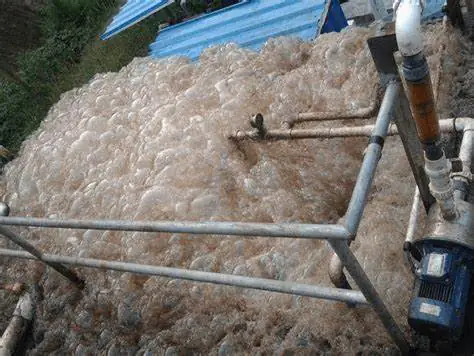
Why Foam Forms in Wastewater Treatment Systems
Foam in wastewater is not a single phenomenon — it’s several different problems that look similar on the surface but have distinct causes and respond to different interventions. Treating all foam the same way is why many facilities find themselves in a cycle of temporary suppression followed by recurrence.
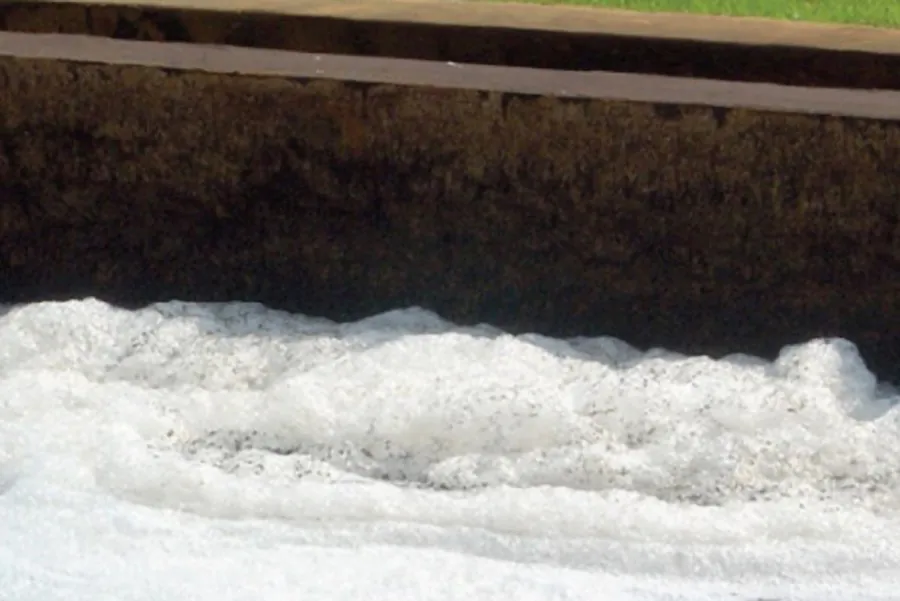
Surfactant-Driven Foam Surfactants from detergents, cleaning agents, personal care products, and industrial process chemicals are the most common cause of foam in municipal and mixed industrial-municipal systems. Surfactants reduce surface tension at the air-water interface and stabilize bubble films, preventing the natural coalescence and collapse that would eliminate foam without chemical assistance. Aeration basins and high-turbulence zones amplify the effect — the more agitation, the more foam a surfactant-laden stream produces. Surfactant foam is typically white, fine-bubbled, and persistent.
Biological Foam from Filamentous Organisms A distinct and often misdiagnosed foam type develops in biological treatment systems when filamentous bacteria — particularly Nocardia species and Microthrix parvicella — proliferate in the mixed liquor. These organisms produce hydrophobic cell surface compounds that stabilize foam in the aeration basin. Biological foam is typically dark brown or gray, viscous, and stable — it doesn’t collapse when prodded the way surfactant foam does. It also doesn’t respond well to defoamers because the foam structure is continuously regenerated by active organisms. Biological foam signals a process imbalance — long sludge retention time, low F/M ratio, or selective enrichment conditions — rather than a chemical contamination event.
Protein-Based Foam Food processing, fermentation, slaughterhouse, and dairy wastewater streams carry high protein loads that generate stable foam under aeration. Protein molecules orient at the air-water interface with hydrophilic groups facing water and hydrophobic groups facing the air, creating highly stable bubble films. Protein foam is typically white to cream-colored, dense, and collapses slowly. It responds well to defoamers but recurs quickly if the protein source in the influent isn’t addressed.
Mechanical and Hydraulic Foam Excessive aeration intensity, air leaks into pump suction lines, and high-velocity discharge from recirculation pumps can generate foam even in wastewater with low surfactant and protein content. This type of foam typically dissipates quickly when turbulence is reduced and responds poorly to defoamers because the problem is physical rather than chemical. Before adding any chemical treatment, check whether reducing aeration rate or fixing air entrainment in the hydraulic system eliminates the foam.
When foam persists in a system, the consequences extend beyond appearance. Level sensors misread foam depth as liquid level, triggering incorrect control responses. Foam overflowing from aeration basins or clarifiers carries solids into downstream units and creates housekeeping and odor problems. In membrane bioreactor systems, foam components can foul membrane surfaces and reduce flux. Persistent biological foam in sludge thickening systems reduces dewatering efficiency and increases polymer consumption.
How Defoamers Work: Three Mechanisms That Eliminate Foam
Defoamers don’t prevent foam from forming — they eliminate it after it forms by destabilizing the liquid films that hold bubble structures together. Understanding which mechanism a defoamer relies on helps explain why different product types suit different foam situations.
Surface Tension Reduction and Film Penetration Effective defoamers have surface tension significantly lower than the foam film they’re targeting — typically 20–25 mN/m compared to 40–60 mN/m for surfactant-stabilized foam films. When a defoamer droplet contacts a foam bubble surface, it spreads rapidly across the film, displacing the stabilizing surfactant molecules and creating zones of locally reduced surface tension. The resulting tension gradient pulls the foam film apart faster than it can reform.
Film Instability Through Pressure Imbalance As a defoamer spreads across a foam film, it creates mechanical instability by inducing localized thinning — the Marangoni effect drives liquid away from the defoamer contact point toward areas of higher surface tension. This thinning accelerates drainage of the liquid phase from the foam film until the film becomes too thin to maintain structural integrity and ruptures.
Bridging and Dewetting Hydrophobic particles in defoamer formulations — silica in silicone-based products, wax particles in mineral oil products — bridge across foam films by adsorbing simultaneously at both surfaces of a bubble wall. Once bridged, the particle draws both surfaces toward it, thinning the film to the point of collapse. This mechanism is particularly effective for thick, stable foam films that resist surface tension reduction alone.
All three mechanisms operate simultaneously in most commercial defoamer formulations. The speed and duration of defoaming effect depend on which mechanism dominates, which is why silicone-based defoamers (strong surface tension reduction) act faster but require more frequent dosing, while polyether-based products (sustained film destabilization) work more slowly but maintain effect longer with fewer applications.
Five Defoamer Types Used in Wastewater Treatment: Selection Guide
Silicone-Based Defoamers
Silicone defoamers — formulated from dimethylsilicone oil with hydrophobic silica and emulsifiers — are the industry standard for rapid foam knockdown in wastewater treatment. Their surface tension of 20–22 mN/m is lower than virtually any foam film they’ll encounter, allowing fast spreading and near-immediate foam collapse.
Best applications: Emergency foam control in aeration basins, clarifier overflow events, high-surfactant industrial influent, and any situation where speed of foam knockdown is the primary requirement.
Practical limitations: Silicone compounds are not readily biodegradable and can accumulate on membrane surfaces in MBR systems, causing flux decline over time. In biological treatment systems, consistent overdosing affects activated sludge structure and can reduce sludge settleability. Use at the minimum effective dose — typically 10–50 mg/L added directly to the foam zone — and avoid routine high-dose application in systems with downstream membrane processes.
Dosage range: 10–100 mg/L depending on foam severity; lower doses for maintenance, higher doses for acute knockdown.
Polyether-Based and Polyether Ester Defoamers
Polyether defoamers act through sustained film destabilization rather than immediate surface tension reduction. They’re slower to act than silicone products — foam knockdown takes 2–5 minutes rather than seconds — but maintain suppression significantly longer per dose and are far more compatible with biological treatment processes.
Best applications: Biological treatment systems (activated sludge, MBR, SBR), systems requiring long-term foam suppression without continuous dosing, and processes sensitive to silicone interference with downstream membrane or coating operations.
Key advantage: Minimal impact on microbial communities at operating doses. Polyether defoamers are metabolized by microorganisms over time and don’t accumulate in the biological system the way silicone compounds can. This makes them the preferred choice for facilities where defoamer application is frequent rather than occasional.
Dosage range: 20–150 mg/L; effect duration significantly longer per dose than silicone products.
| Defoamer Type | Knockdown Speed | Duration of Effect | Biological System Compatibility | Membrane Risk |
|---|---|---|---|---|
| Silicone-based | Very fast (< 1 min) | Short (30–90 min) | Moderate — limit dose | High at elevated dose |
| Polyether-based | Moderate (2–5 min) | Long (2–6 hours) | High — preferred choice | Low |
| Silicone-polyether hybrid | Fast (< 2 min) | Medium-long (2–4 hours) | Moderate | Low-moderate |
| Mineral oil-based | Fast (1–3 min) | Short-medium | Low — avoid in biological systems | Moderate |
| High-carbon alcohol | Moderate (2–5 min) | Medium (1–3 hours) | Moderate | Low |
Silicone-Polyether Hybrid Defoamers
Hybrid formulations combine the fast-acting surface tension reduction of silicone with the sustained suppression and biological compatibility of polyether chemistry. They offer a practical compromise for facilities that need faster knockdown than polyether alone provides but want better biological compatibility than pure silicone products deliver.
Best applications: Complex industrial wastewater with high surfactant loads, systems with variable foam intensity requiring both emergency and maintenance control, and high-temperature treatment processes where standard silicone emulsions may break and lose effectiveness.
Mineral Oil-Based Defoamers
Mineral oil defoamers work through film bridging and dewetting — hydrophobic oil droplets contact foam films and destabilize them through interfacial spreading. They’re effective but water-insoluble, which limits distribution through aqueous treatment systems and makes them better suited to non-aqueous industrial applications than wastewater treatment.
Best applications: Oil-based industrial process streams, cutting fluid treatment, paint and ink wastewater. Limited utility in biological wastewater treatment — oil accumulation in activated sludge degrades biological performance and sludge settleability over time.
High-Carbon Alcohol Defoamers
Long-chain alcohols (C8–C18) are effective against stubborn, high-stability foam in systems where standard defoamers lose effectiveness. Their strong hydrophobicity and low residue profile make them suitable for food-grade adjacent applications and high-temperature processes where thermal stability is required.
Best applications: Paper mill effluent with high lignin-derived surfactant load, fermentation wastewater, high-temperature industrial effluent treatment, and systems where foam residue on product contact surfaces is a concern.
Defoamer Selection Decision Framework
Selecting the wrong defoamer type wastes chemical spend and can make foam problems worse by interfering with biological treatment or membrane performance. We use a three-question framework to narrow selection quickly:
1. What type of foam is it? Fine white foam → surfactant or protein source; brown/gray viscous foam → biological (filamentous); rapid-forming foam from aeration → possibly mechanical. Biological foam requires process correction first — defoamers alone won’t solve a Nocardia or Microthrix problem.
2. Where in the treatment process is the foam occurring? Aeration basin or biological reactor → polyether or hybrid (biological compatibility priority); clarifier or equalization → silicone acceptable; MBR system → polyether only (membrane compatibility essential); industrial process tank → mineral oil or alcohol grades may be appropriate.
3. Is control needed urgently or continuously? Emergency knockdown → silicone-based for fastest response; ongoing maintenance control → polyether for sustained effect with fewer applications; both needed → silicone-polyether hybrid.
FAQ
Q: How do I dose defoamer correctly in an aeration basin without overdosing?
A: Start at 10–20 mg/L added directly to the foam zone, not the basin inlet. Observe for 5 minutes before adding more. Overdosing is common because operators add product before the first dose has had time to act. For ongoing control, establish a baseline dose through trial and adjust based on foam recurrence interval rather than continuous dosing.
Q: What is the difference between a defoamer and an antifoam, and which should I use in wastewater treatment?
A: Defoamers eliminate existing foam; antifoams prevent foam from forming when added before aeration or agitation begins. In wastewater treatment, defoamers are more practical because influent quality and foam trigger conditions change continuously — preventive antifoam dosing is difficult to time correctly. Use defoamers reactively for most wastewater applications; antifoam pre-dosing makes more sense in batch processes with predictable foam timing.
Q: Can defoamer use affect activated sludge performance or effluent quality?
A: Yes, at excessive doses. Silicone-based defoamers at high concentrations reduce surface tension in the aeration basin enough to affect oxygen transfer efficiency and alter sludge floc structure. Mineral oil-based products accumulate in sludge and interfere with biological activity. Polyether products at normal operating doses have minimal biological impact. Always use the minimum effective dose and switch to polyether or hybrid products if defoamer application frequency is high.
Fix the Root Cause — Use Defoamers to Buy Time While You Do
Defoamers are an essential operational tool, but they’re a management strategy for foam, not a solution to it. Every foam problem has a root cause — surfactant loading, biological imbalance, protein-rich influent, or mechanical air entrainment — and defoamer application that isn’t paired with root cause investigation leads to escalating chemical spend without permanent resolution. Our approach is always to identify the foam type and source first, use the appropriate defoamer to stabilize operations in the short term, and then address the upstream process or operational factor driving foam generation.
If your facility is dealing with persistent foam and the cause isn’t clear, our technical team can review your process data and recommend both the right defoamer product and the process adjustments most likely to reduce foam recurrence. Contact us for a consultation or product recommendation.