
Sludge disposal is one of the largest and fastest-growing operating costs in petrochemical and refinery operations. Oily sludge from tank cleaning, API separators, dissolved air flotation units, and biological treatment systems must be collected, dewatered, transported, and disposed of — each step carrying significant cost and environmental liability.
The economics are straightforward: wetter sludge costs more to dispose of. Every percentage point reduction in cake moisture content directly reduces the volume sent for disposal, lowering transport cost, landfill fees, and incineration charges simultaneously.
Polyacrylamide is the primary conditioning chemical used to improve petrochemical sludge dewatering. When the right cationic grade is correctly applied before mechanical dewatering, it significantly improves cake solids content, increases press throughput, and reduces overall sludge disposal volume — delivering measurable cost savings that typically far exceed the cost of the polymer program itself.
Why Petrochemical Sludge Is Difficult to Dewater
Petrochemical and refinery sludge presents dewatering challenges that most other industrial sludges do not.
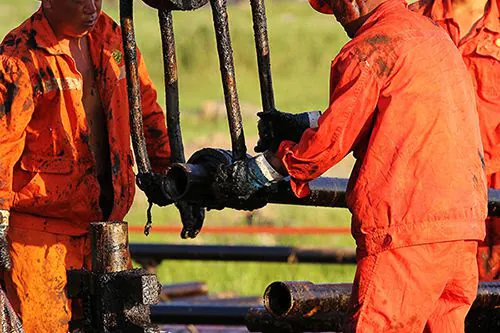
The primary difficulty is oil content. Oily sludge from API separators, tank bottoms, and DAF units contains free oil, emulsified oil, and oil bound to solid particles. Emulsified oil creates stable colloidal structures that resist both mechanical separation and polymer conditioning. Before effective dewatering can occur, the oil-water-solid matrix must be destabilized.
Additional challenges include:
- High organic content from biological treatment sludge mixed with oily process sludge
- Variable composition as sludge from different process areas combines in the collection system
- Fine particle size of biological and catalyst solids that require high polymer doses for adequate flocculation
- High specific resistance to filtration — a measure of how difficult the sludge is to dewater mechanically — that limits press throughput regardless of conditioning quality
These combined factors mean that petrochemical sludge typically requires higher cationic PAM doses than municipal or standard industrial sludge, and that pre-treatment — demulsification, thermal conditioning, or oxidation — is sometimes required before polymer conditioning is effective.
How PAM Improves Petrochemical Sludge Dewatering
Cationic PAM improves petrochemical sludge dewatering through charge neutralization and polymer bridging of negatively charged organic and inorganic particles in the sludge matrix.
When correctly dosed and mixed with sludge before entering a centrifuge, belt press, or filter press, PAM:
- Neutralizes the surface charge on fine organic and biological particles, allowing them to aggregate
- Bridges aggregated particles into larger, denser floc structures with better drainage characteristics
- Reduces the compressibility of the sludge cake, maintaining filtration channels under mechanical pressure
- Improves solids capture efficiency in centrifuges, reducing polymer-conditioned solids in the centrate
Typical performance improvements with optimized PAM conditioning:
| Parameter | Without PAM | With Optimized PAM |
|---|---|---|
| Filter press cake moisture | 65–75% | 45–58% |
| Centrifuge cake moisture | 70–80% | 55–65% |
| Centrifuge solids capture | 85–92% | 94–98% |
| Belt press throughput | Baseline | 15–25% improvement |
| Sludge disposal volume | Baseline | 20–35% reduction |
These improvements translate directly into lower disposal costs — the primary financial driver for PAM optimization in petrochemical sludge treatment.
Selecting the Right Cationic PAM Grade
Not all cationic PAM grades perform equally on petrochemical sludge. Grade selection depends on the specific sludge composition and the mechanical dewatering equipment being used.
For centrifuge dewatering: High charge density cationic PAM (50–80% charge density) at medium to high molecular weight (10–15 million Daltons) typically performs best. The high charge density provides rapid, strong binding to the negatively charged organic solids that dominate biological and oily sludge. Emulsion form is often preferred for centrifuge applications due to faster dispersion kinetics before the centrifuge applies separation force.
For filter press dewatering: Medium charge density (30–60%) at higher molecular weight (12–18 million Daltons) usually produces better cake structure for filter press applications. The longer chains improve filtration channel formation in the cake, maintaining drainage pathways under press pressure.
For belt press dewatering: Medium charge density (30–50%) at high molecular weight produces the open floc structure needed for gravity drainage in the belt press gravity zone before roller compression.
For oily sludge with high emulsified oil content: A demulsifier or coagulant pre-treatment step before PAM conditioning is often required to break oil-water emulsions and expose the solid surfaces that PAM needs to adsorb onto. Without pre-treatment, PAM may condition the emulsified oil droplets rather than the solid particles, producing poor dewatering results despite high polymer doses.
For broader guidance on PAM grade selection across applications, see: Choosing the Right PAM Grade for Your Industry
The Cost Case for PAM Optimization
The financial return from optimizing petrochemical sludge dewatering with PAM is typically larger and faster than operators expect.
Consider a refinery generating 50 tonnes of wet sludge per day at 70% moisture content — equivalent to approximately 15 tonnes of dry solids. Disposal cost at $80 per tonne of wet sludge is $4,000 per day, or approximately $1.46 million per year.
Optimizing PAM conditioning to reduce cake moisture from 70% to 55% reduces wet sludge volume from 50 tonnes to approximately 33 tonnes per day — a reduction of 34%. At the same disposal rate, annual disposal cost falls to approximately $960,000 — a saving of $500,000 per year.
The polymer program cost to achieve this improvement is typically $50,000–$150,000 per year depending on sludge volume and PAM grade requirements — delivering a net annual saving of $350,000–$450,000 from polymer cost alone, before accounting for reduced transport and handling costs.
Contact our technical team today to calculate the potential disposal cost savings for your specific sludge volumes and dewatering equipment. → Contact our technical team today
Optimizing PAM Dosage for Petrochemical Sludge
Dosage optimization for sludge dewatering follows a different approach than clarifier applications. The target is not effluent clarity but cake solids content and press performance.
Key optimization parameters:
- Dose on a dry solids basis: Express dosage as kg PAM per tonne of dry solids, not as mg/L of sludge volume. This normalizes for variable sludge concentration and makes dosage adjustment more systematic.
- Test cake moisture, not just visual floc quality: Good visual conditioning in the mix tank does not always translate to good dewatering. Always measure cake moisture as the primary performance metric.
- Optimize contact time: Allow adequate mixing between PAM addition and mechanical dewatering entry — typically 30–90 seconds depending on equipment. Too little contact time reduces conditioning quality; too much can shear formed flocs.
- Match dosage to sludge feed concentration: Sludge concentration varies throughout the day as different process areas contribute to the collection system. Dosage should track sludge feed concentration rather than remaining fixed.
For detailed guidance on sludge dewatering optimization, see: Optimizing Sludge Dewatering with Cationic PAM
Frequently Asked Questions
Why is my PAM dose for petrochemical sludge much higher than recommended ranges for municipal sludge?
Petrochemical sludge typically has higher organic content, more complex particle surface chemistry, and higher oil content than municipal biological sludge — all of which increase polymer demand. Oily sludge in particular requires higher doses because some polymer is consumed conditioning oil droplets rather than solid particles. If doses are extremely high without achieving target cake moisture, demulsification pre-treatment may be needed before PAM conditioning.
Should I use powder or emulsion PAM for centrifuge dewatering?
Emulsion PAM is often preferred for high-speed centrifuge applications because its faster dispersion provides better polymer-sludge contact before the centrifuge applies separation force. However, for large-volume applications where cost is the priority, powder PAM with adequate dissolution time can achieve comparable performance. Trial both forms through your specific centrifuge before making a long-term decision.
Can PAM reduce the hazardous waste classification of petrochemical sludge?
PAM conditioning affects moisture content and physical characteristics but does not change the chemical composition of petrochemical sludge. Hazardous waste classification is determined by the chemical contaminants present — heavy metals, hydrocarbons, specific organics — not by moisture content or physical form. However, drier cake produced by better PAM conditioning may reduce disposal costs even within the hazardous waste classification by reducing total weight sent for treatment or incineration.
Conclusion
Petrochemical sludge disposal is a significant and controllable cost. The moisture content of dewatered sludge cake directly determines disposal volume — and cationic PAM conditioning is the most cost-effective tool available to reduce that moisture content.
The key to maximizing returns from a petrochemical sludge PAM program is grade selection matched to your specific sludge composition and dewatering equipment, dosage expressed and optimized on a dry solids basis, and pre-treatment of oily sludge where high emulsified oil content limits PAM effectiveness.
Facilities that invest in proper PAM optimization consistently achieve 20–35% reductions in sludge disposal volume — delivering annual savings that typically return the polymer program investment many times over.
Ready to reduce your sludge disposal costs? Contact our technical team today for a free dewatering assessment and cationic PAM grade recommendation. → Get in touch today