 Skip to content
High-salinity wastewater presents one of the most common — and most frequently misdiagnosed — polymer treatment challenges in industrial operations. Facilities treating produced water from oilfields, mining operations using saline groundwater, coastal industrial facilities, desalination concentrate management systems, and food processing operations using brine all encounter the same problem: anionic PAM that performs reliably in freshwater conditions fails progressively as dissolved salt concentration increases.
The failure is not obvious at first. Performance declines gradually as salinity builds in recycled water systems or as seasonal groundwater salinity increases. Operators respond by increasing dosage. Performance improves slightly, then declines again. Dosage creeps upward. Eventually the treatment system is consuming significantly more polymer than it did previously, with worse results — and no one has identified the root cause.
Understanding why salinity affects PAM performance, which grades are resistant to this effect, and how to optimize treatment for high-salinity conditions resolves this problem systematically rather than through endless dosage escalation.
Why Salinity Reduces Anionic PAM Performance
The mechanism is rooted in polymer physics. Anionic PAM chains carry negative charge groups — carboxylate groups distributed along the polymer backbone. In freshwater, the mutual repulsion between these negative charges causes the chain to extend outward into solution, maximizing its length and bridging reach.
In saline water, dissolved cations — sodium, calcium, magnesium — surround and partially screen the negative charge groups on the polymer chain. This electrostatic screening reduces the repulsion between charge groups, allowing the chain to coil and contract rather than extend. The result is a shorter, less extended chain with dramatically reduced bridging reach.
The practical consequence: A high-MW anionic PAM grade that extends to 15–20 µm chain length in freshwater may contract to 5–8 µm in water with 5,000 mg/L total dissolved solids. This 60–70% reduction in effective chain length translates directly into reduced floc size, slower settling, and higher required dosage — all without any change in the product itself.
The TDS threshold: Performance decline begins to be measurable above approximately 1,000–2,000 mg/L TDS. The decline accelerates significantly above 3,000–5,000 mg/L TDS. Above 10,000 mg/L TDS — common in produced water and some mining operations — anionic PAM performance may be so severely compromised that treatment with standard anionic grades is essentially ineffective regardless of dosage.
Which Industries Face High-Salinity Treatment Challenges
Oilfield produced water: Formation water co-produced with oil and gas typically contains 10,000–300,000 mg/L TDS — far above the threshold where anionic PAM fails completely. Produced water treatment is one of the most demanding high-salinity applications globally.
Mining operations in arid regions: Many mining operations in Australia, the Middle East, Central Asia, and parts of Africa rely on saline groundwater sources. Process water salinity accumulates in closed-loop recycling systems, progressively reducing anionic PAM effectiveness over time.
Desalination concentrate management: Reverse osmosis concentrate from seawater desalination contains 50,000–70,000 mg/L TDS — extremely hostile conditions for ionic PAM.
Coastal industrial facilities: Facilities using seawater for cooling or process water introduce saline streams into treatment systems. Even partial seawater contamination can raise TDS above the anionic PAM performance threshold.
Food processing with brine: Pickle processing, fish processing, and cured meat production generate high-sodium brine wastewater that severely impacts anionic PAM performance.
Textile dyeing with high salt content: Some dyeing processes use large quantities of sodium chloride — creating high-TDS effluent streams that challenge standard anionic PAM programs.
PAM Grade Selection for High-Salinity Conditions
Nonionic PAM — The Primary Solution
Nonionic PAM carries no ionic charge groups. Its flocculation mechanism relies entirely on physical adsorption and polymer bridging — not charge-assisted adsorption. Because there are no charge groups to be screened by dissolved salts, nonionic PAM maintains consistent chain extension and bridging performance regardless of solution ionic strength.
Performance characteristics:
- Maintains full chain extension at TDS levels above 50,000 mg/L where anionic grades have essentially failed
- Consistent flocculation performance across wide salinity ranges — suitable for facilities where salinity varies seasonally or as recycled water TDS accumulates
- Effective across extreme pH ranges (pH 2–12) — an additional advantage in some industrial applications
- Generally requires higher dosage than anionic PAM in freshwater conditions — the absence of charge-assisted adsorption reduces adsorption efficiency on most particle surfaces
Recommended for: TDS above 3,000–5,000 mg/L, oilfield produced water, desalination concentrate, consistently saline process water systems.
Typical specifications for high-salinity applications:
- Molecular weight: 12–20 million Daltons (higher MW compensates for reduced adsorption efficiency)
- Form: Both powder and emulsion available — emulsion often preferred for high-salinity applications where rapid dispersion is needed
For a complete guide to nonionic PAM applications, see: When to Use Nonionic PAM: Applications and Benefits
Low Charge Density Anionic PAM — For Moderate Salinity
In the moderate salinity range (1,000–5,000 mg/L TDS), low charge density anionic PAM (below 15% charge density) performs better than medium or high charge density grades. Lower charge density means fewer charge groups to be screened by dissolved salts — preserving more chain extension than higher charge density grades at the same ionic strength.
This is a pragmatic intermediate solution for facilities where salinity is a concern but full nonionic grade performance is not yet required. Below 3,000 mg/L TDS, low charge density anionic grades often provide adequate performance at lower cost than nonionic grades.
Cationic PAM — Generally Unaffected by Salinity
Cationic PAM performance is significantly less affected by dissolved salts than anionic grades — the positive charge groups on cationic polymer are less subject to electrostatic screening by the predominantly cationic dissolved species in most saline waters.
For sludge dewatering applications where cationic PAM is already the standard choice, high-salinity conditions rarely require a grade change. The primary PAM selection challenge in high-salinity operations is for clarification and thickening applications where anionic grades are conventionally used.
Diagnosing Salinity as the Root Cause of Performance Problems
Before switching grades for a salinity-related performance problem, confirm that salinity is actually the cause rather than one of the other common treatment performance issues.
Diagnostic approach:
Step 1: Measure TDS of current influent or process water. If TDS is above 2,000 mg/L, salinity is a potential contributor to performance issues.
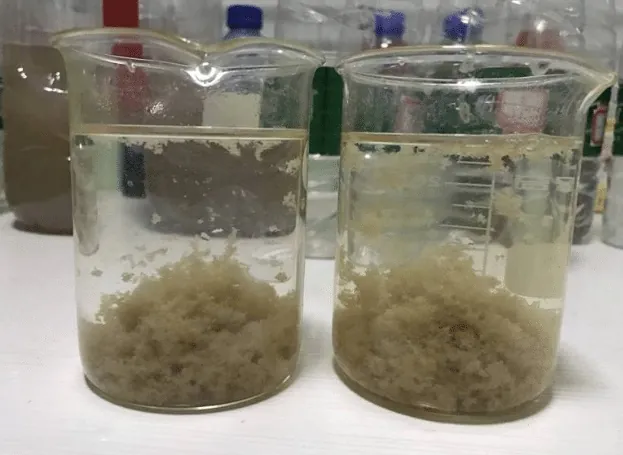
Step 2: Conduct a jar test with current anionic PAM on the actual process water and on the same water diluted 1:4 with fresh water. If performance is significantly better in diluted water, salinity is the primary performance limitation.
Step 3: Conduct a comparative jar test on undiluted process water with your current anionic grade alongside a nonionic grade at equivalent dosage. If nonionic significantly outperforms anionic on the actual process water, a grade switch is warranted.
Contact our technical team today for nonionic PAM grade recommendations and trial quantities for your high-salinity application. → Contact our technical team today
Optimizing Treatment for High-Salinity Conditions
Dosage Adjustment
Nonionic PAM typically requires 20–40% higher dosage than anionic PAM in freshwater applications to achieve equivalent flocculation performance. However, in high-salinity conditions where anionic PAM is severely compromised, nonionic may achieve better performance at lower dosage than the anionic grade at any dosage level.
Always optimize dosage through jar testing with actual process water at its current salinity — do not extrapolate from freshwater jar test results.
Coagulant Pre-Treatment
In very high-salinity conditions where particle surface charge is already partially suppressed by dissolved ions, coagulant pre-treatment provides less incremental benefit than in freshwater applications. The particle surfaces may already be partially destabilized by the high ionic environment — reducing the need for additional charge neutralization.
Test coagulant addition both with and without PAM in high-salinity conditions to confirm whether coagulant provides net performance improvement before committing to a combined program.
Managing TDS Accumulation in Recycling Systems
For facilities where salinity increases over time through water recycling, TDS monitoring is essential for proactive polymer program management. Establish TDS thresholds — typically 1,000, 3,000, and 5,000 mg/L — at which polymer program reviews are triggered and dosage or grade adjustments are made.
Implementing a controlled blowdown rate — replacing a defined fraction of recycled water with fresh water each cycle — maintains TDS below the threshold where anionic PAM performance degrades severely, potentially avoiding the need for a full grade switch to nonionic.
Frequently Asked Questions
At what TDS level should we switch from anionic to nonionic PAM?
The transition zone is typically 3,000–5,000 mg/L TDS, but this varies with the specific anionic grade’s charge density and the dominant cation species in solution. Calcium and magnesium ions suppress anionic PAM performance more severely than sodium at equivalent TDS. Conduct comparative jar testing at your actual process water TDS to confirm the crossover point — this is more reliable than a generic TDS threshold.
Can we mix nonionic and anionic PAM to manage the transition zone?
Yes. Blending nonionic and anionic grades can provide intermediate performance across the 2,000–5,000 mg/L TDS transition zone. A blend of 70% nonionic / 30% anionic often outperforms either grade alone in this range. However, blending adds operational complexity — both grades must be prepared and dosed separately, or a custom blend must be sourced. For most facilities, switching fully to nonionic above the transition threshold is simpler and more reliable.
Does high salinity affect cationic PAM used in sludge dewatering?
High-salinity biosolids or industrial sludge does affect cationic PAM behavior, but less dramatically than it affects anionic clarification grades. Cationic PAM charge groups interact less with the predominantly cationic dissolved species in saline water. Some reduction in performance may occur at very high TDS (above 20,000 mg/L), but for most sludge dewatering applications in industrial facilities, existing cationic grades remain effective across the salinity ranges typically encountered.
Conclusion
High-salinity wastewater is a specific and well-understood treatment challenge. Anionic PAM — the standard grade for most clarification and thickening applications — loses effectiveness progressively as dissolved salt concentration increases, through a mechanism of charge group screening that reduces chain extension and bridging reach.
The solution is straightforward in principle: switch to nonionic PAM, which maintains consistent performance regardless of ionic strength. The practical details — at what TDS threshold to switch, which molecular weight and form to use, and how to optimize dosage in saline conditions — require application-specific jar testing to confirm.
Facilities that identify salinity as the root cause of their polymer performance problems, and respond with the correct grade switch rather than continued dosage escalation, typically achieve significant cost savings alongside better treatment performance.
Contact us today to request nonionic PAM samples, application guidance, and a free salinity impact assessment for your process water. → Get in touch today


