 Skip to content
Written by the HyChron Technical Team — water treatment specialists with over 15 years of field experience in municipal and industrial systems. Last reviewed: April 2026
Groundwater is often perceived as cleaner and simpler to treat than surface water — and for many contaminants, that is true. But groundwater presents its own set of treatment challenges that are increasingly subject to regulatory scrutiny: dissolved iron and manganese, arsenic, hardness, hydrogen sulfide, and in some regions, elevated turbidity from karst aquifers or fractured rock systems.
As groundwater quality standards tighten globally — particularly for iron, manganese, and arsenic — treatment plants that previously operated with minimal chemical intervention are finding that coagulation with PAC is an efficient and cost-effective pathway to compliance.
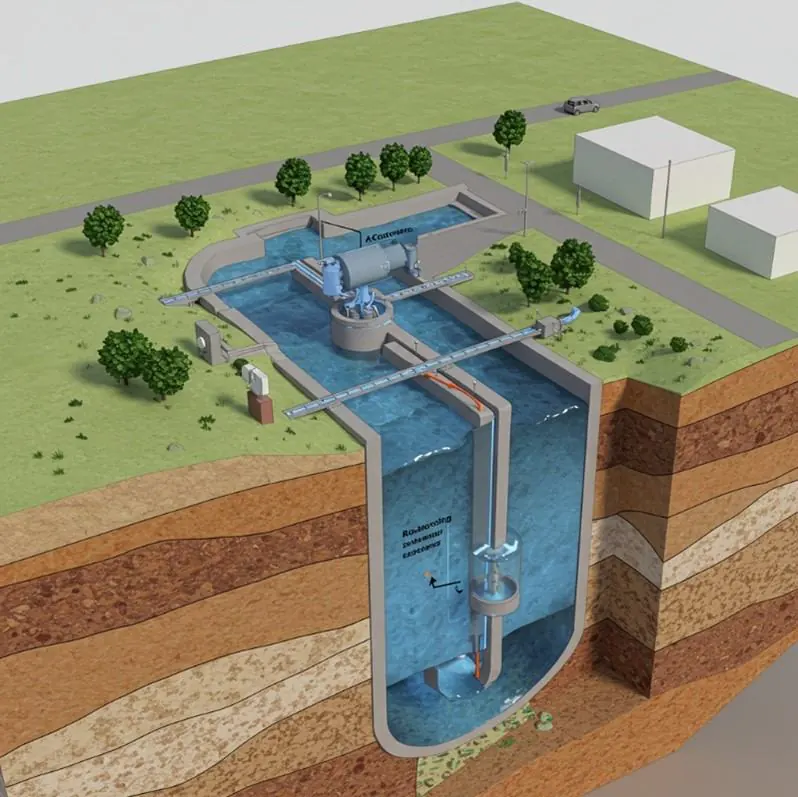
The Groundwater Treatment Regulatory Context
Groundwater quality standards are converging toward surface water treatment levels in many jurisdictions:
- Iron: WHO guideline 0.3 mg/L; many countries enforce 0.2 mg/L
- Manganese: WHO guideline 0.1 mg/L; tightening to 0.05 mg/L in updated standards
- Arsenic: WHO guideline 10 µg/L; enforced at this level in most developed markets
- Turbidity: Same standards as surface water in most frameworks — ≤ 1 NTU in finished water
- Aluminum (residual): Same as surface water — ≤ 0.2 mg/L (WHO)
PAC is directly relevant to iron, manganese, turbidity, and arsenic removal — the four parameters most commonly cited in groundwater compliance challenges.
How PAC Addresses Groundwater Contaminants
Iron Removal
Dissolved ferrous iron (Fe²⁺) in groundwater must be oxidized to ferric iron (Fe³⁺) before coagulation can remove it. Aeration or oxidant addition (chlorine, potassium permanganate) converts Fe²⁺ to Fe³⁺, which precipitates as Fe(OH)₃.
PAC’s role: coagulate the fine Fe(OH)₃ precipitate particles that oxidation produces. Without coagulation, these fine precipitates pass through filtration, leaving iron in the effluent. With PAC, they aggregate into settleable flocs that are effectively removed by sedimentation and filtration.
Sequence: Aeration/oxidation → PAC dosing → Flash mixing → Flocculation → Sedimentation → Filtration
Manganese Removal
Dissolved manganese requires oxidation to MnO₂ before physical removal. Oxidation is typically achieved by chlorination (at pH above 7.5), potassium permanganate, or ozone.
PAC coagulates fine MnO₂ precipitate particles, improving their removal in subsequent sedimentation and filtration. For groundwater with elevated manganese (above 0.5 mg/L), combined oxidation + PAC coagulation typically achieves manganese below 0.05 mg/L in filtered water.
Turbidity in Karst/Fractured Aquifers
Groundwater from karst limestone or fractured rock formations can carry significant turbidity — clay particles, fine minerals, and organic matter from infiltration — particularly after rainfall events. PAC coagulation is the standard treatment for this turbidity, using the same mechanisms as surface water turbidity removal.
Arsenic Co-Precipitation
Arsenic in groundwater exists as arsenate (As⁵⁺) or arsenite (As³⁺). Arsenate co-precipitates with aluminum hydroxide during PAC coagulation — aluminum arsenate and arsenic adsorption onto aluminum hydroxide floc surfaces achieve significant arsenic removal.
Arsenite must first be oxidized to arsenate (by chlorination or aeration) before PAC coagulation is effective. With proper oxidation pre-treatment, PAC coagulation-flocculation-filtration can achieve arsenic below 10 µg/L in most applications.

Step-by-Step Operational Guide for Groundwater PAC Treatment
Step 1 — Groundwater Characterization
Before designing a PAC treatment program, measure:
- Iron (total and ferrous)
- Manganese (total)
- Arsenic (speciation if possible — As³⁺ vs As⁵⁺)
- Turbidity
- pH (groundwater is typically pH 6.5–8.5)
- Hardness and alkalinity (affect flocculation chemistry)
- Hydrogen sulfide (if present, requires oxidation before PAC)
Step 2 — Pre-Oxidation Design
Select the appropriate oxidant based on target contaminants:
- Iron only: Aeration is usually sufficient
- Iron + Manganese: Chlorination at pH > 7.5, or potassium permanganate
- Arsenic: Chlorination to convert As³⁺ to As⁵⁺ (if As³⁺ is the dominant species)
- H₂S: Aeration or chlorination to oxidize sulfide before PAC dosing
Step 3 — PAC Dosage for Groundwater
| Groundwater Application | Typical PAC Dose |
|---|---|
| Iron removal (< 5 mg/L Fe) | 5–20 mg/L |
| Iron removal (> 5 mg/L Fe) | 15–40 mg/L |
| Manganese removal | 5–15 mg/L (in addition to iron dose if present) |
| Arsenic co-precipitation | 10–30 mg/L |
| Karst turbidity | 10–30 mg/L |
pH adjustment to 6.5–7.5 before PAC dosing improves performance for all groundwater applications. Always confirm dose by jar test.
Step 4 — Treatment Train for Groundwater
Groundwater source → Pre-oxidation → pH adjustment (if needed) → PAC dosing → Flash mixing → Flocculation → Sedimentation → Filtration → Disinfection → Distribution
For low-turbidity groundwater with only iron removal needed, direct filtration (without sedimentation) is often sufficient: Oxidation → PAC dosing → Flash mixing → Short flocculation → Direct filtration
Step 5 — Regulatory Compliance Verification
Monitor finished water for: iron (target < 0.2 mg/L), manganese (target < 0.05 mg/L), arsenic (target < 10 µg/L), turbidity (target < 0.3 NTU), and residual aluminum (target < 0.2 mg/L).
Applicable standards: WHO Guidelines for Drinking-water Quality (4th Ed.); local national standards for iron, manganese, and arsenic.
Frequently Asked Questions
Does PAC work for iron removal without prior oxidation?
No. Dissolved ferrous iron (Fe²⁺) does not coagulate efficiently with PAC — it must be oxidized to ferric iron (Fe³⁺) first. Attempting to coagulate unoxidized Fe²⁺ wastes PAC and produces poor iron removal. Ensure adequate oxidation contact time before the PAC dosing point.
Can PAC achieve arsenic below 10 µg/L without additional treatment?
In many groundwater applications, PAC coagulation-flocculation-filtration achieves arsenic below 10 µg/L — particularly when arsenate (As⁵⁺) is the dominant species and PAC dose is optimized. For water with predominantly arsenite (As³⁺) or very high arsenic concentrations (above 100 µg/L), pre-oxidation before PAC dosing is essential. Jar testing with your specific groundwater confirms achievable arsenic levels.
Is groundwater PAC dosage stable, or does it need frequent adjustment?
Groundwater quality is typically much more stable than surface water — composition changes slowly (over weeks to months) rather than hourly. PAC dosage for groundwater treatment can usually be set seasonally rather than adjusted daily. The exception is karst aquifers and fractured rock systems, where rainfall events can cause sudden turbidity spikes that require dose adjustment.
Conclusion
PAC is an effective and increasingly important tool for groundwater treatment as regulatory requirements for iron, manganese, arsenic, and turbidity tighten globally. Its ability to coagulate fine metal hydroxide precipitates, co-precipitate arsenate, and remove karst turbidity — across the stable pH conditions that characterize most groundwater — makes it a practical and cost-effective compliance solution for groundwater utilities.
Combined with appropriate pre-oxidation, PAC coagulation-filtration achieves finished water quality that meets WHO and national drinking water standards for iron, manganese, arsenic, and turbidity in most groundwater applications.
Contact our technical team today for a free groundwater treatment assessment, PAC product samples, and a dosage recommendation for your specific groundwater chemistry. We respond within 24 hours.


