
Poor filter press performance is one of the most common operational complaints we hear from wastewater treatment facilities — and in most cases, the root cause isn’t the equipment itself. It’s a combination of mismatched flocculant selection, inconsistent sludge conditioning, and deferred maintenance that compound over time. This guide walks through the real causes of underperforming filter presses and the specific adjustments that restore dewatering efficiency without major capital investment.
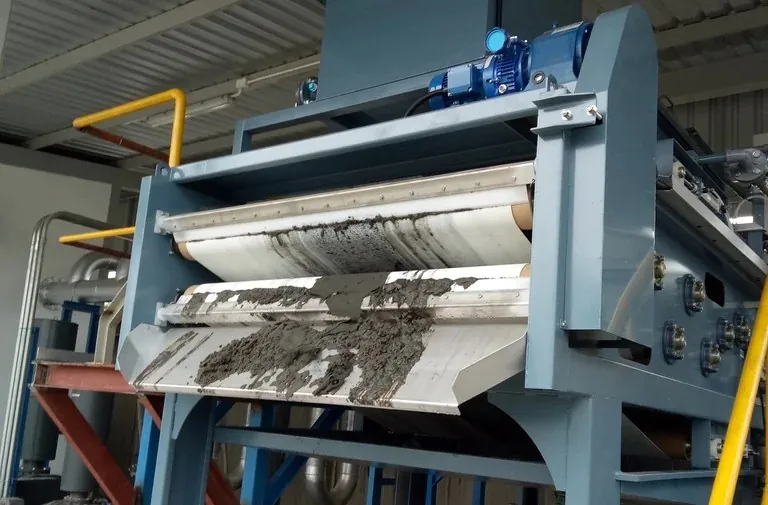
Choosing the Right Filter Press for Your Sludge Type
Before troubleshooting performance, it’s worth confirming that the press type matches the sludge being processed. We regularly encounter facilities running the wrong equipment for their sludge characteristics — and no amount of chemical optimization fully compensates for a fundamental equipment mismatch.
| Filter Press Type | Best Suited For | Typical Feed TSS | Achievable Cake Moisture |
|---|---|---|---|
| Belt Filter Press | Municipal biosolids, mining, sand washing | 2–4% | 75–85% |
| Plate and Frame Press | Chemical and industrial sludge | 3–8% | 65–80% |
| Screw Press (Volute) | Organic sludge, food industry, oily waste | 1–4% | 75–85% |
| Centrifuge | High-water-content organic sludge | 1–5% | 75–82% |
| Ceramic Filter Press | High-solid mineral sludge, mining tailings | 20–50% | 12–20% |
If your press type matches your sludge but performance is still poor, the problem almost certainly sits in one of the four areas below.
Why Filter Presses Fail to Dewater Sludge Properly
In our experience, underperforming filter presses trace back to four root cause categories. Identifying which one — or which combination — is driving the problem determines the fastest path to resolution.
Equipment Condition Issues
Low pressing pressure is the most common mechanical cause of wet filter cake. Plate-and-frame presses require 10–16 bar during the compression phase to achieve target cake moisture. If hydraulic pressure has dropped below 8 bar, cake moisture increases by 5–10 percentage points regardless of how well the sludge is conditioned. Check hydraulic pump output and seal integrity before adjusting any chemical parameters.
Filter cloth condition is the second mechanical factor we check. Blinded or partially blocked cloth reduces drainage flux dramatically — a cloth running at 50% permeability requires roughly double the cycle time to reach equivalent cake dryness, and still won’t fully recover performance. Inspect cloth under backlight monthly; replace when visible blinding covers more than 15–20% of cloth area. For belt filter presses, clean cloth continuously with high-pressure wash water at 3–5 bar — insufficient wash pressure is a common overlooked cause of gradual performance decline.
Filter plate condition also matters more than operators often realize. Cracked or warped plates allow bypass flow, reducing effective press area and causing wet zones in the cake. A visual plate inspection at every major maintenance interval — typically every 500–1,000 operating hours — catches problems before they significantly affect output.
Sludge Property Problems
Feed sludge outside the optimal TSS range is a frequent and underappreciated cause of poor press performance. Sludge below 1.5% TSS carries too much free water into the press, overwhelming the cloth drainage capacity and producing wet, thin cake. Sludge above 6–8% TSS is often too viscous for PAM to distribute evenly before pressing begins, resulting in poorly conditioned floc and uneven cake formation.
Aged sludge — characterized by dark color, fast SV30 settling, and reduced microbial activity — dewaters significantly worse than fresh sludge. The extracellular polymer matrix in aged floc holds water more tenaciously and resists compression. If you’re processing aged sludge, PAM dosage typically needs to increase by 20–40% above normal rates, and even then cake moisture targets may be difficult to achieve until sludge age is corrected at the biological treatment stage.
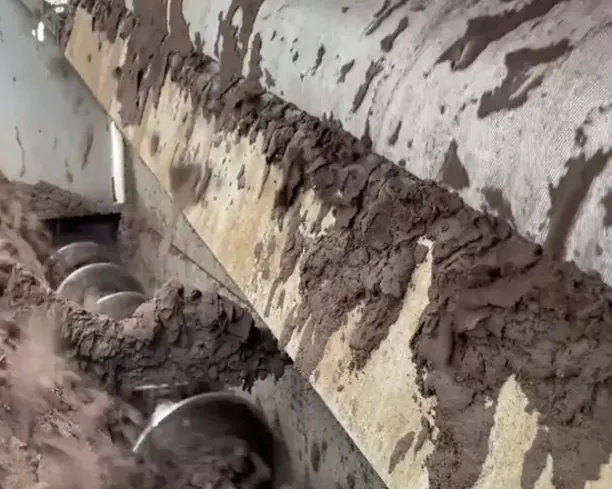
High organic content sludge — food processing waste, oily sludge, pharmaceutical effluent — is inherently more compressible and sticky than inorganic sludge. These sludges compress under press pressure and seal drainage channels within the cake. Filter aids such as diatomite at 50–150 g/kg dry solids improve internal cake structure and drainage for compressible organic sludge that doesn’t respond adequately to PAM alone.
Flocculant Selection and Dosing Errors
This is where we find the most correctable problems. Wrong ionic type, incorrect molecular weight, poor dissolution, and dosing outside the optimal range each degrade floc quality in different ways — and the symptoms often look similar from the outside.
Wrong ionic type: Applying anionic PAM to positively charged industrial sludge, or cationic PAM to a sludge where nonionic would perform better, produces weak, shear-sensitive flocs that break apart under press pressure. The filtrate runs turbid and cake moisture stays high regardless of dosage adjustments. A 30-minute jar test resolves ionic type selection definitively — it’s always worth doing before scaling up a new PAM grade.
Underdosing: Insufficient PAM leaves a significant proportion of fine particles unflocculated. These fines migrate into the filter cloth, cause progressive blinding, and appear in the filtrate as turbidity. For most municipal and industrial sludge on plate presses, effective dosage falls between 2–6 kg PAM per tonne of dry solids. Start at the midpoint and adjust in 0.5 kg/t increments based on cake moisture and filtrate clarity.
Overdosing: This is counterintuitive but well-documented. Excess PAM — particularly cationic grades — can restabilize particle surfaces through charge reversal, producing a gel-like, sticky mass rather than discrete filterable floc. Overdosed sludge is recognizable by unusually viscous behavior in the conditioning tank and rapid cloth blinding. If dosage increases beyond a certain point make performance worse rather than better, overdosing is the likely explanation. Reduce dose by 30% and reassess.
Poor dissolution: Undissolved PAM gel particles reduce effective polymer concentration in solution and physically block spray nozzles and dosing ports. Always dissolve PAM powder at 0.1–0.3% concentration in clean water and allow 40–60 minutes of maturation time before use. Using water above 60°C accelerates dissolution but degrades polymer chain integrity — keep dissolution water between 20–40°C.
Environmental and Process Factors
pH significantly affects PAM performance. Most PAM grades deliver optimal flocculation between pH 6.5–8.5. Outside this range, amide group hydrolysis changes polymer charge character and floc structure weakens. If your feed sludge pH is outside this window, correct it before the conditioning stage — pH adjustment at the filter press inlet is more effective than downstream correction.
Low temperature is a winter operational challenge that many facilities don’t account for proactively. At 5–10°C, PAM dissolution rate slows by 40–60% compared to 20°C, and solution viscosity increases, reducing effective mixing and polymer distribution through the sludge. Two practical solutions: prepare PAM solution with water pre-heated to 30–40°C, or switch to emulsion PAM grades which dissolve significantly faster than powder at low temperatures.
Circulating water chemistry matters in closed-loop systems. High ionic strength from accumulated salts, residual coagulants, or process chemicals in return water can interfere with PAM flocculation by competing for adsorption sites on particle surfaces. If performance gradually declines over a season without obvious equipment or chemical changes, test circulating water conductivity — values above 2,000–3,000 µS/cm often correlate with declining flocculation efficiency.
Step-by-Step Troubleshooting Protocol
When filter press performance drops, work through these checks in order rather than adjusting multiple variables simultaneously:
Step 1 — Verify mechanical condition first. Check hydraulic pressure (target > 10 bar), inspect cloth permeability, and confirm plate seating. Mechanical problems mask chemical optimization entirely.
Step 2 — Confirm feed sludge TSS. Measure and record TSS at the press inlet. If outside 2–5% for belt press or 3–6% for plate press, adjust feed concentration before changing chemistry.
Step 3 — Run a jar test with current PAM. Confirm ionic type is correct for current sludge. Check filtrate clarity and floc size at current dosage. If floc is small or filtrate turbid, adjust ionic type or increase dose.
Step 4 — Check PAM dissolution quality. Verify solution concentration (0.1–0.3%), maturation time (40–60 minutes), and water temperature (20–40°C). Undissolved polymer is invisible in the solution but obvious in performance data.
Step 5 — Measure pH and water temperature. Correct pH to 6.5–8.5 if needed. Address cold-water dissolution issues seasonally before they cause problems.
Step 6 — Evaluate sludge age. If sludge shows aging indicators (fast SV30, dark color, poor floc formation despite correct PAM), address the biological system — filter press chemistry alone cannot fully compensate for severely aged sludge.
FAQ
Q: How do I know if my filter cloth needs replacing or just cleaning?
A: Hold the cloth up to light — if more than 15–20% of the surface shows visible blinding that doesn’t clear after high-pressure washing at 3–5 bar, replace it. Continued operation with a blinded cloth increases cycle time and raises cake moisture faster than the cloth replacement cost justifies.
Q: What is the difference between using PAM alone versus PAM combined with a coagulant like PAC for filter press conditioning?
A: PAM alone handles bridging and floc growth. Adding PAC or alum first neutralizes surface charge on very fine or colloidal particles, giving PAM better surfaces to bridge. For sludge with high colloidal content or variable charge, the dual-step approach typically reduces PAM consumption by 15–25% while improving cake dryness. For simpler sludge, PAM alone is sufficient and more cost-effective.
Q: How should I store PAM during winter to maintain performance in cold conditions?
A: Store powder in a dry indoor space above 5°C — freezing doesn’t destroy PAM but causes clumping that slows dissolution. For emulsion PAM, avoid temperatures below 0°C as phase separation can occur. Prepare dissolution water at 30–40°C during cold months and increase maturation time to 60 minutes minimum.
Fix the Right Problem First — and Filter Press Performance Follows
Most filter press underperformance problems are solvable without equipment replacement. In our experience, the majority of cases come down to one of three things: a PAM grade that doesn’t match the current sludge, a mechanical issue that’s been gradual enough to go unnoticed, or a seasonal change in sludge or water conditions that hasn’t been accounted for in the operating protocol. Work through the troubleshooting steps systematically, and the root cause usually becomes clear within a few days of targeted testing.
If you’re working through a persistent dewatering problem and want a second opinion, our technical team can review your current PAM grade, dosing setup, and press parameters. Contact us for product recommendations or to arrange a sample trial.