Skip to content
Written by the HyChron Technical Team — water treatment specialists with over 15 years of field experience in municipal and industrial systems. Last reviewed: April 2026
Of all the technical parameters that determine PAC performance, basicity is the one most frequently overlooked by buyers — and the one that most often explains why two products with identical Al₂O₃ content deliver different treatment results.
High basicity PAC and low basicity PAC are not simply stronger and weaker versions of the same product. They have different chemical structures, different coagulation mechanisms, and different optimal applications. Understanding the distinction is essential for selecting the right product and getting consistent treatment results.
Evaluating PAC products for your application? Contact our technical team for a free recommendation and sample.
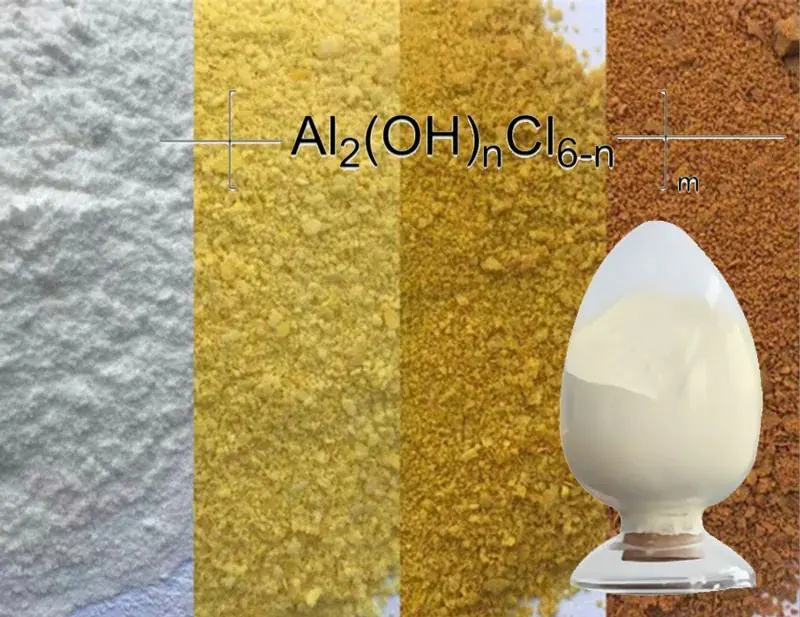
What Basicity Means in PAC Chemistry
Basicity is defined as the ratio of hydroxyl groups (OH) to aluminum in the PAC molecule, expressed as a percentage:
Basicity (%) = [OH] / (3 × [Al]) × 100
A basicity of 0% would mean pure aluminum chloride (AlCl₃) — no hydroxyl groups, completely unpolymerized. A basicity of 100% would mean pure aluminum hydroxide (Al(OH)₃) — fully polymerized, insoluble.
Commercial PAC products occupy the range between these extremes, typically 40–85% basicity. The degree of basicity determines the distribution of aluminum species present — and those species determine how the product coagulates.
How Basicity Affects Aluminum Species Distribution
At low basicity (40–60%):
- Higher proportion of mononuclear Al³⁺ and Al(OH)²⁺ species
- More chloride content relative to hydroxyl
- Less pre-polymerized — more hydrolysis required in water before coagulation begins
- Behaves more similarly to alum than to high-basicity PAC
At high basicity (70–85%):
- Higher proportion of large polynuclear species, including the highly active Al₁₃ polycation
- More pre-polymerized — less in-situ hydrolysis required
- Faster and more efficient charge neutralization at lower doses
- More robust across variable pH and temperature conditions
Performance Differences: High vs Low Basicity PAC
| Parameter | High Basicity PAC (70–85%) | Low Basicity PAC (40–60%) |
|---|---|---|
| Coagulation speed | Faster | Slower |
| Cold-water performance | Significantly better | Degrades below 10°C |
| Dosage required | Lower | Higher |
| pH operating range | 5.0–9.0 | 5.5–8.0 (narrower) |
| Residual aluminum | Lower | Higher |
| Stability in storage | Good | Good |
| Cost per kg | Slightly higher | Lower |
| Best application | Variable water, cold climates, drinking water | Stable warm-water industrial applications |
When High Basicity PAC Is the Right Choice
Cold-climate operations. High basicity PAC maintains coagulation efficiency at temperatures below 10°C because its pre-polymerized species do not depend on temperature-sensitive in-situ hydrolysis. For mining, municipal, and industrial applications in cold climates, high basicity PAC is the operationally reliable choice.
Drinking water treatment. Lower dosage requirements and lower residual aluminum make high basicity PAC preferred for drinking water applications where residual aluminum compliance (WHO guideline 0.1–0.2 mg/L) is a priority.
For drinking water application details: PAC in Municipal Drinking Water Treatment
Variable water quality. Surface water sources — rivers, reservoirs — fluctuate in turbidity, NOM content, and temperature seasonally. High basicity PAC handles this variability more robustly than low basicity products, reducing the need for frequent dosage recalibration.
Low-turbidity water. At turbidities below 5 NTU, the particle concentration is low and charge neutralization must be highly efficient to achieve good coagulation. High basicity PAC’s more active species perform better under these challenging low-turbidity conditions.

When Low Basicity PAC May Be Acceptable
Stable warm-water industrial applications. Industrial wastewater treatment plants with consistent effluent composition, temperatures consistently above 15°C, and stable pH within the 6.0–8.0 range may find that low basicity PAC delivers acceptable performance at lower cost.
High-turbidity coarse particle applications. For very high turbidity water (above 500 NTU) containing coarse particles, sweep flocculation is the dominant removal mechanism. In this regime, basicity has less influence on performance than in low-turbidity charge neutralization-dominated conditions.
Cost-constrained applications. Where budget is the primary constraint and treatment requirements are modest, low basicity PAC at slightly higher dosage may be the most economical option.
Basicity and Storage Stability
Both high and low basicity PAC products are stable in storage when kept correctly — sealed containers, away from direct sunlight and moisture, at temperatures above freezing for liquid products.
One important note: very high basicity products (above 85%) approach the solubility limit of aluminum hydroxide and may be prone to precipitation during cold storage. Products in the 70–85% range offer the best combination of high performance and storage stability.
How to Verify Basicity When Purchasing PAC
Basicity is determined by titration analysis and should be reported on the Certificate of Analysis (COA) for every production batch. When evaluating PAC suppliers:
- Request COA for recent batches — verify that basicity is consistently within the stated range
- Check basicity alongside Al₂O₃ content — a product with high Al₂O₃ but low basicity may underperform a lower-Al₂O₃ product with higher basicity
- Confirm testing method — basicity should be determined by standard titration method (GB/T 22627 or equivalent)
- Request batch-to-batch consistency data — wide variation in basicity between batches indicates inconsistent manufacturing quality control
For detailed guidance on PAC quality evaluation: Comparing PAC Grades: 28% vs 30% vs 31% Al₂O₃
For PAC vs alum selection guidance: PAC vs Alum: Which Coagulant Is Better?
Frequently Asked Questions
Can I mix high and low basicity PAC products in my storage tank?
It is not recommended. Mixing products with different basicity values produces a blend of uncertain specification that makes dosage optimization difficult. If switching between products, drain the storage tank and flush dosing lines before introducing the new product.
Does higher basicity always mean better performance?
For most applications, yes — higher basicity within the 60–85% range provides better coagulation performance. Above 85%, storage stability becomes a concern and performance gains are minimal. The practical optimum for most applications is 70–80% basicity.
How does basicity affect PAC sludge characteristics?
Higher basicity PAC tends to produce more compact, better-dewaterable sludge compared to low basicity products at equivalent Al₂O₃ dose. This is because higher basicity products produce more complete aluminum hydroxide precipitation during coagulation, forming denser flocs that release water more readily during dewatering.
Conclusion
Basicity is as important as Al₂O₃ content when selecting PAC — and for demanding applications including drinking water, cold-climate operations, and variable surface water sources, it is arguably more important. High basicity PAC (70–85%) delivers faster coagulation, lower dosage requirements, better cold-water performance, and lower residual aluminum — consistently outperforming low basicity products in conditions where coagulation efficiency matters most.
Contact our technical team today for a free basicity and grade recommendation, product samples across our full PAC range, and batch COA documentation for evaluation. We respond within 24 hours.