
Written by the HyChron Technical Team — water treatment specialists with over 15 years of field experience in municipal and industrial systems. Last reviewed: April 2026
Many water treatment operators know that PAC and PAM can be used together — but far fewer know exactly how to combine them correctly, in what sequence, at what doses, and under what conditions the combination delivers meaningful improvement over PAC alone.
Used incorrectly, PAM addition wastes chemical and can actually interfere with coagulation. Used correctly, PAC + PAM consistently produces larger flocs, faster settling, lower effluent turbidity, and improved sludge dewaterability — often with no increase in PAC dosage.
This article gives you the practical knowledge to implement PAC + PAM combination treatment correctly in your system.
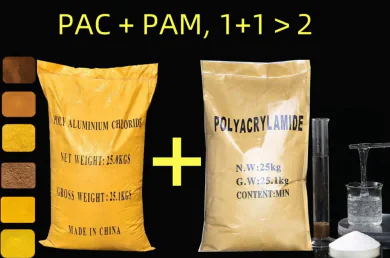
Why PAC and PAM Work Better Together
PAC and PAM address different stages of the coagulation-flocculation process and complement each other’s mechanisms:
PAC handles coagulation — charge neutralization and initial microfloc formation. It destabilizes colloidal particles by neutralizing their negative surface charges, producing small, dense microflocs that are ready to aggregate but too small to settle efficiently on their own.
PAM handles flocculation enhancement — polymer bridging between PAC microflocs. PAM’s long polymer chains (molecular weight typically 10–20 million Daltons) extend between multiple microflocs simultaneously, linking them into larger, faster-settling aggregates that PAC alone cannot produce.
The result: flocs that are 3–10 times larger than PAC-only flocs, with significantly faster settling rates and better sludge compaction.
The Correct Dosing Sequence
The single most important rule for PAC + PAM combination treatment is sequence. Adding chemicals in the wrong order significantly reduces or eliminates the benefit of PAM addition.
Correct sequence:
- PAC first — dose at the flash mixing zone, high-energy mixing (G = 200–400 s⁻¹) for 30–60 seconds
- PAM second — dose at the flocculation stage inlet, after PAC mixing is complete, slow mixing (G = 20–40 s⁻¹) for 15–25 minutes
Why sequence matters: PAM bridges between destabilized particles. If PAM is added before PAC, the particles are still electrostatically stable — PAM polymer chains adsorb onto their surfaces but cannot bridge them because electrostatic repulsion keeps particles apart. The PAM is consumed without producing useful flocculation.
When PAM is added after PAC has completed charge neutralization, destabilized microflocs are already aggregating. PAM bridges accelerate and enhance this aggregation, producing the large flocs that deliver improved settling performance.
Selecting the Right PAM Type
Not all PAM products are suitable for combination with PAC in all applications. PAM type selection depends on the application and the charge of the particles being treated.
| PAM Type | Charge | Best Application with PAC |
|---|---|---|
| Anionic PAM | Negative | Most PAC applications — drinking water, industrial WW, mining |
| Cationic PAM | Positive | Sludge dewatering, some industrial effluents |
| Nonionic PAM | Neutral | Low-pH applications, some mining applications |
Anionic PAM is the most commonly used in combination with PAC for water clarification. After PAC neutralizes particle charges, the slightly negative charge of anionic PAM bridges between now-neutral microflocs without electrostatic interference.
Cationic PAM is used in sludge dewatering applications where the sludge particles still carry residual negative charge and the cationic PAM provides additional charge neutralization alongside bridging.
For drinking water applications, PAM must comply with NSF/ANSI 60 or local equivalent food-grade chemical standards.
Dosage Guidelines for PAC + PAM Combination
PAC Dose
When combining with PAM, the PAC dose is set at the same optimal level as PAC-only treatment — determined by jar test. PAM does not substitute for PAC; it enhances flocculation after PAC has completed charge neutralization.
PAM Dose
PAM is typically effective at very low doses — significantly lower than PAC:
| Application | Typical PAM Dose (with PAC) |
|---|---|
| Municipal drinking water clarification | 0.5–1.5 mg/L |
| Industrial wastewater clarification | 1.0–3.0 mg/L |
| Mining and mineral processing | 1.0–5.0 mg/L |
| Coal washing and thickener feed | 2.0–8.0 mg/L |
| Sludge dewatering conditioning | 3.0–10.0 mg/L |
Start at the lower end of the range and increase in 0.5 mg/L increments, conducting a jar test at each level to confirm improvement before increasing further. Overdosing PAM can cause floc restabilization similar to PAC overdosing — there is an optimal PAM dose beyond which performance decreases.
Step-by-Step Implementation Guide
Step 1 — Establish the Optimal PAC Dose First
Conduct a jar test for PAC alone and set the optimal PAC dose. Do not change PAC dose after introducing PAM — evaluate the PAM benefit at fixed optimal PAC dose.
For jar testing procedure: Jar Testing for PAC Selection
Step 2 — Prepare PAM Dosing Solution
Prepare PAM as a 0.1–0.5% w/v solution — higher concentrations are too viscous for accurate dosing. Dissolve slowly with gentle agitation to avoid fish-eyes (undissolved gel particles). Allow at least 30–60 minutes of mixing time for complete dissolution.
Step 3 — Conduct Jar Tests with PAM Addition
At fixed optimal PAC dose, run jar tests with increasing PAM additions (0, 0.5, 1.0, 1.5, 2.0, 3.0 mg/L). Add PAM at the transition from rapid to slow mixing — after flash mixing is complete. Observe floc size, settling rate, and supernatant turbidity at each PAM dose.
Step 4 — Set Full-Scale PAM Dosing Point
In the full-scale system, dose PAM at the inlet to the flocculation stage — where rapid mixing has been completed and slow mixing begins. This is typically the flocculation tank inlet baffle or the slow-speed mixer inlet.
Step 5 — Monitor and Verify
After implementation, monitor: floc size in the flocculation outlet zone (should be visibly larger than PAC-only), clarifier effluent turbidity (should improve), and sludge volume (should decrease for equivalent treatment).
Expected Performance Improvements
| Parameter | PAC Only | PAC + PAM | Typical Improvement |
|---|---|---|---|
| Floc size | 0.5–2 mm | 2–8 mm | 3–5× larger |
| Settling rate | Moderate | Fast | 40–70% faster |
| Effluent turbidity | Baseline | 20–50% lower | Significant |
| Sludge volume | Baseline | 10–30% less | Moderate |
| Filter run time | Baseline | 15–30% longer | Meaningful |
Results vary with raw water characteristics, PAC dose, and PAM type and dose. Jar testing under your specific conditions will confirm expected improvement.
For context on how PAC + PAM improves specific applications:
- Mining and coal washing: PAC in Coal Washing Water Treatment
- Industrial wastewater: PAC for Industrial Wastewater Treatment
Frequently Asked Questions
Can I use any PAM product with PAC, or does the supplier matter?
PAM products vary significantly in molecular weight, charge density, and dissolution rate — all of which affect performance with PAC. For best results, conduct jar tests with the specific PAM product you plan to use with your PAC and your raw water. Do not assume that results from one PAM product will transfer to another.
Does PAM addition allow me to reduce PAC dose?
Sometimes. In some applications, effective PAM bridging allows a modest reduction in PAC dose (10–20%) while maintaining the same effluent quality. However, this should be confirmed by jar test — in many cases, PAC and PAM each address different aspects of treatment and PAC dose reduction is not beneficial.
Is PAM safe to use in drinking water treatment?
Yes, with qualifications. PAM used in drinking water must comply with NSF/ANSI 60 or national equivalent standards limiting residual acrylamide monomer (typically below 0.5 ppm in the product, resulting in far lower levels in treated water). Always verify compliance documentation from your PAM supplier before use in drinking water applications.
Conclusion
PAC + PAM combination treatment is one of the most effective and lowest-cost process improvements available to water treatment operators. When implemented correctly — PAC first for charge neutralization, PAM second for floc bridging, at the right dose and sequence — it consistently produces larger flocs, faster settling, lower effluent turbidity, and improved sludge management compared to PAC alone.
The key to success is the correct sequence, the right PAM type for your application, and jar testing to confirm the optimal PAM dose before full-scale implementation.
Contact our technical team today for a free PAC + PAM combination assessment, product samples for jar testing, and a customized dosage recommendation for your application. We respond within 24 hours.