Skip to content
Written by the HyChron Technical Team — water treatment specialists with over 15 years of field experience in municipal and industrial systems. Last reviewed: April 2026
Coal washing plants that use PAC for process water clarification consistently achieve two outcomes that matter most to operations managers: higher water recovery rates for reuse in the wash circuit, and lower costs per cubic meter treated compared to alum.
In an industry where process water efficiency directly affects wash plant throughput and operating margins, these results have made PAC the coagulant of choice for coal washing operations worldwide.
Want to improve water recovery and reduce treatment costs at your coal washing plant? Contact our technical team for a free assessment and PAC dosage recommendation.
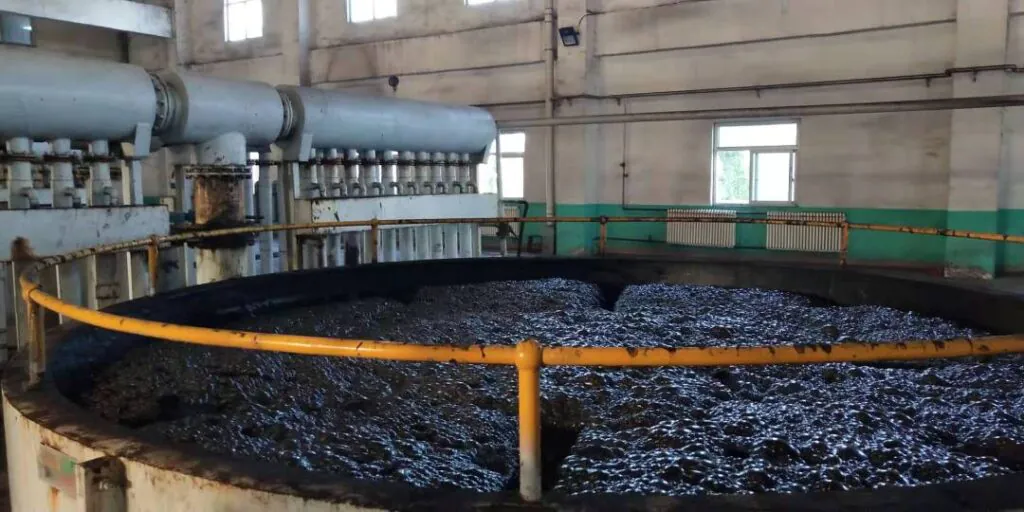
The Core Challenge in Coal Washing Water Treatment
Coal washing — the process of separating coal from rock and mineral impurities using water-based density separation — produces large volumes of highly turbid black water. This water contains:
- Ultrafine coal particles (below 0.5 mm) that remain suspended almost indefinitely
- Clay and mineral fines from the raw coal feed
- Flotation reagents — frothers and collectors used in fine coal recovery circuits
- High suspended solids loads — often 5,000–30,000 mg/L in raw circuit water
Without effective coagulation, this water cannot be clarified for reuse in the wash circuit. Plants that fail to recycle process water efficiently face two problems: increased freshwater consumption and increased discharge volume — both of which carry cost and regulatory implications.
How PAC Solves Coal Washing Water Problems
Clarifier and Thickener Performance
PAC added to the thickener feed or clarifier inlet destabilizes fine coal and clay particles through charge neutralization, causing them to aggregate into larger, faster-settling flocs.
Results operators report:
- Thickener overflow turbidity reduced from 500–2,000 NTU to below 50 NTU
- Underflow density increased, improving water recovery per cycle
- Faster settling rate allows higher throughput from existing thickener capacity
Slurry Pond Management
Coal washing slurry ponds accumulate fine coal and clay particles over time. PAC addition improves settling in slurry ponds, reducing the active pond volume required and extending pond service life before dredging is needed.
Flotation Circuit Water
Fine coal recovered by froth flotation produces a product slurry that requires dewatering and clarification of the returned process water. PAC aids in clarifying the returned water for reuse in the flotation circuit — maintaining circuit water quality and reducing freshwater make-up requirements.
Common Problems and PAC Solutions
Problem: Thickener overflow too turbid for process reuse. Fine coal and clay particles passing through the thickener overflow cause wear in pumps and pipelines and reduce wash efficiency when recycled. PAC solution: charge neutralization aggregates ultrafine particles before they reach the thickener, improving settling rate and overflow clarity.
Problem: Slurry ponds filling faster than expected. Poor settling in slurry ponds means more volume is required to store the same mass of solids, accelerating pond filling rates. PAC solution: faster settling reduces the active volume required, extending pond service life and reducing dredging frequency.
Problem: High freshwater consumption due to poor water recovery. Plants that cannot clarify process water efficiently for reuse must draw more freshwater — increasing operating costs and regulatory exposure in water-stressed regions. PAC solution: clearer thickener overflow and improved water recovery reduces freshwater consumption, cutting both water purchase costs and discharge volumes.
Problem: Cold weather reducing coagulation effectiveness. Many coal mining regions experience significant seasonal temperature drops. Alum coagulation deteriorates below 10°C, requiring large dosage increases to maintain acceptable overflow clarity. PAC solution: maintains stable coagulation performance below 10°C, avoiding the seasonal dosage spikes that drive up chemical costs in winter.

Dosage Guidelines for Coal Washing Applications
| Coal Washing Application | Typical PAC Dosage |
|---|---|
| Thickener feed conditioning | 15–40 mg/L |
| Clarifier inlet treatment | 20–50 mg/L |
| Slurry pond treatment | 25–60 mg/L |
| Flotation circuit water clarification | 15–35 mg/L |
Jar testing is essential — coal type, clay content, and flotation reagent residues all affect the required PAC dose.
Combining PAC with Anionic PAM
For ultrafine coal and clay particles, PAC alone achieves charge neutralization but may not produce flocs large enough for efficient thickener settling. Adding anionic PAM (polyacrylamide) after PAC dosing bridges micro-flocs into larger, faster-settling aggregates — a two-stage approach that consistently outperforms either chemical alone in coal washing applications.
Dosing sequence: PAC first at the flash mixing zone → rapid mix 30–60 seconds → PAM addition → slow mix 15–20 minutes → thickener or clarifier feed.
PAC vs Alum in Coal Washing
Alum is still used in some coal washing operations, primarily where it was the original coagulant and no evaluation of alternatives has been conducted. In direct comparisons:
- PAC achieves equivalent or better overflow clarity at 30–50% lower dosage
- PAC produces 30–50% less sludge, reducing tailings volume
- PAC performs reliably in cold weather where alum degrades
- PAC’s wider pH range handles the variable chemistry of coal washing water without pH pre-adjustment
For the complete coagulant comparison: PAC vs Alum: Which Coagulant Is Better?
For related mining water treatment guidance: PAC for Mining Wastewater Treatment
Frequently Asked Questions
How quickly will I see results after switching to PAC in our thickener circuit?
Most coal washing plants report visible improvement in thickener overflow clarity within the first operating shift after switching to PAC and completing initial dosage optimization. Full optimization — including fine-tuning of PAM combination dose and mixing parameters — typically takes 2–5 days of operation.
Does PAC affect coal product quality?
PAC is added to process water, not to the coal product directly. Residual aluminum in the clarified water is at low levels and does not affect coal product specifications. PAC has no known adverse effect on coal combustion characteristics or ash composition at the concentrations used in process water treatment.
Can PAC be used in zero-liquid-discharge coal washing systems?
Yes. In zero-liquid-discharge (ZLD) coal washing designs, PAC-clarified thickener overflow is recycled directly to the wash circuit. Effective clarification by PAC is a prerequisite for achieving the water quality needed for ZLD operation. Our technical team can provide guidance on PAC dosage optimization for ZLD configurations.
Conclusion
PAC is the most effective coagulant available for coal washing water treatment — delivering faster thickener settling, cleaner overflow for process reuse, lower sludge volumes, and reliable cold-weather performance that alum cannot match.
For coal washing plants currently struggling with turbid overflow, slow settling, or high freshwater consumption, switching to PAC combined with anionic PAM is the most direct path to improved water recovery and reduced treatment costs.
Contact our technical team today for a free coal washing water assessment, PAC and PAM product samples, and a dosage recommendation for your specific circuit configuration. We respond within 24 hours.