
Many wastewater treatment plants struggle with the same problem: either using too much polyacrylamide or too little. Both situations reduce treatment efficiency and increase operating costs.
In real wastewater treatment systems, the correct dosage of polyacrylamide (PAM) can significantly improve flocculation efficiency, reduce sludge volume, and lower chemical expenses. However, finding the optimal dosage requires understanding several key factors such as wastewater composition, polymer type, and mixing conditions.
This guide explains how to calculate PAM dosage accurately and how proper dosing can improve the performance of industrial and municipal treatment systems.
Why Accurate PAM Dosage Matters
Polyacrylamide works by charge neutralization and polymer bridging. When the dosage is correct, suspended particles quickly form large flocs and settle rapidly.
However, improper dosing can create serious problems:
- Underdosing
- Poor floc formation
- Slow sedimentation
- Turbid effluent
- Overdosing
- Restabilization of particles
- Increased treatment cost
- Higher sludge viscosity
For most wastewater systems, the typical PAM dosage range is:
0.5–10 mg/L, depending on wastewater characteristics.
Municipal wastewater treatment plants usually operate between:
1–5 mg/L
Industrial wastewater with higher solids may require higher dosing.
Key Factors That Influence PAM Dosage
Different wastewater conditions require different dosing strategies. Operators must evaluate several parameters before determining the correct polymer dosage.
1. Wastewater Characteristics
The type of contaminants strongly affects polymer demand.
Examples include:
| Wastewater Type | Typical PAM Type | Dosage Range |
|---|---|---|
| Municipal sewage | Cationic PAM | 1–5 mg/L |
| Paper mill wastewater | Anionic PAM | 2–6 mg/L |
| Mining slurry | High MW anionic PAM | 3–10 mg/L |
| Food processing wastewater | Cationic PAM | 2–8 mg/L |
Higher suspended solids usually require higher molecular weight polymers.
2. Polymer Molecular Weight and Charge Density
Polyacrylamide products vary in molecular weight and charge density, which significantly affect dosing requirements.
High molecular weight polymers can produce larger flocs, allowing lower dosage in some systems.
For example:
- Low MW PAM → higher dosage needed
- High MW PAM → stronger bridging and lower dosage
Selecting the correct polymer grade is critical.
👉 Related reading:
Choosing the Right PAM Grade for Your Industry
3. Mixing and Reaction Conditions
Proper mixing ensures that the polymer interacts effectively with suspended particles.
Key operational parameters include:
- Rapid mixing stage: 30–60 seconds
- Slow flocculation stage: 10–20 minutes
- Solution concentration: 0.1–0.3%
Improper mixing may break formed flocs and reduce treatment efficiency.
Jar Testing: The Most Reliable Method
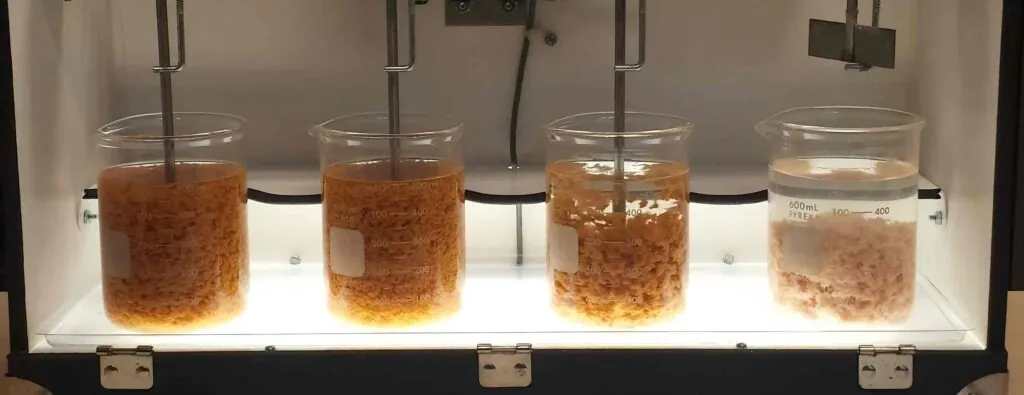
The jar test is the most common laboratory method used to determine the optimal polymer dosage.
Jar testing simulates real treatment conditions in a controlled environment.
Typical procedure:
- Collect representative wastewater samples.
- Prepare several test jars with different PAM dosages.
- Mix rapidly for 1 minute.
- Reduce mixing speed to allow floc formation.
- Observe sedimentation and clarity.
Operators then select the dosage that produces:
- Largest flocs
- Fastest settling
- Clear supernatant

This process helps avoid chemical waste and operational inefficiencies.
How Proper Dosage Reduces Operating Costs
Correct polymer dosing provides several economic benefits for treatment plants:
Lower Chemical Consumption
Optimized dosing prevents excessive chemical use.
Many facilities reduce polymer usage by 10–20% after proper dosage testing.
Improved Sludge Dewatering
Better flocculation improves sludge structure, which leads to:
- Higher solids content
- Lower sludge disposal costs
- Reduced energy consumption
👉 You may also want to read:
Optimizing Sludge Dewatering with Cationic PAM
More Stable Plant Operation
Accurate dosing improves treatment stability and reduces unexpected plant shutdowns caused by poor flocculation.
Why High-Quality PAM Makes Dosage Easier
Not all polyacrylamide products perform the same.
High-quality PAM provides:
- Faster dissolution
- Higher molecular weight stability
- Consistent charge density
- Better flocculation performance
These properties allow operators to achieve the same treatment performance with lower dosage.
Our industrial-grade polyacrylamide is widely used in:
- municipal wastewater treatment
- sludge dewatering
- mining and mineral processing
- food processing wastewater
- paper and pulp industries
The product offers high purity, stable performance, and excellent flocculation efficiency, helping treatment plants reduce operating costs.
Conclusion
Accurate PAM dosage is essential for achieving efficient wastewater treatment. By considering wastewater characteristics, polymer type, and mixing conditions, operators can determine the optimal dosage through simple jar testing.
Proper dosing improves flocculation, reduces sludge volume, and lowers overall treatment costs.
If your treatment plant is struggling with inefficient settling or high sludge disposal costs, selecting the right polyacrylamide and optimizing dosage can significantly improve performance.
Contact our technical team today to get professional polymer selection advice and find the most cost-effective PAM solution for your wastewater treatment system.