
Written by the HyChron Technical Team — water treatment specialists with over 15 years of field experience in municipal and industrial systems. Last reviewed: April 2026
For operators managing high-throughput treatment plants or systems with variable-quality source water, manual PAC dosage management has a fundamental limitation: it is reactive rather than predictive. By the time an operator observes high effluent turbidity and increases PAC dose, turbidity-impacted water has already passed through the clarifier. Smart dosing systems — using online sensors and automated control — close this lag and maintain optimal PAC dosage continuously, without operator intervention for routine adjustments.
This article covers what smart PAC dosing systems are, who needs them, what components they require, and what performance improvements operators can realistically expect.
Who Benefits Most from Smart PAC Dosing
Not every treatment plant needs automated PAC dosage control. The value of smart dosing scales with:
Source water variability. Plants treating surface water sources that vary widely in turbidity (rivers, reservoirs affected by storm events) benefit most. Plants treating stable groundwater or industrial effluent with consistent composition benefit less.
Treatment scale. Large municipal plants processing > 50,000 m³/day, where a 10% dosage reduction represents significant annual chemical cost savings, justify the capital investment in smart dosing more readily than small plants.
Operational staffing. Plants operating 24/7 with limited night-shift staffing benefit from automated dosage adjustment that maintains performance without requiring operator action at 3am during a storm event.
Regulatory sensitivity. Plants operating close to turbidity or residual aluminum compliance limits benefit from tighter automated dosage control that reduces the risk of compliance exceedances during raw water quality fluctuations.
Core Value of Smart Dosing for Buyers and Operators
Consistent effluent quality. Manual dosing adjusts PAC dose after a problem is detected. Automated dosing adjusts before the problem reaches the clarifier — maintaining tighter control around the compliance limit.
Lower average PAC consumption. Manual dosing tends toward safety margins above the optimal dose to avoid compliance risk. Automated dosing with real-time feedback operates closer to the optimal dose, reducing average PAC consumption by 10–20% compared to manual management.
Reduced operator workload. Routine dosage adjustments (daily, seasonal) happen automatically. Operators focus on system maintenance and exception management rather than continuous dosage monitoring.
Early detection of process problems. Smart dosing systems generate continuous process data that enables trend analysis — identifying gradual equipment degradation, raw water quality shifts, or product quality changes before they become compliance events.
Smart Dosing System Components
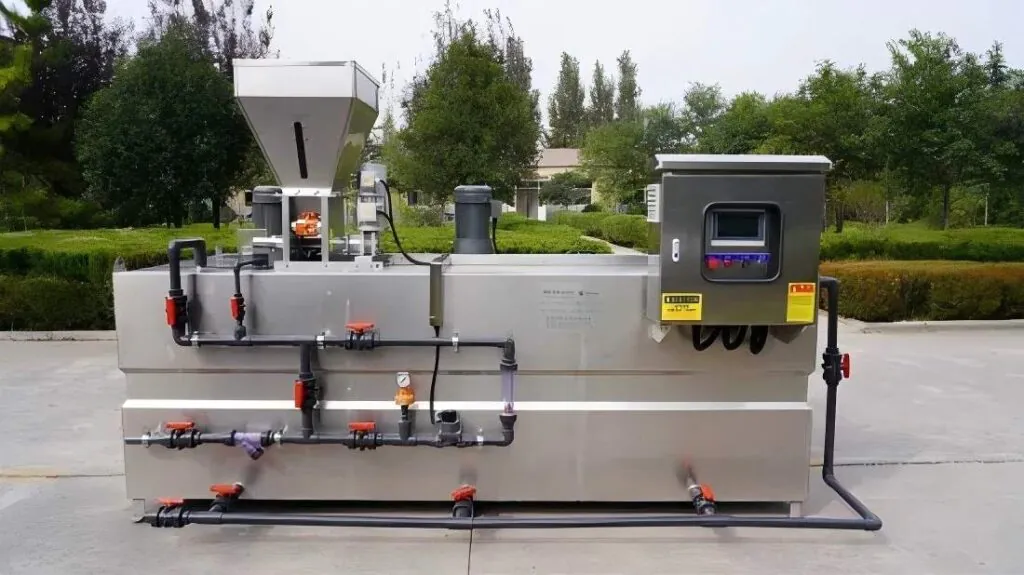
A complete smart PAC dosing system integrates five components:
1. Online Sensors
Raw water sensors (upstream of PAC dosing):
- Online turbidity meter — continuous NTU measurement
- Online pH meter — confirms PAC is dosed within effective pH range
- Optional: online UV₂₅₄ meter for NOM monitoring; temperature sensor for cold-weather adjustments
Treated water sensors (after clarification/filtration):
- Online turbidity meter — primary feedback signal for dose control
- Optional: streaming current detector (SCD) — measures electrokinetic charge of treated particles, providing direct feedback on charge neutralization completeness
2. Dosage Control Algorithm
The control algorithm calculates the required PAC dose based on sensor inputs:
Feed-forward control (most common): PAC dose is set proportionally to raw water turbidity — as turbidity increases, dose increases proportionally. This is the simplest approach and works well for plants where turbidity is the dominant variable.
Feedback control: PAC dose is adjusted based on treated water turbidity (or SCD reading). If treated water turbidity is above target, dose increases; if below, dose decreases. More responsive than feed-forward for variable water.
Combined feed-forward + feedback: The most effective approach for variable-source-water plants. Feed-forward provides immediate response to incoming turbidity changes; feedback trims the dose based on actual treatment performance.
3. Automated Dosing Pump
Peristaltic or diaphragm metering pumps with 4–20 mA or variable frequency drive (VFD) control — standard for PAC dosing. The control system sends a 4–20 mA signal to the pump, which adjusts its stroke rate or speed to deliver the calculated dose rate.
4. Flow Measurement
Accurate treatment plant flow measurement is essential for flow-proportional dosing. For systems using a concentration-based dose (mg/L), dose rate = flow rate × target concentration / product concentration. Real-time flow input to the control system ensures dose adjusts automatically as flow rate changes (diurnal patterns, flow variability).
5. Control System and Data Logging
SCADA or PLC-based control systems integrate sensor data, execute the dosing algorithm, and control dosing pumps. Data logging captures dosage rates, sensor readings, and plant flow over time — providing the operational record needed for process optimization and regulatory reporting.

Implementation: Selecting the Right Level of Automation
Level 1 — Flow-Proportional Dosing (Minimum Automation)
PAC dose is tied to plant flow rate — dose increases and decreases with flow. No raw water quality sensing required. Provides flow compensation but does not respond to turbidity variation.
Suitable for: Stable-quality source water (groundwater, reservoir) where turbidity variation is minimal. Simple to implement, low capital cost.
Level 2 — Turbidity-Based Feed-Forward Control
PAC dose is calculated from real-time raw water turbidity measurement. As turbidity increases, dose increases automatically; as turbidity decreases, dose reduces.
Suitable for: River and surface water sources with significant turbidity variation. Responds to storm-event turbidity spikes without operator intervention.
Capital components: Online turbidity meter at intake + dosing pump with control signal input + flow meter + basic PLC controller.
Level 3 — Combined Feed-Forward + Feedback Control with SCD
PAC dose is calculated from both raw water turbidity (feed-forward) and treated water charge status (streaming current detector feedback). The SCD provides real-time confirmation that charge neutralization is complete at every moment — enabling the tightest possible dosage control.
Suitable for: Large municipal plants, plants operating close to compliance limits, or plants targeting maximum PAC consumption reduction.
Capital components: Turbidity meters at intake and outlet + SCD at flash mixer outlet + flow meter + advanced PLC or SCADA.
Expected Performance Improvements from Smart Dosing
| Parameter | Manual Dosing | Level 2 (Feed-Forward) | Level 3 (SCD Feedback) |
|---|---|---|---|
| Treated water turbidity consistency | ±20–40% variation | ±10–20% variation | ±5–10% variation |
| PAC consumption vs manual baseline | Baseline | 10–15% reduction | 15–20% reduction |
| Response time to turbidity spike | 30–90 minutes | 2–5 minutes | < 2 minutes |
| Operator dosage adjustment events/day | 2–5 | < 1 | Essentially 0 |
| Compliance exceedance events/year | Site-dependent | Reduced by 60–80% | Reduced by 80–95% |
Frequently Asked Questions
How much does a smart PAC dosing system cost to install?
A Level 2 feed-forward system for a medium-scale plant (5,000–20,000 m³/day) typically costs $15,000–$40,000 in equipment and installation, depending on the number of sensors, control system complexity, and whether existing infrastructure (flow meters, PLC) can be reused. At $0.005/m³ PAC consumption reduction, a 15% reduction at 10,000 m³/day recovers this investment in 3–5 years — faster for larger plants or higher PAC dosage rates.
Can existing manual dosing systems be upgraded to smart dosing without replacing the dosing pump?
Usually yes. Most standard peristaltic and diaphragm dosing pumps can be retrofitted with a 4–20 mA control input for variable-speed operation — typically a straightforward electrical modification. The larger investment is in the sensors and control system rather than the pump itself.
We have a streaming current detector but do not know how to use it effectively for dose control. What should we check?
First, verify that the SCD is installed at the correct location — immediately after the flash mixer outlet, where charge neutralization should be complete. If the SCD is installed upstream of the flash mixer or too far downstream, the reading does not reflect actual charge neutralization status. Second, establish the target setpoint — typically SCD reading of 0 ± 10% of full scale corresponds to complete charge neutralization. Contact our technical team for SCD calibration and setpoint guidance specific to your water and PAC product.
Conclusion
Smart dosing systems for PAC are not a luxury for large plants — they are an operational efficiency investment that pays back through chemical savings, reduced compliance risk, and lower operator workload. The appropriate level of automation scales with plant size, source water variability, and compliance requirements.
For most surface water treatment plants above 5,000 m³/day, a Level 2 turbidity-based feed-forward system delivers meaningful benefits at a capital cost that is recovered within the first operating contract period. For larger plants or those operating close to compliance limits, the incremental investment in streaming current detection for feedback control provides the tightest available dosage control.
Contact our technical team today for a smart dosing system specification, compatible sensor recommendations for your PAC product and water type, and a PAC consumption reduction estimate for your plant. We respond within 24 hours.