Skip to content
Written by the HyChron Technical Team — water treatment specialists with over 15 years of field experience in municipal and industrial systems. Last reviewed: April 2026
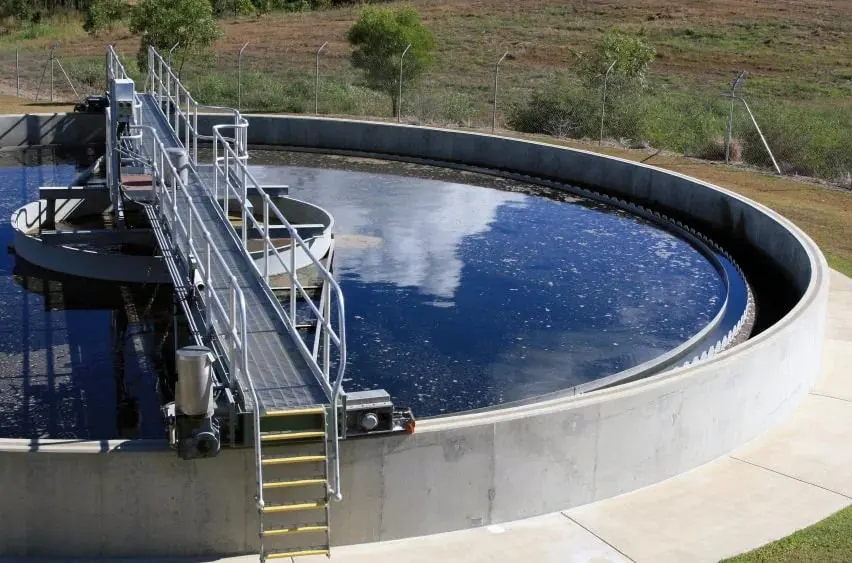
The clarifier is where PAC’s coagulation chemistry delivers its visible result — where flocs formed in the flash mixer and flocculation tank settle out of suspension and produce the clarified effluent that downstream treatment stages depend on. Getting PAC to perform well in a clarifier is not just about the chemistry — it is about understanding how clarifier hydraulics interact with floc characteristics, and how to configure your PAC program to work with your specific clarifier design.
This article compares PAC performance across different clarifier configurations, establishes the criteria that determine whether your clarifier is limiting PAC performance, and provides operational guidance for optimizing the PAC-clarifier system.
Clarifier Types and PAC Compatibility
Conventional Gravity Clarifiers (Rectangular or Circular)
The most common clarifier configuration in municipal and industrial treatment. Coagulated water enters at one end or center, flows slowly across the tank while flocs settle by gravity, and exits as clarified effluent at the opposite end or periphery.
PAC compatibility: Excellent. PAC’s fast, dense floc formation is well-suited to gravity clarifiers. Key requirement: adequate flocculation time before the clarifier inlet. Short flocculation time produces micro-flocs that settle poorly in conventional clarifiers.
Optimal PAC floc characteristics for gravity clarifiers: Floc size 1–5 mm, settling velocity > 0.5 mm/s. Achievable with optimized PAC dose, proper pH, and PAM addition where needed.
Lamella (Inclined Plate/Tube) Clarifiers
Use inclined plates or tubes to increase effective settling area within a smaller footprint. The inclined surfaces allow flocs to slide down and consolidate while clarified water rises between plates.
PAC compatibility: Good. Lamella clarifiers are more sensitive to floc size and density than conventional clarifiers. PAC flocs must be sufficiently dense to slide along plate surfaces rather than resuspend. Overdosing PAC (charge reversal) produces fragile, restabilized flocs that perform poorly in lamella systems. Precise dose control is more important in lamella clarifier applications.
Key consideration: Maximum surface loading rate for lamella clarifiers with PAC-treated water: typically 5–15 m³/m²/hr. Verify against manufacturer specifications for your specific unit.
Sludge Blanket (Upflow) Clarifiers
Coagulated water flows upward through a suspended sludge blanket. Incoming particles are captured by contact with the established blanket rather than by gravity settling alone.
PAC compatibility: Good with stable operation. Sludge blanket clarifiers are highly sensitive to flow rate changes — sudden increases can carry blanket material into the effluent. PAC’s fast floc formation helps establish and maintain a stable blanket. Maintaining consistent PAC dosage and flow rate is more critical than in conventional clarifiers.
Key consideration: Sludge blanket clarifiers perform best when coagulation chemistry is stable and predictable. PAC’s consistent performance across variable pH and temperature is particularly valuable in these systems.
Key Comparison: PAC vs Alum in Clarifier Operation
| Parameter | PAC | Alum |
|---|---|---|
| Floc formation speed | Fast — establishes quickly | Slower — lag time before effective flocculation |
| Floc density | Higher — settles faster | Lower — more voluminous, slower settling |
| Cold-water floc quality | Maintained | Degrades significantly |
| Clarifier loading rate tolerance | Higher | Lower — sensitive to overloading |
| Sludge blanket stability | Better | More variable |
| Sludge volume in hopper | 30–50% less | Baseline |
| Carry-over risk during storm events | Lower | Higher |
For the complete PAC vs alum comparison: PAC vs Aluminum Sulfate (Alum): Complete Comparison
Diagnosing Clarifier Performance Problems
If your clarifier is not meeting turbidity targets despite adequate PAC dosing, the problem is usually one of four types:
Hydraulic short-circuiting. Water finds a fast path from inlet to outlet without traversing the full settling zone. Signs: inlet turbidity spikes translate immediately to outlet turbidity increases with no lag time. Fix: review clarifier baffling and inlet distribution.
Floc carryover from flocculation. Micro-flocs entering the clarifier that have not grown to settable size. Signs: effluent looks uniformly hazy rather than containing distinct settling particles. Fix: extend flocculation time, reduce flocculation mixer G-value, consider PAM addition.
Sludge hopper overloading. Sludge accumulates in the clarifier faster than it is removed, eventually reaching the sludge blanket and resuspending into the effluent. Signs: gradual effluent deterioration over time, improving after sludge withdrawal. Fix: increase sludge withdrawal frequency, consider switching to PAC to reduce sludge volume generation.
Density currents. Cold incoming water sinks rapidly to the bottom and short-circuits under the sludge blanket. Signs: worse performance in cold weather even with adequate PAC dose. Fix: add inlet baffling to reduce density current formation; consider PAM addition to produce faster-settling, denser flocs.
Optimizing PAC Dosing for Clarifier Performance
Upfront Requirements
- Jar test result confirming optimal PAC dose at current raw water conditions
- Flash mixing G-value confirmed at 200–400 s⁻¹
- Flocculation residence time ≥ 15 minutes (20–30 minutes for cold water or difficult-to-settle particles)
Clarifier-Specific Adjustments
For gravity clarifiers: Standard PAC program. Add PAM if floc size at clarifier inlet is below 1 mm.
For lamella clarifiers: Precise dose control is essential — install online turbidity monitoring at both inlet and outlet to detect charge reversal immediately. Consider a streaming current detector for automatic dose control.
For sludge blanket clarifiers: Maintain consistent flow rate and PAC dosage. Avoid sudden changes. During storm-event turbidity spikes, increase PAC dose gradually (10–15% increments) rather than sharply.
For mixing optimization before the clarifier: Optimizing PAC Mixing and Reaction Time
For PAC + PAM combination to improve settling: Using PAC with PAM: Best Practices
Expected Performance: PAC-Treated Clarifier Effluent
| Raw Water Turbidity | Clarifier Type | Expected PAC-Treated Effluent Turbidity |
|---|---|---|
| < 10 NTU | Conventional gravity | 1–3 NTU |
| < 10 NTU | Lamella | 0.5–2 NTU |
| 10–50 NTU | Conventional gravity | 2–5 NTU |
| 50–200 NTU | Conventional gravity | 3–8 NTU |
| > 200 NTU | Conventional gravity | 5–15 NTU |
Results assume optimized PAC dose, adequate flash mixing, and ≥ 15 minutes flocculation time. Post-clarification filtration achieves sub-1 NTU in all cases.
Frequently Asked Questions
My clarifier was designed for alum — do I need to make changes to use PAC?
Usually no physical changes are needed. PAC produces denser flocs that settle faster — your clarifier will likely perform better with PAC than with alum, not worse. The main operational change is dosage recalibration via jar test. If your clarifier has a sludge hopper, you may be able to reduce sludge withdrawal frequency due to PAC’s lower sludge production.
Can PAC handle the loading during storm-event turbidity spikes without overloading the clarifier?
PAC’s faster floc formation responds more quickly to turbidity increases than alum, reducing carry-over risk during initial spike events. For very severe spikes (above 500 NTU), pre-flocculation with PAM before the clarifier inlet significantly improves performance. Monitor clarifier effluent continuously during storm events and increase PAC dose incrementally as turbidity rises.
How do I know if my clarifier is limiting PAC performance rather than the PAC itself?
Compare jar test results with full-scale results. If jar tests at the same dose show significantly better turbidity removal than full-scale operation, the clarifier (mixing, hydraulics, or sludge management) is the limiting factor — not the PAC. If jar tests also show poor results, the issue is chemical (dose, pH, or product quality).
Conclusion
PAC is highly compatible with all standard clarifier configurations — conventional gravity, lamella, and sludge blanket — and consistently outperforms alum in each in terms of floc quality, settling speed, and cold-weather stability. The key to achieving optimal clarifier performance with PAC is ensuring that the upstream coagulation and flocculation conditions are correct before water enters the clarifier.
When clarifier performance is limiting treatment results, systematic diagnosis — distinguishing between hydraulic, floc quality, and sludge management issues — points to the specific corrective action rather than requiring a chemical change.
Contact our technical team today for a free clarifier performance assessment and PAC optimization recommendation for your specific system. We respond within 24 hours.