Skip to content
Written by the HyChron Technical Team — water treatment specialists with over 15 years of field experience in municipal and industrial systems. Last reviewed: April 2026
Plants that switch to PAC for turbidity and suspended solids removal report a consistent finding: the same clarifier produces clearer effluent at lower chemical cost. Turbidity readings drop, filter run times extend, and the seasonal performance dips that plagued alum-based systems largely disappear.
Understanding why PAC achieves these results — and how to optimize its application — is what this article covers. Whether you are evaluating PAC for the first time or troubleshooting an underperforming coagulation system, the mechanism behind turbidity and TSS removal is the starting point.
Want to know if PAC can improve turbidity removal at your facility? Contact our technical team for a free assessment.
What Turbidity and Suspended Solids Actually Are
Turbidity and suspended solids are related but distinct measurements:
- Turbidity measures how much light is scattered by particles in water, expressed in NTU (Nephelometric Turbidity Units). It is a proxy for particle concentration but is more sensitive to small particles than to large ones.
- Suspended solids (TSS) measures the mass of particles that do not pass through a standard filter (typically 0.45 microns), expressed in mg/L.
Both are regulated in discharge standards and drinking water quality requirements, and both are removed by the same coagulation mechanism — but the relationship between PAC dose and removal efficiency differs depending on particle size distribution, particle charge, and water chemistry.
Why Particles Stay Suspended Without Chemical Treatment
Most particles in water that cause turbidity and elevated TSS are in the colloidal size range — roughly 0.001 to 1 micron. At this size, particles:
- Are too small to settle by gravity in any practical timeframe
- Carry negative surface charges (zeta potential typically −20 to −40 mV)
- Repel each other electrostatically, preventing natural aggregation
- Remain stable in suspension for days, weeks, or indefinitely
Clay, silt, algae, bacteria, organic colloids, and fine mineral particles all behave this way. Without chemical intervention, no amount of settling time will clarify the water to acceptable turbidity levels.
How PAC Removes Turbidity and TSS: Two Mechanisms
Mechanism 1 — Charge Neutralization
When PAC is added to water, it hydrolyzes rapidly to release positively charged aluminum species — Al(OH)²⁺, Al₈(OH)₂₀⁴⁺, and larger polymer chains. These cationic species:
- Adsorb onto the negatively charged surfaces of colloidal particles
- Neutralize the surface charge (zeta potential approaches 0 mV)
- Eliminate the electrostatic repulsion that kept particles dispersed
- Allow particles to collide and begin aggregating
This mechanism is most effective at lower PAC doses and for particles with moderate negative charge. It produces compact, dense micro-flocs.
Mechanism 2 — Sweep Flocculation
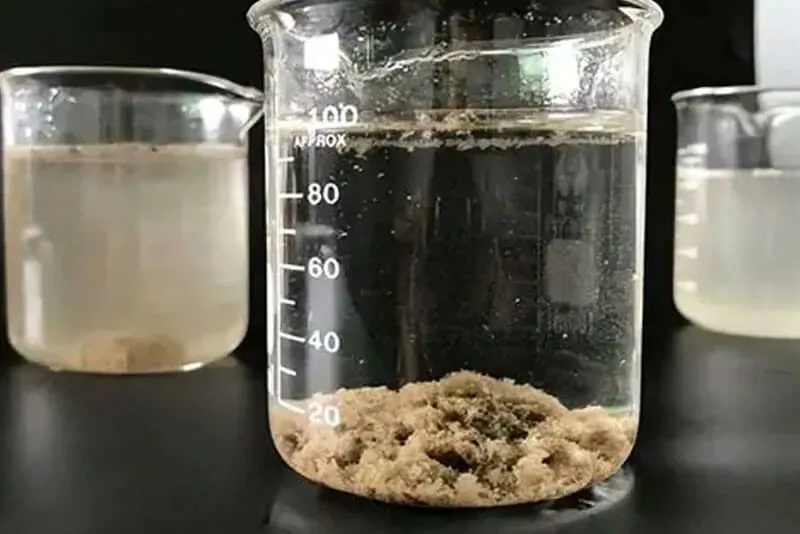
At higher PAC doses, aluminum hydroxide precipitates form a voluminous amorphous floc matrix. As this floc grows and settles, it physically sweeps smaller particles — including those too small for effective charge neutralization — out of the water column.
Sweep flocculation is less dose-sensitive than charge neutralization and works well for:
- Very fine particles (below 0.1 micron)
- Low-turbidity water where particle concentration is too low for effective charge neutralization
- Water containing diverse particle types that respond differently to charge neutralization
In practice, both mechanisms operate simultaneously. The relative contribution of each depends on PAC dose, water chemistry, and particle characteristics — which is why jar testing is essential for dose optimization.

Factors That Affect PAC Turbidity Removal Efficiency
pH. PAC performs across pH 5.0–9.0. Within this range, slightly acidic conditions (pH 6.0–7.5) typically favor charge neutralization; more alkaline conditions favor sweep flocculation. Optimal pH for turbidity removal in most natural waters is pH 6.5–7.5.
Temperature. Below 10°C, water viscosity increases, slowing particle collision rates and floc settling. PAC handles cold-water conditions significantly better than alum because its pre-polymerized structure does not depend on in-situ hydrolysis reactions that are temperature-sensitive.
Natural organic matter (NOM). Humic and fulvic acids in source water compete with particles for PAC’s active aluminum species, increasing the dose required for effective turbidity removal. High NOM water requires higher PAC doses than low-NOM water at the same turbidity level.
Initial turbidity. Counter-intuitively, very low-turbidity water (below 5 NTU) can be harder to treat than moderate-turbidity water because particle concentrations are too low for effective charge neutralization. Sweep flocculation at slightly higher PAC doses is typically more effective in these conditions.
Mixing energy. Rapid, uniform mixing immediately after PAC dosing is critical for effective charge neutralization. Insufficient mixing energy leaves PAC incompletely dispersed, reducing removal efficiency regardless of dose.
Typical Turbidity Removal Performance
| Initial Turbidity | Optimized PAC Dose | Achievable Effluent Turbidity |
|---|---|---|
| < 10 NTU | 5–15 mg/L | < 1 NTU |
| 10–50 NTU | 10–25 mg/L | < 1 NTU |
| 50–200 NTU | 20–40 mg/L | < 1–2 NTU |
| 200–1,000 NTU | 30–60 mg/L | < 2–5 NTU |
| > 1,000 NTU | 50–100 mg/L | < 5 NTU |
These are achievable ranges with optimized PAC dosing, rapid mixing, and adequate flocculation time. Jar testing is required to confirm performance for your specific water.
Optimizing PAC Dosing for Turbidity Removal
- Jar test first — determine the dose-response curve for your specific water source before setting operational dosage
- Dose at maximum turbulence — introduce PAC at the flash mixing zone, G-value 200–400 s⁻¹ for 30–60 seconds
- Allow adequate flocculation time — G-value 20–60 s⁻¹ for 15–30 minutes; flocs need time to grow before entering the clarifier
- Monitor continuously — online turbidity monitoring after sedimentation enables real-time dose adjustment as raw water quality changes
- Recalibrate seasonally — NOM levels, temperature, and particle composition all change with season, requiring dosage recalibration
For guidance on PAC dosing in specific applications:
- Drinking water: PAC in Municipal Drinking Water Treatment
- Industrial wastewater: PAC for Industrial Wastewater Treatment
- Mining water: PAC for Mining Wastewater Treatment
Frequently Asked Questions
What turbidity level can PAC consistently achieve in drinking water applications?
With optimized PAC dosing followed by sedimentation and sand filtration, finished water turbidity below 0.1–0.5 NTU is routinely achievable — well within WHO drinking water turbidity guidelines of 1 NTU (preferably below 0.1 NTU for effective disinfection).
Why is my PAC-treated water still turbid after sedimentation?
The most common causes are: insufficient PAC dose (under-dosing), poor mixing dispersion, inadequate flocculation time, or raw water pH outside PAC’s effective range. Jar testing under current raw water conditions will quickly identify which parameter needs adjustment.
Can PAC remove colloidal silica?
Colloidal silica carries a strong negative charge and is one of the more challenging turbidity contributors to coagulate. PAC at optimized dose and pH can achieve significant colloidal silica removal, but performance is more sensitive to dose and pH conditions than for clay or organic turbidity. Jar testing is particularly important for silica-rich source waters.
Conclusion
PAC removes turbidity and suspended solids through two complementary mechanisms — charge neutralization and sweep flocculation — that together achieve effluent quality that gravity settling or filtration alone cannot approach. Its wide pH range, cold-water stability, and faster floc formation compared to alum make it the most reliable coagulant for consistent turbidity removal across the variable conditions that real water sources present.
Contact our technical team today for a free turbidity removal assessment, PAC product samples, and a dosage recommendation for your specific water source. We respond within 24 hours.