
Written by the HyChron Technical Team — water treatment specialists with over 15 years of field experience in municipal and industrial systems. Last reviewed: April 2026
Dissolved Air Flotation (DAF) is the separation technology of choice for removing materials that do not settle well by gravity — emulsified oils, algal cells, low-density organic matter, and fine fibres. Coagulation with PAC is a prerequisite for DAF performance: without proper chemical pre-treatment, DAF achieves only a fraction of its potential removal efficiency.
The PAC-DAF combination is one of the most effective and widely used physical-chemical treatment configurations in water and wastewater treatment. Understanding how to optimize PAC dosing specifically for DAF — which differs in important ways from optimization for gravity clarifiers — is the focus of this article.
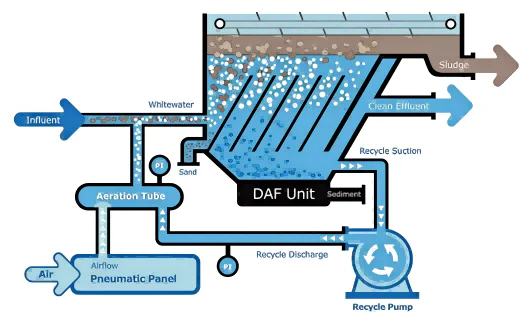
Why DAF Needs PAC Pre-Treatment
DAF works by generating micro-bubbles (20–100 microns in diameter) that attach to destabilized particles and carry them to the surface for skimming. The attachment efficiency — how readily bubbles attach to particles — depends critically on the surface chemistry of those particles.
Stable colloidal particles with strong negative surface charges repel the negatively charged bubble surfaces: bubble-particle attachment is poor. When PAC neutralizes particle surface charges, the electrostatic barrier to bubble attachment is eliminated — destabilized particles contact bubbles and rise efficiently to the DAF surface for removal.
Without PAC coagulation: DAF removal efficiency for emulsified oil and fine particles typically 40–60%. With optimized PAC pre-treatment: DAF removal efficiency typically 85–95%.
The improvement is not marginal — it is the difference between a DAF system that works and one that barely justifies its capital cost.
PAC vs Alum for DAF Pre-Treatment
| Parameter | PAC | Alum |
|---|---|---|
| Charge neutralization speed | Fast — active before DAF inlet | Slower — may be incomplete at DAF contact zone |
| Cold-water performance | Stable | Degrades — DAF performance suffers in winter |
| Floc characteristics for DAF | Micro-flocs — ideal for bubble attachment | Larger, heavier — tendency to settle before flotation |
| Sludge (float) production | 30–50% less | More |
| pH operating range | 5.0–9.0 | 6.5–7.5 |
PAC’s faster charge neutralization is a particular advantage in DAF applications because the contact time between PAC dosing and the DAF unit is limited — typically 2–5 minutes. At this short contact time, alum’s slower in-situ hydrolysis may be incomplete, producing sub-optimal bubble attachment.
Optimal PAC Dosing Configuration for DAF
Dosing Point
Dose PAC upstream of the DAF unit — at a point that provides 2–5 minutes of contact time before the water reaches the DAF contact zone. This allows PAC to complete charge neutralization before bubble attachment occurs.
A common configuration:
- PAC dosing → in-line static mixer (flash mix) → 2–5 minute contact pipe → DAF inlet
Do not dose PAC directly into the DAF contact zone — insufficient contact time for charge neutralization before bubble attachment.
Flash Mixing for DAF Applications
For DAF pre-treatment, the flash mixing requirement is the same as for gravity clarifiers:
- G-value: 200–400 s⁻¹
- Duration: 30–60 seconds
- In-line static mixer at the PAC injection point is acceptable if it achieves adequate G-value at the operating flow rate
Flocculation Before DAF
Unlike gravity clarifiers, DAF does not require large, well-formed flocs — in fact, micro-flocs (0.1–1 mm) are more efficiently captured by micro-bubbles than large flocs (which may settle in the DAF contact zone before reaching the float layer).
A short, gentle flocculation step (G = 30–50 s⁻¹, 5–10 minutes) after flash mixing and before the DAF inlet produces the micro-floc size ideal for DAF capture.
PAC Dosage Guidelines for DAF Applications
| DAF Application | Typical PAC Dose |
|---|---|
| Food processing (oil/grease removal) | 30–80 mg/L |
| Dairy wastewater | 25–70 mg/L |
| Paper mill white water | 15–40 mg/L |
| Municipal drinking water (algae) | 10–30 mg/L |
| Industrial wastewater (general) | 20–80 mg/L |
| Petroleum refinery wastewater | 30–80 mg/L |
Always confirm by jar test or DAF-specific flotation test with your actual effluent.
DAF-Specific Jar Test
Standard jar tests simulate sedimentation, not flotation. For PAC optimization in DAF systems, request or conduct a flotation jar test — a modified procedure that uses a dissolved air pressure tube to generate micro-bubbles in the jar, simulating the DAF bubble-particle contact process.
Contact our technical team for flotation jar test support and guidance.
Common PAC-DAF System Problems and Solutions
Problem: DAF float layer thin and poorly defined. Usually indicates insufficient PAC dose — bubble attachment is incomplete, not enough destabilized particles are reaching the float layer. Solution: Increase PAC dose in 10% increments, monitor float layer thickness and clarity of sub-float effluent.
Problem: Good float layer but high suspended solids in DAF effluent. Particles are floating but the float layer is being carried over into the effluent — typically a hydraulic problem (excessive flow rate, poorly designed baffling). Solution: Reduce DAF flow rate, review float skimmer operation, check float layer depth.
Problem: PAC not working in cold weather — DAF performance deteriorates. Alum systems experience this significantly; PAC systems are more resistant but not immune. Alum’s cold-water hydrolysis problem is largely eliminated by switching to PAC. Solution: If already using PAC and experiencing cold-weather deterioration, check pH (algal blooms reduce pH in summer; cold weather may change buffering conditions), and consider a small PAM addition to improve micro-floc quality before the DAF unit.
Problem: Foam on DAF surface. Surfactants in the feed water can cause stable foam on the DAF float layer. PAC coagulation removes some surfactant-associated colloids but does not eliminate dissolved surfactants. Solution: Check for surfactant sources in the influent. Antifoam addition may be needed for high-surfactant streams.
Integrating PAC-DAF into the Broader Treatment System
PAC-DAF is typically a primary treatment step that removes the majority of suspended solids, oil and grease, and algal cells. Downstream treatment options:
- Biological treatment: PAC-DAF reduces the organic load entering biological stages — improving stability and reducing aeration energy
- Sand filtration: DAF effluent is typically suitable for direct filtration — PAC ensures the remaining fine particles are destabilized for filter capture
- Membrane systems: PAC pre-treatment before ultrafiltration or microfiltration reduces membrane fouling — a key application in modern water reuse systems
For related applications:
- PAC for Food Processing Wastewater Treatment
- PAC for Oilfield Wastewater Treatment
- PAC in Algae Control for Water Treatment Systems
Frequently Asked Questions
What is the optimal PAC contact time before the DAF unit?
2–5 minutes between PAC dosing (after flash mixing) and the DAF contact zone is standard. Less than 2 minutes may result in incomplete charge neutralization before bubble contact. More than 10 minutes risks floc growth to sizes that settle rather than float. For most industrial DAF systems, 3–4 minutes is the practical optimum.
Can I use PAC in a pressurized recycle DAF vs an injection DAF?
Yes — PAC pre-treatment benefits all DAF configurations. The dosing point and contact time requirements are the same regardless of the bubble generation method (pressurized recycle, electrolytic, or dissolved air injection). The critical requirement is that charge neutralization is complete before bubbles contact the particles.
How does PAC affect DAF float sludge management?
PAC reduces float volume by 30–50% compared to alum through lower dosage requirements. DAF float sludge from PAC-treated water is denser than alum float sludge and may dewater more efficiently. For industrial applications where float sludge contains oil or regulated substances, characterize the sludge before selecting disposal method.
Conclusion
PAC is the optimal coagulant for DAF pre-treatment — its fast charge neutralization, wide pH range, and cold-water stability are all direct advantages in DAF applications where contact time is limited and treatment conditions vary. The PAC-DAF combination delivers 85–95% removal of emulsified oil, algal cells, and fine suspended solids — performance that neither PAC alone nor DAF alone can approach.
Optimizing the PAC-DAF system requires attention to dosing point, contact time, and micro-floc size rather than simply applying standard clarifier dosage protocols.
Contact our technical team today for a free DAF system assessment, flotation jar test support, and PAC dosage optimization for your specific DAF application. We respond within 24 hours.